Good morning. If you live in the UK, you have probably heard about the Bayeux tapestry exhibition, which opens today, and you probably haven’t got a ticket. The digital queue was nine-hours long when they first went on sale in July, and the exhibition has already broken the British Museum’s record for the number of tickets sold in a single day.
Some lucky individuals, including King Charles and aspiring overlord Peter Thiel, have been treated to early previews of the medieval tapestry. Guests staying at One Aldwych, a hotel where rooms go for £1,000 a night, can partake in the “Bayeux experience” with a themed cocktail (mead spritzer, anyone?), a full English breakfast and preferential access to tickets.
In a break from our regular programming, this morning’s newsletter brings you 68 facts about the Bayeux tapestry for anyone who hasn’t been able to see the real thing. That’s one fact for each of its 68 metres (bonus fact: it’s 68.3m long). If that’s not your vibe, just be glad I didn’t manage to find 1066 facts. First, here are the headlines.
Five big stories
Reform | The Met police will investigate allegations that Reform UK broke electoral law relating to overseas donations as part of a wider inquiry.
UK- Israel | Prominent British rabbis have backed Ed Miliband’s sanctions on Israeli settlements, warning that the time for inaction on settler violence must come to an end.
Technology | Just a day after three Anthropic researchers warned that artificial intelligence could kill off humanity within the decade, US politicians have begun lashing out about the risks of the burgeoning technology.
UK news | Protesters who gathered outside a Portsmouth hotel mistook Pakistan’s under-19 cricket team for asylum seekers.
US news | Donald Trump pledged to pay every adult citizen in the US $5,000 if Republicans retain the House and Senate in the midterm elections, during a marathon speech at the Republican midterm convention in Dallas.
In depth: From nudity, a save from the Nazis and its restoration, a buffet of Bayeux facts
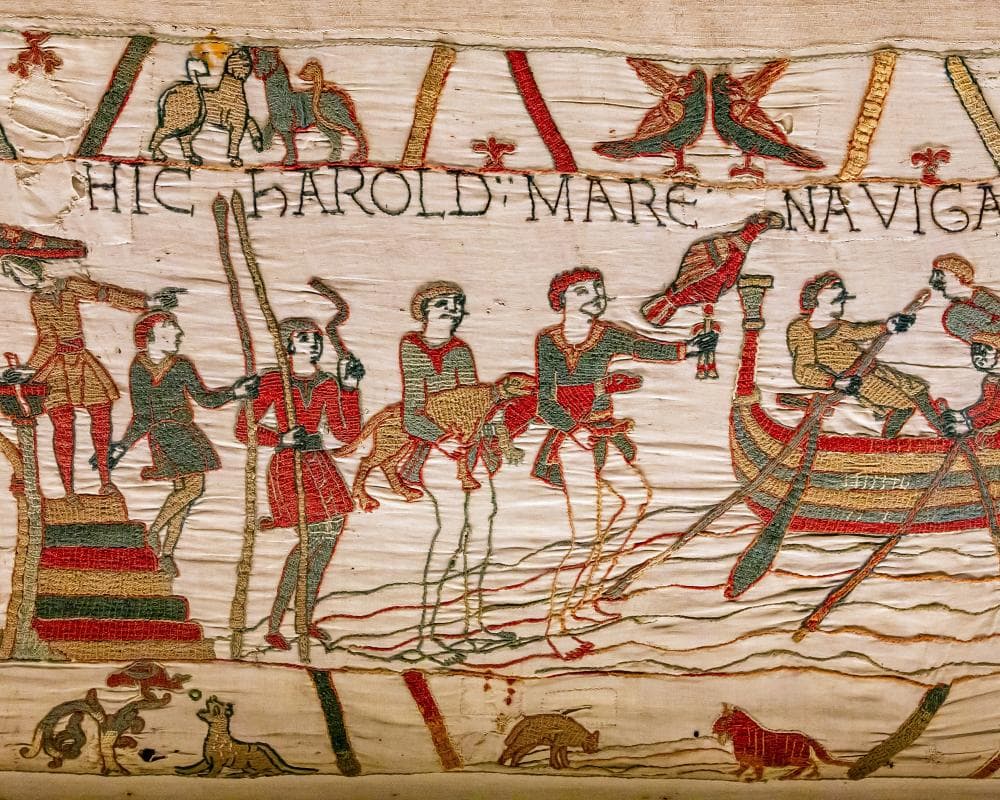
1. First of all, as the exhibition’s curator Michael Lewis points out in his book, the Bayeux tapestry isn’t really a tapestry. It’s “more accurately described as an embroidery”, Lewis writes. (Nobody actually calls it an embroidery, though, so we’ll stick with tapestry).
2. The embroidery tapestry tells the story of the events that culminated in the Battle of Hastings in 1066, when William the Conquerer defeated King Harold.
3. It was supposedly commissioned by Bishop Odo, William the Conquerer’s half-brother, for his newly built cathedral in Bayeux in 1077. He was prone to “self-aggrandisement” (in Lewis’s words), which is why he gave himself a starring role in the tapestry.
4. But it wasn’t made in Bayeux. Researchers think it was probably made in England, near Canterbury.
5. It’s embroidered on linen, with 10 colours of woollen thread likely dyed with woad, madder and indigo.
6. Its nine panels were embroidered separately, and then stitched together to form a continuous picture.
7. It features 623 men, 190 horses, 35 dogs, 37 buildings (including Mont-Saint-Michel) and 41 ships.
8. It may have had a single master designer who plotted its narrative, but …
9. The embroidery was almost certainly stitched by multiple women (William of Poitiers cited English women as skilled embroiderers).
10. It’s unclear how long it took them – one estimate reckons the stitching took between two and four years.
11. Yet, only three women actually feature in the tapestry. None of them are having a good time: one is weeping at her husband’s deathbed, another is fleeing a burning building and a third is being assaulted by a priest.
12. This third figure is Ælfgyva (meaning elf-gift), the only named woman in the tapestry. Scholars think that she could be Emma of Normandy, who was accused of having an affair with the Bishop of Winchester.
13. The tapestry conveniently doesn’t mention Edgar Ætheling, who had a stronger hereditary claim to the English throne in 1066 than either William or Harold.
14. The borders tell their own stories. They’re filled with fantastical beasts, creating what the Guardian’s art critic Jonathan Jones described as a “marginal world of monsters and myths”.
15. The upper border features one of the first depictions of Haley’s Comet.
16. The tapestry also shows a figure with the name Harold, depicting the famous (and probably apocryphal) moment he was struck in the eye by an arrow. Most scholars think Harold was actually hacked to death.
17. It was possibly designed to be interpreted by a live storyteller in front of an audience, much like an epic poem.
18. It’s damaged at the end, and incomplete. Nobody knows what scene would have finished the tapestry (some think it could have been a depiction of William’s coronation at Westminster Abbey in 1066).
19. It survived at least three fires in Bayeux Cathedral.
20. The first recorded reference to the tapestry was in the 1476 inventory of Bayeux cathedral, which described a “very long and narrow hanging of linen, embroidered with figures and inscriptions representing the Conquest of England.”
21. The tapestry hasn’t always been well looked after. For centuries it was rolled out for cathedral visitors. One visiting English antiquary observed in the early 1800s that it was “much rubbed at the beginning, torn towards the end.”
22. In 1792, during the French Revolution, the tapestry was nearly used to cover a wagon (it was saved at the last minute by an official who swapped it for a piece of canvas).
23. In 1794, an proposal was briefly floated to cut the tapestry into strips to decorate a festival float.
24. A 19th-century British artist secretly snipped off two fragments that ended up in a London museum (these were eventually returned to Bayeux).
25. In 1803, Napoleon had the tapestry temporarily moved from Bayeux to Paris, where it hung on display at the Louvre, to rally support for his planned invasion of Britain.
26. The first full photographic copy of the tapestry was made for the South Kensington Museum in 1872 (now the V&A museum).
27. A group of women in Staffordshire created the largest Bayeux reproduction in 1885, which is displayed in Reading Museum. It took them 18 months.
28. They removed 93 penises from their reproduction, 88 belonging to horses and five to men.
29. The Nazis saw the tapestry as a propaganda tool, and wanted to establish that Normans were actually the descendants of Viking settlers.
30. They appointed a professor of Viking archaeology as the leader of “Special Assignment Bayeaux” to study it.
31. Heinrich Himmler tasked two SS officers in 1944 to seize the Bayeaux tapestry from the basement of the Louvre, where it was being stored.
32. A group of local resistance fighters tipped off by code breakers at Bletchley Park managed to intercept the officers and protect the tapestry.
33. Since 1983, the tapestry has been displayed at the Bayeux museum, in a 17th-century seminary near Bayeux’s medieval town centre.
34. When the tapestry arrived at the Bayeux museum in the 1980s, photos show that it appeared to have been folded and hoisted up a stairwell.
35. It’s incredibly fragile, and liable to fray. A 2020 study found the tapestry had “24,204 stains, 16,445 wrinkles, 9,646 gaps in the cloth or the embroidery” and “30 non-stabilised tears.”
36. The first request for the Bayeux tapestry to be loaned to Britain was in 1953, for Queen Elizabeth II’s coronation. The French refused.
37. Another request was made in 1966, to mark the 900th anniversary of the Battle of Hastings. The French refused, again.
38. In 2013, a committee was formed to advise on how the tapestry could be redisplayed. It raised the prospect of a loan to the UK (“I did sort of bang on about it,” Lewis, a committee member, later recalled, “until I was a bit like a broken record”).
39. The Bayeux museum was scheduled to be closed for refurbishment, creating an opportunity for the tapestry to travel on loan.
40. In January 2018, Emmanuel Macron announced at a summit with Theresa May that the French had agreed to loan the tapestry. Although France had “found the best experts of the world to explain in perfect detail” why the loan “was impossible”, Macron said that the French government had “decided” otherwise.
41. Many people insist it should never have been moved. Arts journalist Didier Rykner started a petition against the loan that gained more than 70,000 signatures.
42. The late David Hockney agreed, described the loan as “madness,” and said “some things are too precious to take a risk with.”
43. And two expert reports in 2021 and 2022 advised Macron against the transportation of the tapestry.
44. The loan specified the tapestry had to be stored lying flat, and couldn’t be subject to tremors any greater than two millimetres per second during its transportation.
45. A team of conservators and experts, including a German vibration technology scientist, were involved with its relocation. They designed a meticulous solution for transporting the tapestry involving a “paravent”, a hinged folding screen on wheels.
46. The paravent was designed so it could be closed into a rectangular block with the tapestry inside, effectively folded 28 times.
47. It took ninety people in blue latex gloves seven hours working to extract the tapestry from its case and transfer it to the paravent.
48. It then had to be stored in a specially manufactured crate for shipping. The art logistics firm Hizikia built two nesting crates, with an outer aluminium crate designed to reduce the impact of movement.
49. The firm also provided a customised reinforced truck to dampen vibrations.
50. Experts carried out two dry runs, one with a replica tapestry transported across the channel that made its way to an art warehouse in south London.
51. Data from these dry-runs showed that French roads are smoother than British roads.
52. The tapestry has been insured by the Treasury’s indemnity scheme for £800m, which is more than twice the value of the most expensive artwork ever sold at auction (Salvator Mundi, a painting of Jesus attributed to Leonardo da Vinci).
53. Two threads were reportedly broken when the tapestry arrived in London.
54. At the British Museum, it will be housed in a custom-made case, believed to be the longest ever constructed, and will be exposed to a limited number of light hours per day.
55. When the lights are switched on, they’ll be dimmed to 50 lux, the international museum standard for sensitive materials.
56. Andy Burnham, Emmanuel Macron and King Charles viewed the tapestry last Wednesday.
57. It will be displayed at the British Museum until July 2027, before it returns to a newly built museum in Normandy that will open later next year.
58. Nicholas Cullinan, director of the British Museum, has said he hopes the Bayeux loan could revive the prospect for a loan of the Parthenon marbles.
59. The tapestry has inspired numerous copycats, including the Bloody Sunday Tapestry created by the artist Darren Cullen in 2013.
60. There’s also a Game of Thrones Tapestry at the Ulster Museum in Belfast.
61. The Sun newspaper commissioned a “Bye-EU” tapestry in 2018 to commemorate the Brexit vote, which depicted Boris Johnson in chain mail and Theresa May surrounded by the decapitated corpses of Brussels bureaucrats.
62. A helmet from Sutton Hoo, and the Lewis chess pieces, were both loaned to Normandy museums as part of the Bayeux loan.
63. My favourite bit of any trip to the British Museum is the gift shop (eds: does this count as a fact?), where you can now buy a replica Norman helmet and bottle of Bayeux mead with your Tutankhamun pencil tin.
64. Speaking of Bayeux tat, Nigel Farage sported a Bayeux-themed tie during the 2014 Rochester byelection, a reminder of “the last time we were invaded and taken over”.
65. Radio 4 has devoted a special day of broadcasts to mark the arrival of the tapestry.
66. And the museum’s videos about the tapestry’s arrival are narrated by the Traitors presenter Claudia Winkleman.
67. Philippe Bélavel, Macron’s former culture adviser, has said “such a loan will only happen once and never again.”
68. The next wave of public tickets for the tapestry, which cost £33, will go on sale on 21 October at 10am. Best of luck getting yours.
What else we’ve been enjoying
I loved Micha Frazer-Carroll’s brilliant newsletter exploring how and why generations of Black athletes have become style icons. Sign up to receive the Long Wave in your inbox here. Michael Segalov, newsletters team
J Oliver Conroy’s long piece on what happened to Turning Point USA in the year after the killing of Charlie Kirk is a compelling, frightening read on the future of the American right. Charlie Lindlar, newsletters team
Among all the tributes, I found these reflections on Gloria Steinem’s legacy from a host of contemporary feminist writers to be a particularly powerful homage. Michael
Resident sex expert Alix Fox hosted this riveting reader Q&A yesterday, fielding your queries on making time for intimacy in parenthood, the rise of audio erotica, and why trendy sex toys are apparently shaped like fruit now. Charlie
I watched the trailer for Andrew Garfield’s new film The Uprising while at the cinema last weekend (the Odyssey; quite long?), and Peter Bradhsaw’s cutting review confirmed my initial instinct to steer well clear. Michael
Sport
Cricket | England lead Pakistan by 23 runs at Edgbaston, after 14 wickets tumbled on the opening day of the third Test.
Tennis | Elena Rybakina will become the No 1 woman in the world for the first time after orchestrating a supreme recovery to reach the semi-finals of the US Open with a 3-6, 6-1, 6-4 win over the Olympic champion Zheng Qinwen.
Cycling | Matthew Brennan claimed a fifth stage victory on Wednesday as the young British rider edged a bunch sprint in Seville to win the 17th stage.
The front pages
“Police launch inquiry into alleged overseas donations to Reform UK”, is the Guardian’s front page today. The Times says “Farage faces Met inquiry over Reform donations”, the i Paper also has “Police set to interview Farage over Reform UK donations”, and the Mirror writes “Farage faces cop quiz on donors”.
The FT has “US spy chief to take stronger role in stalled Ukraine talks”, the Mail writes “Burnham: National security can’t come at the expense of social security”, and the Express leads with “The King has spoken with Harry since return”. The Telegraph splashes “Labour’s new tax assault on hospitality”, and on air traffic chaos, Metro has “Ready for departure?”
Today in Focus: The Latest
Why is Trump silent on UK sanctions against Israeli West Bank settlements?
The foreign secretary, Ed Miliband, is facing a backlash over the government’s sanctions against illegal Israeli settlements in the West Bank after the chief rabbi, Ephraim Mirvis, said the safety of British Jews could be at risk. Miliband has rejected the warnings, emphasising that ministers can confront the actions of Benjamin Netanyahu’s government while also fighting antisemitism. US president Donald Trump, however, has failed to comment on the UK government’s action. Lucy Hough speaks to diplomatic editor Patrick Wintour.
Cartoon of the day | Ella Baron
The Upside
A bit of good news to remind you that the world’s not all bad
For decades, Robert Ashton contended with paruresis: a condition that meant, if in the presence of others, his shy bladder left him unable to urinate. Turns out, all that was needed to alleviate this affliction was a trip to an Essex naturist club. Stripping down helped Robert let go of his inhibitions and alleviated a lifetime of anxieties – he’s been free-flowing ever since.
Sign up here for a weekly roundup of The Upside, sent to you every Sunday
Bored at work?
And finally, the Guardian’s puzzles are here to keep you entertained throughout the day. Until tomorrow.