Summary
Following yesterday’s attack on Riyadh international airport that killed 12 people and injured hundreds, the site was hit again on Sunday. Authorities said an “unidentified projectile” struck Terminal 4 at King Khalid International Airport. Air defenses also “intercepted and destroyed a cruise missile” in the vicinity of the airport.
An Egyptian flight attendant, a Syrian woman, and an Indian national were among the 12 killed in yesterday’s Saudi airport attack. The Egyptian woman killed was identified as Azza Ramzy, 28. The Syrian woman was identified as Buthaina Ahmad Oweida.
The Saudi General Authority of Civil Aviation said in a statement that today’s attack on King Khalid international airport in Riyadh “resulted in injuries” but did not specify how many.
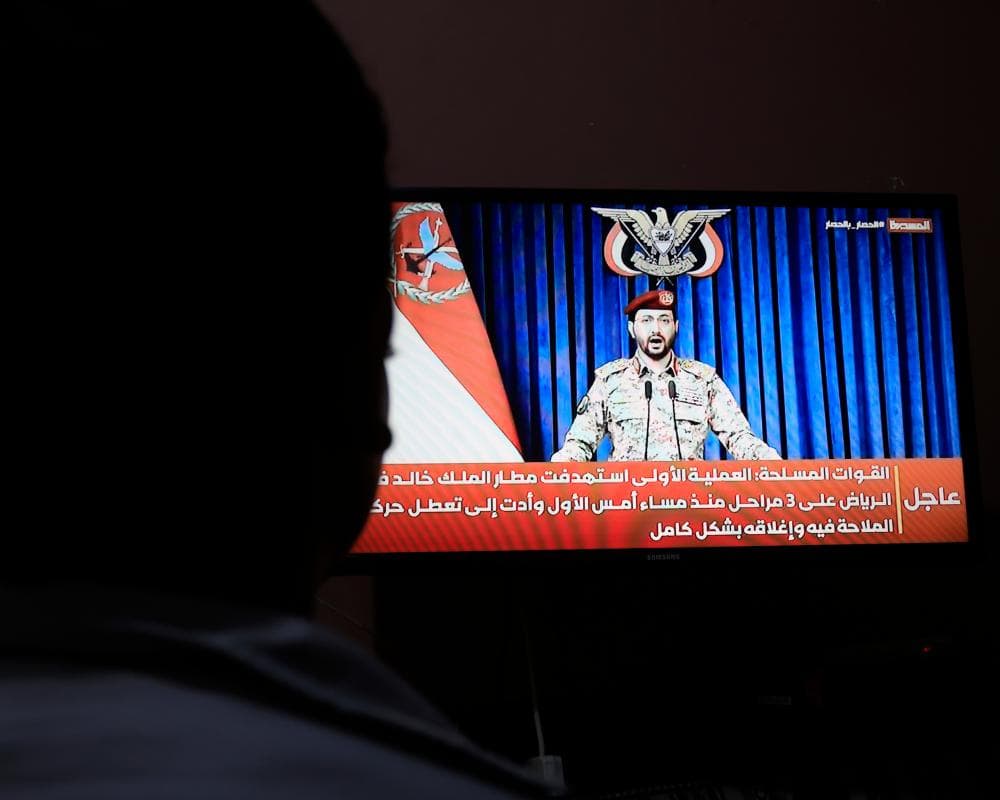
Yemen’s Houthis have claimed responsibility for both Saturday and Sunday’s attacks on Riyadh Airport. The group said on Sunday they had targeted Riyadh’s airport several times as well as Saudi energy facilities, a day after Saturday’s deadly attack.
The United Arab Emirates issued a statement in solidarity with Saudi Arabia, expressing support for “all measures aimed at safeguarding the kingdom’s security and stability”. The UAE message is significant given the major rupture in relations this year.
The Houthis this morning issued a warning to travelers and airlines to stay away from Saudi airports following yesterday’s attack. A Houthi military spokesman warned the public to “take our warning seriously” and also claimed that “Saudi Arabia bears responsibility for any failed interceptions”.
The attacks on Riyadh airport came just before a major oil summit, the World Petroleum Congress, scheduled for this week. The repeated attacks have temporarily halted oil flows and driven up global oil prices. The CEOs of major companies Shell, ExxonMobil, BP, TotalEnergies had been due to attend the summit but given the attacks, it’s unclear if executives will take the risk.
Indian national dies from injuries following Riyadh airport attack
An Indian national wounded in yesterday’s Houthi airport attack in Riyadh has died from his injuries, the Indian embassy in Saudi Arabia said in a statement.
“It is learnt that one Indian national injured in the Riyadh attack has unfortunately lost his life today,” the embassy said. “We convey our heartfelt condolences to the family of the deceased. We are in touch with the family and will provide all support for ensuring the early repatriation of mortal remains.”
In an earlier statement, the embassy said that 11 Indians were among those injured in yesterday’s attack.
Yemen’s Houthis are claiming responsibility for both Saturday and Sunday’s attacks on Riyadh Airport. The group said on Sunday they had targeted Riyadh’s airport several times as well as Saudi energy facilities, a day after Saturday’s deadly attack.
Houthi military spokesman Yahya Saree said the Iran-backed group “carried out four qualitative operations in the past 24 hours using ballistic and cruise missiles and drones,” AFP reported.
Saree said the group targeted the Riyadh airport multiple times, as well as the Dammam airport and two facilities belonging to the Saudi state oil company Aramco.
Saudi authorities say latest airport attack 'resulted in injuries'
The Saudi General Authority of Civil Aviation said in a statement that today’s attack on King Khalid international airport in Riyadh “resulted in injuries” but did not specify how many.
The statement said that an “assessment of the damage and verification of the safety of the facilities is ongoing”.
Earlier on Sunday, an “unidentified projectile” hit Riyadh’s international airport, the same site targeted in Saturday’s strike which injured hundreds of people and killed 12. Minutes earlier, Yemen’s Houthis claimed responsibility for the attack.
Updated
Israeli prime minister condemns attack on Riyadh airport
Benjamin Netanyahu, the Israeli prime minister, condemned on Sunday the “horrific terrorist attack” on Riyadh airport in Saudi Arabia.
“I condemn in the strongest possible terms the horrific terrorist attack on King Khalid International Airport in Riyadh,” Netanyahu wrote in a social media post, adding that he extended Israel’s “deepest condolences” to the families of the victims.
Updated
Yemen’s Houthis claim responsibility for Riyadh airport attack that killed 12 people
Yemen’s Houthis have claimed responsibility for the attack targeting Riyadh airport, according to a statement released by the group.
The Houthis claimed to have launched strikes against Dammam airport and Saudi Aramco facilities located in Saudi Arabia’s Eastern Province. It is not immediately clear whether the group is claiming just yesterday’s attack or the strike from earlier today as well. Saudi authorities have not yet issued a confirmation.
Updated
SriLankan Airlines announced that it has suspended all flights to Riyadh, Saudi Arabia until October 18 “in view of the recent security incident affecting Riyadh Airport and ongoing safety and operational assessments.”
“The safety and security of our passengers and crew remain our highest priority and services will resume once the prevailing conditions are assessed to be suitable for commercial flight operations,” the statement said.
Attacks on Riyadh airport and capital come on eve of major oil summit
Saudi Arabia of course is the world’s top oil exporter and its oil refineries and facilities have been repeatedly targeted by the Houthis this past month.
It was forced to temporarly close its key East-West pipeline last month after a drone attack on the 1,200km Saudi Aramco pipeline which spans the Arabian peninsula.
That temporarily halted oil flows; the kingdom had been diverting much of its oil that used to go out through the Strait of Hormuz through the pipeline to be shipped out through the Red Sea, however that trade route has now also been targeted by the Iran-allied Houthis.
That has driven up global oil prices and spooked the market. The kingdom was in fact due to host a major oil summit – the World Petroleum Congress - this week in Riyadh.
The CEOs of major companies Shell, ExxonMobil, BP, TotalEnergies had been due to attend but given the attacks, it’s unclear if exceutives will take the risk. Saudi authorities were saying this morning that the summit would still proceed.
Updated
If confirmed as a strike, this marks the fourth attack on the Saudi capital’s airport just this week alone.
The Houthis haven’t claimed responsibility for Saturday’s attack on King Khalid International in Riyadh, but earlier this morning issued a threat warning travellers and airlines and trade operators to stay away from all Saudi airports and airspaces – barring those of Islamic holy cities Mecca and Medina.
The Houthis have declared that all Saudi airspace is a theatre of their military operations.
They’ve escalated their attacks as Saudi Arabia has launched hundreds of airstrikes on Houthi areas in Yemen this week, as part of the Yemeni government force’s counter-offensive this week to repel the Houthis from a critical Red Sea strait.
The Houthis say the Saudi and Saudi-backed attacks have killed more than 91 people in Yemen in the past five weeks. Earlier they warned of reciprocal action: “airport for airport, siege for siege, escalation for escalation”.
Updated
Riyadh international airport reportedly hit again in second strike
The Saudi-led coalition in Yemen says an “unidentified projectile” hit Riyadh’s international airport on Sunday – the same site targeted in Saturday’s strike which injured hundreds of people and killed 12.
Coalition spokesman Major General Turki al-Malki said the projectile struck Terminal 4 at King Khalid International Airport, causing a fire, AFP reported.
Al-Malki said air defences also “intercepted and destroyed a cruise missile” in the vicinity of the airport.
The airport has been closed today following yesterday’s deadly attack.
Updated
Houthi airport attack forces swift rethink of Trump’s new 'Blame Ukraine' strategy
The reckless missile attack on King Khalid international airport in Riyadh on Saturday did not just export the death and misery inside Yemen to Saudi Arabia, it also left Donald Trump forced to reconsider his diplomatic and political strategy designed to take him into the midterm elections next month.
The US president’s plan had only been unveiled on Saturday.
It was to blame what he described as “a world problem” – spiralling diesel prices – on the Ukrainian president, Volodymyr Zelenskyy, saying his attacks on Russian oil refineries were the cause. He was going to keep the political temperature down on his war of choice in Iran and its spillover in Yemen until after the midterms.
In pursuit of this strategy, he claimed the Iranian blockade in the strait of Hormuz was in effect broken, producing figures on daily oil barrel exports to assuage the markets. As a further insurance he also claimed it was impossible to negotiate with the Iranians since there was no single leadership in Tehran.
Saudi Arabia, in conjunction with Turkey, and Pakistan, were largely to be left to sort out the Houthis along the Red Sea. The fate of Yemen, the poorest country in the world according to the International Monetary Fund, was not going to shift votes in Kansas or Alaska.
Now, after the Riyadh airport attack, it is doubtful, for a basket of reasons, that this anyway threadbare strategy, largely born of desperation, can hold.
For all the talk of the Gulf becoming responsible for its own security, it is doubtful that Saudi Arabia can be left to fend for itself after the carnage in Riyadh. One of the the 12 dead is an American and there may be more among the severely injured. Something is clearly wrong with Saudi defences since the Houthis are firing rockets from 500 miles away, and they are reaching their target too often.
The US has had a unilateral ceasefire with the Houthis since 2025, and once the hostilities between Saudi Arabia and the Houthis recommenced in the summer, the pact was quietly renewed.
Trump has twice rejected Saudi appeals for help. Can he spurn them three times? The pressure to act as allies are expected to may prove overwhelming.
Related: Houthi attack on Riyadh airport forces swift rethink of Trump’s new strategy
Egyptian flight attendant and Syrian woman among 12 killed at Saudi airport
We have some more detail on the 12 people killed in the Houthi missile strike on Riyadh’s King Khalid International Airport on Saturday.
The attack on a civilian space – the airport had no military facility- has drew widespread condemnation from Arab and Western leaders and the UN.
Saudi authorities said the dead included four Saudi citizens, two Bangladeshi nationals, a Palestinian, a U.S. citizen, an Egyptian, a Jordanian, a Syrian and a Sudanese.
The Egyptian woman killed has been identified as Azza Ramzy, 28, a flight attendant who worked for the Saudi airline Flynas, according to the Egyptian state-run TV.
The Syrian woman has been identified as Buthaina Ahmad Oweida by the Syrian embassy in Riyadh.
She was a widowed mother of four who had been living in Saudi Arabia for the past five years after fleeing the Syrian civil war, her niece told AP. She had been visiting her sister in Riyadh and was on her way home to Mecca, where she lived, when she was killed in the attack.
There is attention too on the still yet to be identified American citizen who was killed at the airport because that will add to Saudi pressure on Donald Trump for the U.S. to join in the fight.
Updated
As we await more detail on this reported blast in the Saudi capital, it’s worth noting that there’s been a distinct lack of information coming from Saudi authorities on the Houthi attacks and other dangers.
Officials have announced that schooling will move online until the end of the week, meaning schools and campuses are closed.
But they have otherwise been largely quiet on the major attack on the country’s largest airport yesterday which killed 12 people and injured 300 more.
They have not issued a wider emergency alert, nor given a national address or offered any assurance to residents on why and how the kingdom’s air defences failed. We know that Saudi Arabia has been requesting more missile interceptors from the US and other European allies – but the US is also facing its own shortage due to the Iran fighting.
The Houthis have targeted Riyadh’s airport for the past few weeks – including two attacks earlier in the week, which killed four people. But Saudi authorities have not publicly announced a closure of King Khalid International Airport, with the suspension of flights detected through air traffic monitoring sites instead.
This withholding of information the public is in line with a pattern of communication from not just Saudi but other Gulf state authorities these past seven months since they’ve come under attack from Iranian missiles and drones.
Gulf authorities have tended to suppress the flow of information – ostensibly for national security purposes and to maintain public confidence in the countr'y’s defences.
However, the lack of information is also leading to confusion and speculation online, particularly as the Houthis continue to threaten new strikes against the kingdom.
Updated
Further explosion heard in Saudi capital
Another blast has been heard in Riyadh, Agence France Press (AFP) journalists in the city report.
They described a powerful blast in the central area of the Saudi capital. The cause is not immediately known.
Houthi state media says capital's airport hit by Saudi strike
Houthi-run state TV is reporting that Saudia Arabia has carried out a strike on the main airport in Sana’a, the Yemeni capital currently controlled by the Houthis.
Al Masirah TV said the strike had hit Sana’a International Airport.
No comment yet from Saudi authorities or the Saudi-backed government forces in Yemen.
Earlier however, the coalition had issued a issued a statement saying they would “respond decisively” to the Houthis’ “terrorist attack” on Riyadh’s airport on Saturday which killed 12 people and injured 309.
The Saudis have launched hundreds of air strikes on Houthi positions in Yemen since fighting recommenced last month.
Updated
UK advises against travel to parts of Saudi Arabia
The UK Foreign Office has updated guidance for British nationals following the deadly Houthi attack on Saturday.
It has advised against:
All travel to within 10km of the border with Yemen
All but essential travel to Aseer province, Riyadh province, Najran province, Jizan province and Taif city and Taif International Airport
There are an estimated 20,000- 30,000 British nationals living in Saudi Arabia, although those numbers have presumably fluctuated since the war began and Iran and its allies fought back against US and Israeli strikes by targeting cities like Dubai and Doha, in Gulf states allied with the US.
In the first fortnight of the war earlier this year in March, more than 102,000 Britons across the Middle East registered with the Foreign Office for help.
UAE expresses 'full solidarity' with Saudi Arabia
Some more Gulf reaction to Houthi’s deadly airport attack and continued threats to target Saudi airspace.
In a significant message, the United Arab Emirates has issued a statement in solidarity with Saudi Arabia – expressing support for “all measures aimed at safeguarding the kingdom’s security and stability”.
The UAE message is improtant given the major rupture in relations this year between the two oil-rich kingdoms, first sparked by lingering divisions in Yemen, and made worse by the Iran War and arguments over oil prices which led to the UAE quitting OPEC (currently led by the Saudis) after six decades of membership.
In Yemen in particular, the two Gulf states have significant history.
Both the UAE and Saudi Arabia bankrolled anti-Houthi forces in Yemen during the civil war from 2015-2022, and the UAE-backed forces were seen as particularly successful.
But relations broke down in January this year when the UAE-backed force in Yemen, which was a seperatist group trying to create a breakaway southern state, was attacked and defeated by Saudia Arabia.
That led the UAE to pull out of Yemen altogether. But the UAE were viewed as the most knowledgeable and effective authorites on the ground in the fight against the Houthis; when the Houthis launched their lightning offensive in September to take areas along the Red Sea and secure the Bab al-Mandab chokepoint, they were able to quickly seize areas and defeat the authorities in them previously backed by the UAE.
It’s since been suggested that Saudi Arabia might need to reconcile with the UAE to form a military alliance again to drive the Houthis back.
So this latest message from the UAE’s foreign ministry will be closely read.
The UAE foreign ministry criticised the “flagrant violation” of Saudi Arabia’s sovereignty and “reaffirmed the UAE’s full solidarity with Saudi Arabia and its support for all measures aimed at safeguarding the kingdom’s security and stability.”
The Guardian’s diplomatic correspondent Patrick Wintour has offered some context on the latest between the Houthis and the Saudi kingdom.
Saturday’s incident comes amid an escalation of missile strikes by Yemen’s Iran-aligned Houthis on the kingdom. The airport has already been attacked twice this week, leaving four people dead and others wounded, and badly damaging an aircraft.
The Houthis have repeatedly attacked Saudi airports, oil facilities and tankers after a truce in their long-running war with Yemen’s Riyadh-backed government unravelled in July.
The attack came as forces allied to the UN-recognised government in Yemen claim to have mounted a successful offensive to retake the Bab al-Mandab strait from Houthi rebels, but accounts vary as to whether the push has been repelled.
Related: Twelve killed and hundreds injured in Houthi attack at Riyadh airport
Houthi foreign ministry says 'worse yet to come' if Saudi strikes continue
The Houthi’s foreign ministry in Yemen has also put out a statement being carried by Houthi media.
They threatened again that continued Saudi military action in Yemen would lead to an even stronger response. Echoing what military spokesman Saree said earlier in his airport warning – they said their actions were “guided by reciprocity” – as in they say they’re responding to Saudi strikes on their area in Yemen.
“Unless the Saudi enemy stops its aggression and interference in Yemen, worse is yet to come, God willing,” the ministry said in statements carried by Houthi-run Al Masirah television.
As I reported earlier, the Saudi-backed Yemeni government forces launched a major counter-offensive this week to drive back the Houthis from the Bab al-Mandab strait and hit other Houthi positions along the Red Sea. How successful that has been is still unclear.
But the Houthis are striking back with slightly different targets- choosing to escalate their attacks on civilian airspaces as well as Saudi oil facilities. They have repeatedly said their aim is to remove Saudi influence from Yemen.
Updated
Why else has the US been reluctant to intervene so far in Saudi Arabia’s fight?
The Houthis have repeatedly attacked Saudi airports, oil facilities and tankers after a truce in their long-running war with Yemen’s Riyadh-backed government unravelled in July.
Saturday’s attack might change things but Donald Trump has been reluctant so far to help out Saudi Arabia for several reasons, as my colleague Patrick Wintour explains:
The US has its hands full and its munitions stocks are empty due to the war in Iran.
Ahead of the midterms, Donald Trump does not want to launch another forever war.
After bombing the Houthis for 50 days in spring 2025, he struck a bilateral ceasefire with the Houthis – a deal that excluded Israel.
He has twice rejected Saudi pleas that the fate of the strait is a matter for the world.
Related: Yemen civil war: what sparked latest escalation and who is involved?
Updated
Trump evaluating Houthi strikes
An American citizen was among the 12 killed in the airport attack yesterday. For weeks now there’s been speculation over whether the US will join Saudi Arabia in carrying out air strikes against the Iran-backed Houthis in Yemen.
When fighting recommenced last month with the Houthis, Saudi Crown Prince Mohammed bin Salman had reportedly called Donald Trump to request military assistance. The US president committed only military intelligence and targeting help rather than send war planes.
On Saturday, following the deadly airport attack, Trump was asked by reporters if the US would take a more active position and join in the Saudi strikes.
“We may. We’re going to look at it. We just found out about the recent attack, so we’ll make a decision. We move very quickly,” he said.
He later said he also planned to speak with Saudi Arabia’s leader.
Asked again by reporters if the U.S. might get involved, Trump responded, “We’ll find out.”
The fighting between Saudi Arabia and the Houthis in Yemen this past month have marked a new front in the Iran war, further driving up global oil and fuel prices as Saudi Arabia is the world’s top oil exporter and had been delivering its output through the Red Sea which has seen shipping attacks by Iran’s ally in recent weeks.
The US is now in the seventh month of the war it began against Iran in February, and across American states gasoline prices have surged 47%.
Trump’s approval rating has also dropped from 41% in Feburary to 37%- his lowest level yet ahead of the midterm elections next month.
Updated
Global condemnation of 'attack on civilians'
There’s been a strong condemnation of this morning of the Houthi’s deadly strike on Saudi Arabia’s largest airport. Global leaders say attacks on civilians must stop.
UN Secretary General Antonio Guterres said he was “deeply shocked” by Saturday’s strike.
“Attacks on civilians and civilian infrastructure are a violation of international law. These attacks must cease immediately,” he said.
Meanwhile EU chief Ursula von der Leyen said the European Union stands “in solidarity with Saudi Arabia”, noting the “murderous attack on civilians” as a “dangerous escalation” in the wider war.
These “attacks by Iran’s proxies are pushing the region into a spiral of violence. They are destabilizing crucial global transport and energy nodes with shockwave sent through the world,” she said.
The EU as a bloc has not sent any direct military aid to Saudi Arabia since fighting recommenced with the Houthis last month. The Saudis have asked France and Germany directly for aid; France has sent military equipment.
The UK meanwhile has sent air defences and RAF Voyager refuelling aircraft to Saudi Arabia since late September, in part says the government to help keep Red Sea oil flows open.
This morning UK Defence Secretary Wes Streeting said Houthi attacks on civilian sites “is one of the reasons why the UK is providing support to Saudi Arabia in the form of air defences and air-to-air resupplying”.
Meanwhile in the Middle East region, Iraq, which neighbours Saudi Arabia, warned this morning that the attack endangered “regional security and stability”.
Updated
As you can expect, passengers have been avoiding Saudia Arabia’s main international airport since the major attack yesterday.
King Khalid remains closed today. It remains to be seen if operations will continue at other Saudi airports.
The Houthis earlier in the week had warned commercial airlines “for the last time” about the consequences of flying into Saudi airspace, noting it was a theatre of fighting.
Several airlines have previously suspended flights during the past month as the Iran War has expanded to this new front. Air India, FlyDubai, Lufthansa Group and Pakistan International Airlines had all temporarily paused their routes into Riyadh and other Saudi cities.
Updated
Houthis renew threat against Saudi airspace
The Houthis this morning have just also issued a warning to travellers and airlines to stay away from Saudi airports following yesterday’s attack.
It’s the first public message from the group since Saturday’s deadly assault.
Houthi military spokesman Yahya Saree said Mecca and Medina – the holiest cities in Islam - were excepted but the other Saudi airports and airspace “are exposed to targeting and constitute a theatre of operations for our forces”.
He warned the public to “take our warning seriously” and also claimed that “Saudi Arabia bears responsibility for any failed interceptions”.
The Gulf state has been asking the US and other Western allies for more missile interceptors since the fighting escalated.
Saree ended his post by saying his group is pursuing: “airport for airport, siege for siege, and escalation for escalation” until they achieved their goals.
All week the Houthis have been striking the main airport in the Saudi capital as Saudi Arabia has increased strikes on Houthi territory in Yemen. The Houthi-run health ministry says 91 Yemenis have been killed and 168 injured in the past five weeks due to Saudi-led attacks. It said 60% of those killed were women and children.
This week, the Saudi-led coalition backing the Yemeni government forces launched a major counter-offensive to try and push back the rebel group who’ve rapidly seized and gained territory since September.
The Houthis have taken over islands in the Bab al- Mandab strait and also staked positions along the Red Sea, tightening their grip on the crucial passageway through which Saudi Arabia, a top oil exporter, had been diverting flows as the Strait of Hormuz remains shut off.
Updated
12 killed at Riyadh airport and hundreds wounded in Saturday strike
Saturday’s attack was the third launched on the Saudi capital’s main airport this week- with the missile making it past Saudi air defences to strike terminals 3 and 4 of King Khalid airport where hundreds of passengers were awaiting domestic flights.
The attack killed at least 12 people and injured 309 at last count, say Saudi officials.
The dead include four Saudi citizens, two Bangladeshi nationals, a Palestinian, a US citizen, an Egyptian, a Jordanian, a Syrian and a Sudanese.
A projectile also fell near the King Fahd international airport in Dammam, according to the Saudi-led coalition fighting the Houthis.
The Dammam airport has been an important alternative to Riyadh amid the recent spate of attacks.
Opening summary
Good morning and welcome to our live coverage of rapidly unfolding events in the Middle East.
After attacking Saudi Arabia’s main international airport on Saturday in strikes which killed at least 12 people and injured 309, the Houthis have issued another message this morning about the kingdom’s airports.
In response to the Houthi’s assault – the deadliest in Saudi Arabia in over a decade – US President Donald Trump has said Washington may join the Saudis in carrying out air strikes against the Iran-backed group in Yemen.
Trump said: “We may. We’re going to look at it. We just found out about the recent attack, so we’ll make a decision. We move very quickly.”
Updated