Saturday summary
-
French police arrested 1,000 people during protests about the cost of living and education, with that number expected to rise, according to the country’s interior minister Laurent Nunez
-
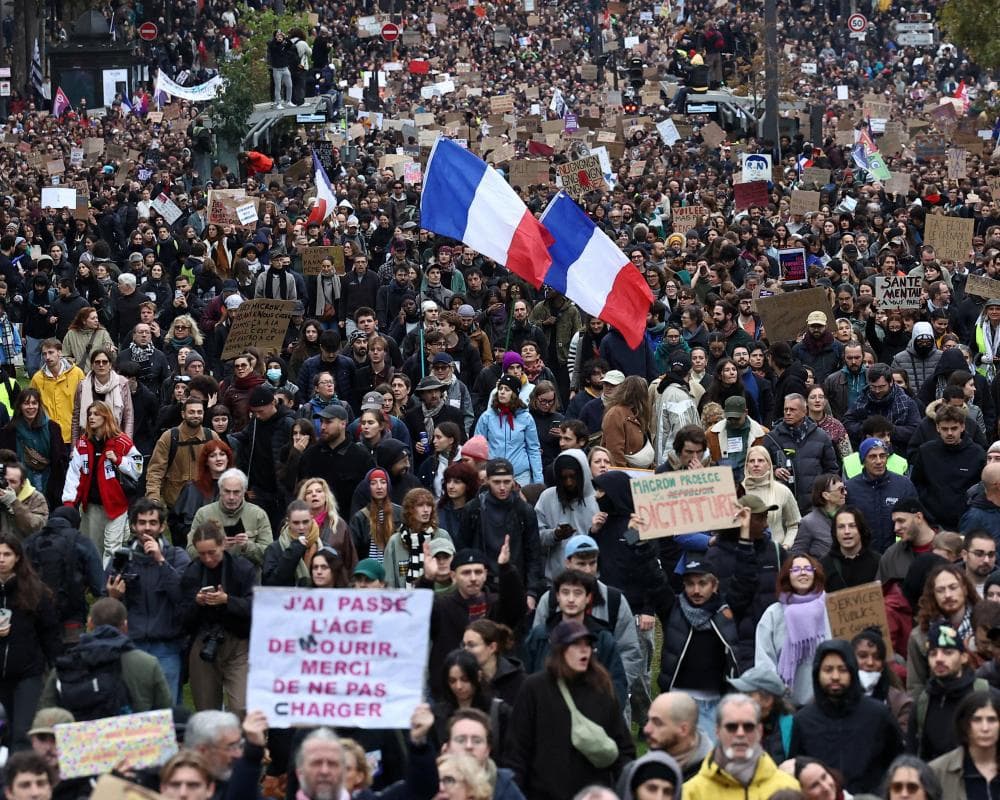
The government estimated that at least 400,000 people had marched across France. Trade unions estimated the number at double that.
-
Two serious injuries were sustained during the protests, Nunez said, including a 20-year-old man who had his fingers blown off.
-
A demonstration on the outskirts of Paris was largely peaceful but was marred by violence at the end, with police using a water cannon and teargas to quell the crowds.
-
More than 70,000 police were on the streets of French cities, with shops boarded up and many museums closed.
-
In Italy, nine were arrested and more than 370 people “briefly detained” by police.
-
Protests also took place in Belgium, Spain, Portugal and Albania over different issues.
Paris protesters report heavy handed response from police
A peaceful protest during the day in Paris descended into violent clashes with police by the time night fell.
The sound of pop music blaring and chanted slogans was swapped for the sound of teargas being released and fireworks being released, according to reports.
Eyewitnesses say the mood soured at the end of the march, where rows of police officers and vans awaited the crowd.
Protesters reportedly fired fireworks towards law enforcement officers, who responded with charges and baton strikes.
The AFP news agency quoted David, a protester who gave only his first name. He is said to have appeared shaken and had a gash on his face, which he said was caused by a police officer throwing a baton at him.
“The police started moving towards everyone, telling them to get down and back off. They were just taking people down, you know, beating protesters,” he said.
Mike, a 23-year-old student who also declined to give his surname, said: “Look around, they’re just teenagers. Is it normal for teenagers to be teargassed and beaten with batons?”
For Jessica, a 24-year-old student, said: “I just don’t understand why there’s so much violence. I feel like our right to protest is being trampled on.”
As night fell, police began clearing the streets and protesters started to disperse.
Italian police said nine people were arrested, and 371 briefly detained during protests in eight cities.
In a statement, the police said 110 of those either arrested or detained were minors.
My colleague Angelique Chrisafis has been reporting from the protest in Paris today, which has since dispersed.
She writes about how a largely peaceful demonstration on the outskirts of the French capital was marred at the end by violence.
The mood in Paris on Saturday afternoon was peaceful and lighthearted, with brass bands playing and children and grandchildren present. Some people carried banners critical of the government’s policing, saying: “Oppression breeds rebellion” and “The right to protest”.
But at the end of the Paris demonstration, at Porte de Vincennes on the city’s eastern edge, different groups of masked men dressed in black emerged who had not appeared to have taken part in the peaceful march. Some groups of masked men threw glass bottles and stones at police, who responded with teargas, water cannon and stun grenades. A bin was set alight and fireworks were set off towards police.
A man reportedly had his fingers blown off during trouble in France, a minister has said.
France’s interior minister – equivalent to the home secretary in the UK – Laurent Nunez said two people had been “seriously injured” during what he called “an extremely elevated level of violence” at today’s protests.
A 20-year-old man in Toulouse, in southern France, is said to have had his fingers blown off, and the other serious injury occurred in Clermont-Ferrand in the centre of the country. He did not give details of either case.
In an update, Nunez said “ultra-left” groups had thrown projectiles and aimed fireworks at police to provoke clashes.
He struck a more positive tone than last week when violence erupted across French cities during protests about the level of investment into public services and the cost of living.
Nunez said that, while some shops and businesses had been vandalised and looted today, “the scale was far smaller” than a week earlier. He stressed that shopping centres had been well protected this time.
In Paris, where the main demonstration passed off largely peacefully but clashes broke out with police as the crowd dispersed, Nunez said “several thousand radical activists gathered at the rear of the march, including about 500 individuals identified as rioters”.
Ensuing clashes in the French capital lasted for around two hours, he said.
The minister said that there were first-time clashes in the southern cities of Cannes and Montpellier between far-right activists who sought confrontations with “ultra-left militants” who he said claimed to be there to protect businesses.
The authorities will remain “on high alert” through the night and into Sunday, he said.
Protesters try to force entry into Colosseum in Rome
Demonstrations were held in the Italian cities of Rome, Turin and elsewhere, with some turning violent.
As we reported earlier, security was heightened in Rome, where authorities locked down luxury shopping streets and stepped up controls around the Circus Maximus and Piazza del Popolo.
A small number of protesters tried to force their way into the Colosseum, but were ushered out by guards.
Elsewhere in the city, several hundred students demonstrated peacefully to stress they were not rioters after unrest last week, particularly in Milan.
Riccardo Ponzio, national president of an Italian far-right student association, said: “I think the images from last week were truly something terrible, especially for the young people, for the students, for the vast majority of the younger generations who want to study … and do not accept being represented by those who use issues and needs to devastate entire cities.”
A separate anti-war march took place in central Rome. Organisers sought to distance themselves from potential unrest, urging participants to keep their faces uncovered and hands visible.
But it was these marchers who briefly clashed with police near the Piazza della Repubblica, even as organisers were trying to hold the crowd back using batons and teargas.
In the end, the protesters pulled back when a water cannon was turned on. They retreated to a location about 500m away.
Updated
French interior minister: 1,000 arrested during protests, with number expected to rise
French police arrested almost 1,000 people on Saturday during the protests held across the country, interior minister Laurent Nunez said.
He told reporters that the number “will rise” as more data from police becomes available.
Although marches over the cost of living “passed off well” in cities, officers found themselves later confronted with “an extremely elevated level of violence” from “ultra-left” groups, Nunez said.
Updated
Jean-Luc Mélenchon, the radical-left presidential candidate who marched in the Paris rally today, said in a social media post that the French police “ruined the day” by “shooting indiscriminately” at Paris protesters.
“In Paris, as a way to ruin the day and blow off some steam, the so-called ‘forces of law and order’ are firing tear gas and shooting indiscriminately into the crowd at the tail end of the march, all to secure footage for domestic television channels, which have spent the entire week broadcasting the very images that incited the killer in Trappes,” he wrote. “A non-stop display of shame.”
In addition to the earlier footage of police using tear gas against protesters in Lyon, we are now seeing tear gas being deployed in the cities of Paris, Marseille, Nantes, and Bordeaux.
Though the protests have been relatively contained so far, the use of tear gas has become an increasingly common tactic for police to disperse crowds at the end of organized rallies, even without an immediate threat. And taking past demonstrations into consideration, these situations often become more volatile as the sun begins setting and the organized gatherings are ending.
Updated
Total of 410,000 protesters marched across France
The Interior Ministry has put today’s nationwide turnout at 410,000 total protesters across France.
Clashes began to erupt late on Saturday, following a pattern of otherwise peaceful protests growing more tempestuous as the day draws to a close.
The Paris march began calmly, but near its endpoint at Porte de Vincennes, some protesters threw projectiles while police fired volleys of tear gas and used water cannons to disperse people.
Authorities had confined the capital’s march to the city’s southeastern edge, keeping protesters away from central neighborhoods hit by last weekend’s destruction.
Updated
Police say 110,000 people marched in Paris
Police in Paris say that about 110,000 people have marched across France’s capital today, but that the “situation remains calm” according to reporting from AFP. Authorities have now begun dispersing the crowds.
The 110,000 figure is roughly the same amount as the number of protesters in Paris last weekend. Considering the fears many people had that the protests could turn violent, as well as the rainy weather across the area, the number is an impressive showing.
The police also said more than 3,000 checks have been carried out and 65 people were arrested during the demonstrations in Paris.
Updated
Meanwhile in Albania, more than 2000 police have been deployed around Tirana on the 12th day of student-led protests amid reports of concerted efforts to stop demonstrators entering the capital.
Protests initially spurred by fury over a planned Trump family-backed resort in Albania have turned increasingly violent as students have joined what growing numbers are now calling a revolution to oust prime minister Edi Rama. Today, rally numbers swelled with demonstrators traveling to Tirana from cities across the Balkan state and as teachers, doctors and labour unions also weighed in.
But police also stand increasingly accused of heavy-handed tactics amid reports of civilians being plucked from the streets by masked officers and riot police increasingly resorting to using rubber bullets, batons, tear gas and water cannons to disperse crowds.
Speaking to the Guardian after spending several hours at Tirana’s National Trauma hospital earlier in the day, Kei Brisku, who heads the Abania Rehabilitation Centre for Trauma and Torture, said there were growing concerns about “the mass and random use” of rubber bullets.
“Nine protestors, five women and four men, were badly wounded by rubber bullets today and are now in hospital,” he said.
“The use of rubber bullets against violent protesters may be justified under applicable regulations ... however, their indiscriminate use against crowds is unacceptable, as it risks harming peaceful protesters and bystanders who pose no threat.”
In power for 13 years, Rama has resolutely refused to resign. While he has offered to discuss the “ legitimate concerns” of students, he has ruled out talking with hooligans who resort to violence.
Last week, the socialist leader told the Guardian the “violence in Tirana is very real,” as he dismissed accusations that his government was employing underhand tactics to fast-track the controversial resort championed by Jared Kushner, the US president’s son-in-law.
Updated
The NFL (American football league) closed its “NFL House” in Paris as the city braced for street protests with a heavy police presence and storefronts boarded up.
The league announced the closure to fans on Saturday morning through its “OnePass” app, according to the AP, citing “potential accessibility issues.”
Security concerns have overshadowed the NFL’s planned debut in Paris. The New Orleans Saints will play the Pittsburgh Steelers on Sunday at Stade de France in the league’s first-ever regular-season game in France.
Major museums including the Louvre and Orsay Museum are also closed Saturday, though tourists were seen lined up to enter Notre Dame Cathedral.
Updated
25,000 people rally in Madrid for pension guarantees
Spanish authorities say about 25,000 demonstrators have marched through the country’s capital demanding protections to the state pension scheme.
Spain is voting in a snap parliamentary election in a few weeks and this has been a key topic of concern. Spain’s Socalist prime minister Pedro Sanchez, who called the snap election after struggling to get pension reforms through parliament, has accused conservative parties of holding back inflation-linked increases.
Protesters marched from the Atocha train station to the Gran Via shopping avenue in the Spanish capital.
Some expressed concern about portions of their state pensions being privatised in the future. About 6.8 million Spaniards receive a state pension and fiscally conservative, right-wing politicians have raised questions over how sustainable the current system is.
Spain has also seem major protests in recent months over increasingly unaffordable housing and renters’ rights.
Updated
Are French high school buildings dilapidated and rat-infested with collapsing ceilings?
Some are, namely in certain cities and low-income suburbs. Videos filmed by students and teachers have shown leaks, scurrying rats, holes in walls and ceilings, broken toilets and not enough chairs or tables, meaning teachers have to carry them from classroom to classroom. Some children said they had to learn in class while leaks were pouring into buckets, or move desks to avoid getting wet. Many school classrooms experienced temperatures over 35C (95F) in the heatwaves of last May and June.
Estimates in recent years have pointed to thousands of French schools at all levels, both primary and secondary, in need of repair. These include many 1960s school buildings. French regions are responsible for upkeep of high school buildings, but have asked for higher budgets from the government. A senate report has advised that billions need to be spent in the coming years to renovate and repair schools, as well as to address the impact of the climate crisis.
Related: How dilapidated are French schools and how bad is inequality in the education system?
Heavy police presence at demonstrations
Tens of thousands of people have turned out to the heavily policed demonstrations across France and they have been, on the whole, quite contained so far.
Some sections of the crowd could be seen singing and dancing in Paris as they walked along the route, which was pushed to the city’s fringes at the last minute as police sought to move the march away from the fortified city centre.
In Lyon, police used teargas early on in the banned demonstration to disperse some of the crowd but people were still able to walk on.
In the last half hour there’s also a been of bit of rough activity in Marseille between police and a few dozen people. The French broadcaster BFMTV has shown live footage of masked attendees throwing bins, flares going off and spot fires in the street. There are cordons of riot police around.
Overall though, the heavy policing has appeared to be successful so far in staving off the type of looting, ransacking and violent activity we saw on the fringes of the marches last week. The government has added on 20% more officers, for a 70,000 strong force across the country.
Earlier today, the French interior minister had said protest numbers – at about 36,000 in the morning- were about half of what they were last Saturday.
Updated
At the Paris march, Nadège, a communications worker, said she was at Place de la République last Saturday when teargas hit. But that hadn’t deterred her.
I’m out again peacefully today to support everyone who is brave enough to demonstrate. It does take courage. People are afraid now.
We have to keep our rights alive. We’ve seen what happens in the US when a bad president is in power. In France, it’s our legal right to protest in the street and I’m here to defend that.
Key event
The French president had hosted student representatives for a highly anticipated meeting yesterday afternoon.
Going in, the student leaders had already expressed cynicism over whether the French president would adequately address their concerns.
Pupils in Paris began protests over the quality of their education four weeks ago – and their spirit has since inspired demonstrations elsewhere, across the nation and also into other countries, such as Italy and Greece.
French high schoolers say they’re fed up with the deteriorating state of their school buildings, overworked and underpaid teachers, and packed classrooms.
They’re demanding school renovations and upgrades, better study conditions and the scrapping of the Parcoursup univeristy admissions platform which was introduced in 2018 and has long been criticised for lack of transparency.
Macron held a two-and-a-half hours-long meeting with 20 students.
Nathanael Combary, president of campaign group High School Renewal, said the president had been “attentive” and they would continue talks with Prime Minister Sébastien Lecornu on Monday on proposed changes like reform of Parcoursup.
But he and other student leaders called on their peers to continue protesting this weekend.
Updated
The radical-left presidential candidate Jean-Luc Mélenchon, leader of the La France Insoumise party, is also marching in the Parisian procession.
Speaking to the press earlier he said the protests would continue every week until Emmanuel Macron and his government addressed the public’s demands.
He said Macron “is going to understand that this is going to repeat itself every week” and urged the president, “there is still time for him to concede” to the students’ wishes.
Macron met with student leaders on Friday for the first time since the demonstrations began a month ago. More on that meeting next.
Updated
Demonstrations kick off across France's major cities amid heavy security
People have also begun marching in the port city of Marseille, France’s second-most populous city. Thousands had gathered for the procession down the Canabière main street.
In Lyon, crowds have set off from Place Jean-Macé, chanting slogans and singing, flanked by rows of police officers. Crowds are also marching in Toulouse and Lille.
Meanwhile protest restrictions remain in place in other cities, where last-minute legal appeals have failed.
In Bordeaux, demonstrators have shown up at the Place de la Bourse despite a city-wide ban and tram cancellations.
“Whether the protest is banned or not, we will support the high school students’ movement and we won’t abandon them. We are parents, we were young once, and we are also workers,” said Brigitte Couderc, general secretary of the CGT-Commerce and Services union in the Gironde region told Le Monde.
In Nice, police said they had ordered the dispersal of a crowd of several hundred people who had gathered at Place Masséna despite all gatherings being banned.
France’s interior minister, Laurent Nuñez, earlier said that there was a turnout of about 35,000 people in marches across the country, compared with 60,000 last Saturday. He said authorities had counted 136 public street actions, down from 264 the previous weekend.
Updated
My colleague Angelique Chrisafis has been at Place d’Italie in the French capital.
Many cardboard signs held by demonstrators in Paris referenced the dozens of ongoing inquiries into mutilations and injuries by police weapons in the four weeks since high school protests began.
One 21-year-old student from a Paris science faculty that is currently blockaded by demonstrators, said: “We feel in France that we are increasingly living in an authoritarian regime that is trying to stop our democratic right to protest in the street.”
Paris protesters set off on march
The thousands gathered in the French capital have begun walking along the designated 1.5km route from Porte d’Italie to Porte de Vincennes.
The metro trains headed to the 13th arrondisement starting point were packed.
The march has been organised by a coalition of unions, the CGT, CFDT, FSU, and Solidaires, supporting student federations, and there are the flags and banners of these various grooups.
But there are also protesters of all stripes – many young people, but also families, office workers, retirees.
Updated
Marches over pensions in Madrid
Thousands of retired people and others also marched in the Spanish capital, Madrid, on Saturday, to demand that state pensions should be protected.
Pensions have become a key battleground ahead of next month’s snap election, with the Spanish prime minister, Pedro Sanchez, arguing that the conservative opposition Popular party wants to privatise pensions.
Housing and rental costs have also sparked demonstrations in Spain in recent weeks. The September eviction of an 87-year-old woman from her rented apartment in Madrid triggered huge street protests in the capital and elsewhere.
The movement is centered at a tent camp protest that has remained in the capital’s Puerta del Sol square for almost a month.
French police make 135 arrests, interior minister says
France’s interior minister, Laurent Nuñez, has said that police have made 135 arrests in relation to the nationwide protests, and seized a variety of weapons.
Weapons confiscated included metal balls, lead pellets, fireworks, slingshots, steel balls, improvised weapons, a katana and airsoft weapons, Nuñez said. He added that, so far, “there has been no major incident”.
Fresh protests also under way in Albania
An anti-government rally is taking place in the Albanian capital, Tirana, after days of violent unrest in the city.
Protesters have been calling for the prime minister, Edi Rama, to resign since last week, and demanding action against corruption and poor living standards. More than 300 people have been injured in the protests amid clashes with police, with dozens of demonstrators detained and damage to government buildings.
“There is a lot of anger,” activist Sidorela Vatnikaj told AFP, labelling the movement a “revolution”.
“It’s not a matter of only students, it’s not a matter only of environmental struggles ... It’s a matter of the state of rights and state of law.”
French police fire teargas at protesters in Lyon
AFP is reporting that police in Lyon, south-east France, fired teargas to disperse about 150 protesters near the city centre – where demonstrations had been banned – when they briefly tried to block a road.
A 21-year-old student, speaking anonymously, told AFP: “The police are really mobile ... They come and disperse marches before they even form.”
Protest march under way in Orléans
Demonstrators are on the move in Orléans, where Marine Le Pen’s National Rally party is holding its congress.
Thousands of people are marching, Agence France-Presse reports, shouting anti-fascist slogans and calling for Le Pen to be imprisoned, and for the French president, Emmanuel Macron, to resign. Police put the number of marchers at 11,000, while organisers said 26,000 took part.
The Guardian’s Paris correspondent, Angelique Chrisafis, has been speaking with more demonstrators in the French capital.
Pierre, 60, a retired banking consultant, said he was demonstrating to support young people’s demands for improvements in education.
I think young people need to take part in building the future they will live in. I have an eight-year-old granddaughter, I want her to have a brighter future than the sombre times we are facing today. There is a complete refusal by the government to listen to people’s demands and feelings.
Emma, 35, a science podcaster, was protesting for the second Saturday.
I want to be part of a mass of people standing up for the schoolchildren protesters and saying the misery of the few is the concern of us all. I feel anger and despair at the rise of fascism and misery in the world and I want people to unite to campaign for something better.
Updated
Italy bracing for several protests nationwide
Further student and youth demonstrations across the political spectrum are expected in Italian cities today after major anti-government protests kicked off last weekend.
Like in France, several of those demonstrations at times spiralled into looting and clashes with police.
Prime Minister Georgia Meloni – deeply unpopular with many young people – has deployed 500 extra soldiers to Milan and announced harsher penalties for minors, after major looting there last week.
Police said the ransacking in Milan had involved about 2,000 youths. Police have stepped up ID checks at railway stations and deployed surveillance drones.
In Rome, authorities have also stepped up patrols and shut down luxury shopping strips and are restricting access around the Circus Maximus and Piazza del Popolo.
Right-wing students have been staging a demonstration this morning, in response to largely left-wing protests held last week which railed against Meloni’s government and called for better schools, affordable housing and cost-of-living measures.
An anti-war protest is also scheduled in a few hours time at Piazza della Repubblica.
'Here to support the schoolchildren's demands'
Jesse, 40, a charity worker from the north of Paris, had turned out for the street march.
She said: “I’m so angry. I’m here to support schoolchildren’s demands for better conditions. I’m so proud of them and we have to stand together.”
She said: “I know I’m not going to war by coming out to demonstrate peacefully. But at times it really does feel like a war… This is the first time I’ve prepared so carefully for a peaceful march, wearing old clothes in case they are gassed or torn.”
Updated
Italy police raid homes in Milan ahead of protests
Police in Italy have raided 150 homes in Milan and other cities as the country braces for more protests on Saturday afternoon.
The searches were conducted in the homes of those, including 51 minors, suspected of intending to cause trouble during the demonstrations.
The events, organised by the 17 October Movement and due to take place in Milan, Turin, Rome, Bologna, Naples and other cities and towns, are targeted at various issues, from the high cost of living and underfunding in schools to support for Palestine.
They follow protests last weekend which escalated into violence, especially in Milan, where hooded youths vandalised and looted shops in the city centre.
Many stores in Milan, Naples and other cities have covered windows with plywood over fears of further violence on Saturday.
Updated
Paris protest route moved away from Bastille and pushed back to afternoon
Late last night, Paris police also ordered a change in the route for the main march that’s been organised by trade unions.
Originally, protesters had been given the green-light to march from Bastille to Nation squares in the centre, with the rally to commence in the late morning.
However, in their decree banning the route, police said such a procession presented “serious risks of public disorder, particularly due to the high density of businesses similar to those targeted during the 17-18 October weekend.”
Demonstrators can now only march from Porte de Vincennes and Porte d’Italie from 1pm to 7pm. Organisers had scrambled a legal challenge but that has failed, and groups are now preparing for a 2pm start.
The new route is on the outskirts of the Parisian ring, through the 13th and 12th arrondisements.
Paris’s streets are pretty quiet at the moment. Police are out in full force guarding the main squares and government buildings, metro stations are closed, and most retail shops are closed or about to shut up shop.
Updated
Some protest bans overturned in last-minute court challenges
Following last weekend’s unrest, authorities across France moved to try to restrict demonstrations, limiting gathering numbers and march routes and issuing blanket bans in some cities.
That led to groups seeking permission for “authorised” protests with mixed results. For example, in Paris, the leading trade union was granted permission for their march while the Yellow Vest demonstrators were denied.
The bans have also sparked last-minute legal challenges from civil rights groups.
And now in the past hour, courts have overturned two protest bans – in the Bouches-du-Rhône prefecture and its capital Marseille and also in the city of Limoges, which saw its centuries-old city hall set on fire last week.
Other cities that have bans in place for “unauthorised” demonstrations include:
-
Paris, Lille, Strasbourg, Mulhouse, Grenoble, Toulouse, Amiens
Of course, many protesters – from students to union groups – have said they will march anyway regardless of the bans or rules around where and when they can demonstrate.
Updated
Drive-by shooting outside of Paris targeted victims on skin colour
The mood in Paris was heightened by fear and horror after what the government said was “racist, terrorist attack” in two towns west of the city on Friday.
A 26-year-old, well-respected martial arts star from a club outside Paris was killed and five other people were injured, including a 12-year-old girl shot eight times as a gunman pointed an automatic weapon from his car.
The French president, Emmanuel Macron, said they were targeted because of the colour of their skin.
“These people were targeted because of their skin color or perceived religion, and for no other reason,” he said during his visit to Trappes, one of the affected towns, on Friday afternoon. “There is no place for this in France.”
“There are no words,” wrote the sports club of the 26-year-old victim, the ATCH Academy. “Nothing could justify a life being torn away like this.”
Updated
Several of France’s leftwing political leaders have already shown up at the rallies in Orléans protesting against Marine Le Pen and her anti-immigrant party.
The demonstrations against “racism, fascism and imperialism” are being held as the National Rally’s congress takes place this weekend and Le Pen launches her presidential campaign.
“It was important for me to come here to Orléans,” said Bally Bagayoko, the mayor of Saint-Denis, saying he was there to stand up against racism and the hate speech spread by the right.
He also directly referenced the “close link” between hateful rhetoric from parties like Le Pen’s, and the drive-by shooting outside of Paris on Friday morning which the town’s mayor had said appeared to be targeting people of African origin.
Sophie Binet, General Secretary of the CGT union, also began her address to protesters by addressing the Trappes attack.
I want to express our support and condolences to the victims, their families, and all the residents of Trappes.
This violence does not come from nowhere, it comes from speeches that convey racism, anti-Semitism, violence, which essentially come from the speeches of the far right.
The Socialist party leader, Olivier Faure, has also been seen in the crowds, marching behind an “All united against fascism” banner.
Updated
Counter-demonstrators expected at Le Pen rally
Tension was also high in the city of Orléans on Saturday as Marine Le Pen’s far-right, anti-immigration National Rally party gathers for its annual congress and the official launch of her presidential campaign.
The police presence in the city has been stepped up as around 5,000 party members and officials gather on Saturday and 10,000 attend Le Pen’s first campaign rally on Sunday.
A protest march by the left has been organised against “racism, fascism and imperialism”. Between 20,000 and 30,000 people are expected to demonstrate against the far right in the city.
Several political personalities on the left were to attend the Orléans march including the leader of the Socialist party, Olivier Faure, the head of the leftwing CGT union, Sophie Binet, and the mayor of Saint-Denis, Bally Bagayoko, from the party La France Insoumise.
Updated
Paris closes 24 metro stations
The capital’s authorities have shut down the stations in a bid to contain crowds and curb movement throughout the city today.
The affected stations are: Argentine, Assemblée Nationale, Bel Air, Champs-Elysées – Clemenceau, Charles de Gaulle – Étoile, Cluny - La Sorbonne, Concorde, Daumesnil, Dugommier, Franklin D. Roosevelt, George V, Mabillon, Maubert – Mutualité, Miromesnil, Odéon, Picpus, Rennes, Rue du Bac, Saint-Germain-des-Prés, Saint-Sulpice, Sèvres - Babylone, Solférino, Tuileries and Varenne.
We’ve seen other attempts by authorities to restrict movement in cities across France for this weekend; Marseille authorities earlier this week said they would suspend public transport services on Saturday; they were forced to reverse the decision following outcry.
In Orléans, which is hosting the far-right National Rally congress, the tram lines are suspended and bike-sharing rentals have been removed from the city centre.
Updated
All through the night in neighbourhoods in the centre and east of Paris, the sound of sawing, drilling and hammering rang out as wooden boards were hastily secured into place to cover windows and shop-fronts.
Businesses being boarded up included opticians, supermarkets and pharmacies as well as trainers and handbag stores.
Hundreds of shops were smashed and looted over two nights last weekend in Paris, and thousands more in cities across France, including Marseille and Bordeaux.
At a public meeting at Paris city hall this week, some shop-owners had cried as they spoke of their fears of businesses being smashed and looted again this weekend.
“I’m afraid there isn’t enough wooden board left to protect shops and the demand is making it so expensive to board up shops,” one optician near Châtelet in the city centre said. “We’ll close up and take all our stock of glasses out of the shop.”
Opening summary
Good morning and welcome to our live coverage of events in Europe – we will be closely following protests across the continent today.
In France, hundreds of thousands are expected at rallies across the country, with high school students, unionists, “yellow vest” demonstrators and others turning out for a fourth weekend of protests demanding more government funding for schools and measures to help with housing and the cost of living.
Desperate to avoid the looting and property damage seen on the fringes of some protests last weekend, French authorities have ramped up restrictions on where protesters can march and which groups are “authorised” to do so. They’ve increased policing 20%, mobilising 70,000 police officers and soldiers to the streets, including both elite units and trainee officers.
Many of Paris’s metro stations and major museums and tourist sites are shut today, while across the country, shops and businesses have been urged to close their doors.
Community tensions are also high following a deadly shooting on Friday west of Paris where the gunman targeted non-white people, killing one person and injuring five others including a child. The French president called it a “racist terrorist attack”.
Meanwhile, Marine Le Pen’s anti-immigration party is also due to hold its national conference in the central city of Orléans. The far-right National Rally’s meeting is expected to draw up to 30,000 counter-demonstrators.
Protests are also being held in Italy, Spain, Austria, Portugal, Albania and Ireland today.
Stay with us for all the developments.