Closing summary
And, on that note, we will be closing the blog for today.
Hungary told 10 Russian diplomats “engaged in activities … unacceptable for diplomats under the Vienna Convention” to leave the country, foreign minister Anita Orbán said (11:09), prompting a furious reaction from Moscow threatening Budapest with “harsh and painful” response (12:22).
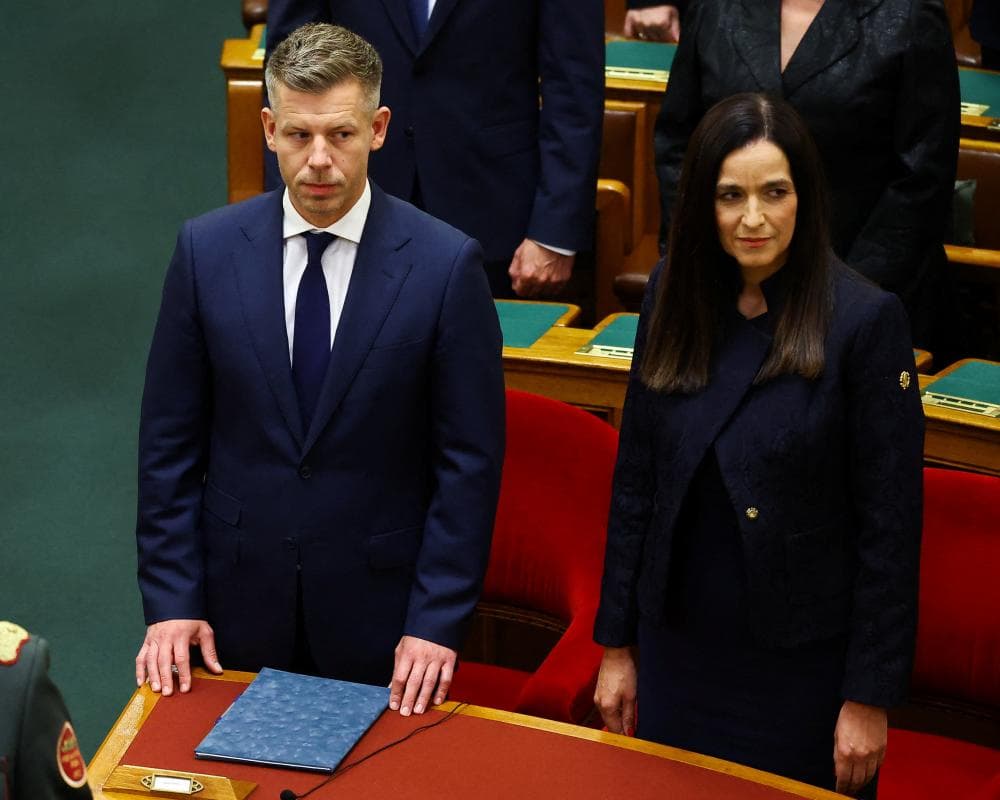
Hungary’s PM Péter Magyar said the decision was taken to “defend our country’s sovereignty” (16:32).
The EU backed Hungary’s decision, saying it was “an expected reaction” in response to “Russia’s persistent campaign in using hybrid attacks against the EU” (12:51).
Elsewhere,
US president Donald Trump and Russia’s Vladimir Putin spoke on the phone, discussing the latest in US-led peace talks after peace envoys Witkoff and Kushner visited Moscow and Kyiv over the weekend (16:32).
A Kremlin aide said the two leaders discussed the state of the Russian aggression on Ukraine, and discussed prospects for a potential broader restoration of US-Russia relations (16:45).
These talks come as Ukraine’s allies met online and urged partners to help Kyiv boost its defences amid expectations of continued Russian attacks over the winter (14:28, 15:29, 15:47).
Ukrainian president Volodymyr Zelenskyy suggested he hoped to meet Trump later this month to discuss missile defence, among other things (10:57).
In other news,
Several European countries condemned Serbia’s decision to hold a ceremonial funeral for Bosnian Serb war criminal Ratko Mladić, stressing the incompatibility of the move with the country’s aspirations to join the EU (13:16, 15:23, 15:35).
The European Commission joined in condemnations today, after facing harsh criticism from Bosnia over its comments yesterday (12:48), but said it was “looking into” the issue without suggesting any immediate moves against Serbia (12:32).
If you have any tips, comments or suggestions, email me at jakub.krupa@theguardian.com.
I am also on Bluesky at @jakubkrupa.bsky.social and on X at @jakubkrupa.
Eiffel Tower management under fire after decision to hide female staff
in Paris
The Eiffel Tower has reopened after a one-day strike was called in response to the landmark’s management ordering female staff to keep out of sight at the request of a visiting religious group.
City Hall, which operates the Paris landmark, has apologised for breaching France’s republican principle of equality and ordered a full inquiry.
Workers at the tower walked out on Monday, closing the landmark to visitors, after female colleagues were sidelined and replaced during a visit organised by a Hindu religious group at the weekend.
In a statement, staff said they objected to “professional instructions that led to female employees being sidelined, replaced and made invisible because of their sex” during the visit.
“Some were asked to leave their posts and wait in separate rooms. In some posts, women were replaced by men. All female employees were instructed not to pass through or enter certain areas while the [Hindu] delegation was present,” they said in a statement.
Employees said they were shocked to find themselves in a situation that was “deeply contrary to the values of equality and nondiscrimination”.
“The Eiffel Tower is the symbol of France. We believe it must also be exemplary in the values it promotes and the way it treats staff,” the statement said.
The Bochasanwasi Akshar Purushottam Swaminarayan Sanstha (BAPS) spiritual movement, whose members made the request in advance of a visit on Saturday, apologised.
“To our knowledge, nobody was refused access to the Eiffel Tower at any moment. Nevertheless, we offer our sincere apologies to anyone who may have been hurt or offended by this situation,” it wrote in a statement.
BAPS is close to India’s ruling Hindu nationalist party, Bharatiya Janata, and was in France to consecrate its first major temple in the country on Sunday.
Related: Eiffel Tower management under fire after decision to hide female staff
Anti-AfD protests sweep Germany as far right closes in on two more states
in Berlin
Thousands of Germans have staged protests against the far-right Alternative für Deutschland (AfD) after the party’s watershed victory in a state election, warning it posed a danger in two more polls this month.
Demonstrators at Berlin’s Brandenburg Gate held a peaceful pro-democracy rally denouncing the anti-immigrant, pro-Russian AfD, which has called for mass deportations of asylum seekers and a rollback of state support for renewable energy and public broadcasting.
The party captured its best-ever state result in the former communist eastern state of Saxony-Anhalt on Sunday, with clear momentum heading into regional elections in the capital and Mecklenburg-Western Pomerania, on the Baltic coast, on 20 September.
Police reported 5,000 protesters, while organisers said they drew more than 14,000 people in a campaign to mobilise voters against the AfD. Posters in the crowd read: “Fascism is no alternative”, “Stop the Nazi AfD: end racism and cuts to social services” and “History has its eyes on us”.
With less than two weeks to election day, demonstrators at the Berlin rally cautioned against resignation and cynicism after Sunday’s shock result.
The AfD’s nearly 44% vote in Saxony-Anhalt, the best for a nativist party since the Nazi period, is a “disgrace that makes you furious and stunned”, Jens-Christian Wagner, the director of the memorial at the former Nazi concentration camp Buchenwald, said from the stage.
Related: Anti-AfD protests sweep Germany as far right closes in on two more states
Polish-Belarusian journalist Poczobut visits Belarus first time after prisoners swap
Polish-Belarusian journalist and activist Andrzej Poczobut has returned to Belarus on a visit, a Polish newspaper reported on Tuesday, nearly five months after he was freed from a Belarusian prison and transferred to Poland in a prisoner exchange, Reuters said.
Poczobut, a member of Belarus’ Polish minority, was arrested in March 2021 and sentenced in 2023 to eight years in prison on charges of inciting ethnic hatred and harming Belarusian national security.
Poland said the charges were politically motivated and repeatedly called for his release. Poczobut was freed and transferred to Poland as part of a prisoner exchange in April, but immediately signalled that he wanted to return to Belarus.
“On Tuesday morning, Andrzej Poczobut crossed the Polish-Belarusian border and headed to his hometown of Grodno,” Gazeta Wyborcza, a Polish newspaper with which he has long cooperated, reported.
“He intends to meet his family and colleagues from the Union of Poles in Belarus. The trip is expected to last a week,” it said.
Poczobut was awarded in absentia the European Parliament’s 2025 Sakharov Prize for Freedom of Thought, a prestigious human rights award, for his “brave fight for freedom of expression and the democratic future” of Belarus.
Belarusian exiled opposition leader Sviatlana Tsikhanouskaya responded to Poczobut’s decision in a statement:
“Andrzej Poczobut’s decision to return to Belarus shows extraordinary courage. It doesn’t mean repression has ended. Arrests & intimidation continue. I fully support Andrzej. International attention is vital to his safety. Every Belarusian must be able to come home without fear.”
Updated
Italy records the hottest summer since 1950s, figures show
in Palermo
According to the National Research Council (CNR), the summer of 2026 was the hottest recorded in the Italy since 1950, as the country battled a wave of wildfires and the largest glacier in the Dolomites suffered a record loss of mass.
The CNR said on Monday that temperatures during the summer months even surpassed the previous record set in 2003, an exceptionally hot summer that had long been seen as difficult to repeat.
The average temperature across Italy this summer was 24.3C, measured 2 metres above the ground, compared with 23.6C in 2003, said Lorenzo Arcidiaco of the CNR.
The average temperature in August was 25.6C, beating the previous records of 24.6C in 2024 and 24C in August 2017, Arcidiaco said.
“The data suggest that 2026 will end as the hottest year since 1950.”
Meanwhile, wildfires that have hit Sicily in recent days continued to burn on Monday, forcing thousands of residents and tourists to leave their homes and holiday accommodation.
Firefighters were battling blazes in several parts of the island, days after the death of Salvatore Giglia, 26, who suffered severe burns while trying to fight a fire near his home and land in Ciminna, near Palermo.
In Palermo province, fires broke out in Castronovo di Sicilia and Bolognetta, while in Trapani province flames burned woodland near the Zaffarana dam.
The extreme temperatures have also taken a heavy toll on the Marmolada glacier, the largest in the Dolomites.
The glacier suffered a record loss of mass this summer, according to data presented on Monday by the University of Padua, the Veneto environmental protection agency and the Italian Glaciological Foundation.
The Marmolada retreated by an average of about 23 metres over the summer and its surface area fell from 92 hectares to 83 hectares.
Experts said the only comparable loss was recorded in 2022, when part of the glacier collapsed after a heatwave brought unusually high temperatures, killing 11 people.
Let’s take a quick look at other news from around Europe.
Romania issues air alert over suspected drone flying from Moldova, Ukraine
Meanwhile, Romania has issued a air alert to residents in the eastern part of the country amid concerns about a potential drone identified in the neighbouring Moldova, likely flying in from Ukraine.
Prefect of Iași County, Constantin Dolachi-Pelin, told Agerpress news agency that the drone entered Romanian territory from the Republic of Moldova.
Two F-18 fighter jets were also scrambled to respond to the incident, Romanian defence ministry said.
The warning also forced a brief suspension of flights at Iași international airport.
Let’s see if we get a bit more detail on the incident later.
Putin, Trump discussed Ukraine war, bilateral relations in first call ahead US peace envoys visit
Vladimir Putin and Donald Trump spoke by phone for an hour on Tuesday, days after US envoys travelled to Moscow and Kyiv in a renewed push to revive stalled peace talks over Ukraine.
According to Kremlin aide Yuri Ushakov, the two leaders discussed the war in Ukraine, with Trump stressing his desire to achieve a breakthrough in peace efforts during his presidency.
Trump’s special envoys Jared Kushner and Steve Witkoff visited Moscow and Kyiv over the weekend, but the meetings failed to produce a breakthrough. Russia resumed large-scale attacks on Kyiv on Monday night after a brief lull that coincided with the US visit to the Ukrainian capital.
Ushakov said Putin gave Trump an “objective and detailed assessment” of developments on the battlefield. Putin has repeatedly sought to portray Russian forces as making gains at the front, while at times claiming the capture of Ukrainian territory that remains outside Russian control.
According to Ushakov, Trump argued during the call that ending the war in Ukraine could pave the way for a broader restoration of US-Russia relations.
Ushakov also said Putin stressed to Trump that Russia had “no hostile plans whatsoever” towards Europe.
Trump has in recent days insisted that Putin would not attack Nato territory, playing down concerns in European capitals that Russia could eventually test the alliance with some form of military incursion.
Putin, Trump discusses weekend envoy talks on Ukraine, Kremlin says
Meanwhile, we have just heard from the Kremlin on a phone call between US president Donald Trump and Russia’s Vladimir Putin.
The pair talked about the visit of US peace envoys to Moscow and Kyiv over the weekend, and prospects for their bilateral relations.
Kremlin claims that Trump would like to see US-Russia ties restored during his presidency, while Putin assured him that he had no hostile plans towards Europe.
We will bring you more on this shortly.
'We will defend our country's sovereignty,' Hungary's PM Magyar says after move to expel Russian diplomats
Hungarian prime minister Péter Magyar commented on his government’s decision to expel ten Russian diplomats from the country.
In a very brief statement echoing what his foreign minister, Anita Orbán, announced earlier (11:09), he said:
“The Hungarian government has ordered ten diplomats from the Russian Embassy in Budapest to leave the country. They carried out activities in Hungary that are unacceptable for diplomats. We will defend our country’s sovereignty.”
He did not comment on Russia’s response after Moscow threatened with “harsh and painful” actions in retaliation (12:22).
Ukraine 'racing against time' to prepare for winter as allies must prepare for 'protracted' conflict, allies say
Back to the videoconference on Ukraine (15:29), Germany’s defence minister Boris Pistorius urged partners to help Kyiv prepare for winter as it faces “race against time,” as “we can expect Russian air raids to increase again once temperatures drop and the damage will be even greater.”
A senior Pentagon official Elbridge Colby also warned that allies “must be prepared for a protracted conflict and for Ukraine’s requirements to persist in the months and years ahead.”
“Europe’s greater assumption of responsibility for its own defence is fully consistent with a strong and viable Ukrainian defence, provided that Europe continues to act with requisite seriousness and urgency,” he said.
Colby also said Europe “must not slacken” in its remilitarisation efforts.
“Support for Ukraine contributes to Europe’s security by helping to rebuild Europe’s military strength and industrial capacity. But words are not enough. Real money and industrial capacity must be put to work. Again, I underline that this is happening, but we must not slacken. The United States stands ready to continue supporting this effort.”
Separately, Germany’s Pistorius also warned that Ukraine’s supporters face being “targeted by Russia” with “hybrid means to sow uncertainty in order to erode our social cohesion, democratic our democratic principles and weaken our willingness to support Ukraine.”
He recalled the recent attempted drone attack at Leipzig airport in this context, but insisted Germany was “unwavering” in its support to Ukraine.
“These attempts will not produce the intended outcome,” he said.
Updated
UK summons Serbian chargé d'affaires over Mladić funeral
The UK has joined the growing chorus of countries criticising Serbia for the pomp and the participation of state officials in yesterday’s funeral of Bosnian Serb war criminal Ratko Mladić.
In a short statement, the UK government said that:
“The UK’s Special Envoy to the Western Balkans, Dame Karen Pierce DCMG, summoned the Serbian Chargé d’Affaires to condemn the involvement of Serbian state and military officials in the funeral of Ratko Mladić.”
Europe minister Lord Wood of Anfield said that Mladić “presided over crimes that are among the worst committed in Europe since the second world war,” and so “the denial and whitewashing of his crimes is an affront to international law and directly undermines regional stability and trust.”
“The thoughts of the UK Government are with Mladić’s victims and their families. They deserve respect, compassion and accountability, not efforts to rewrite proven history. Political leaders and public institutions have a responsibility to look to the future, not to the past, and to act in ways that support regional reconciliation, not to reopen old wounds.
The International Criminal Tribunal for the former Yugoslavia was established by the UN Security Council and Serbia is obliged to respect its judgments.
That is why today we summoned the Serbian Chargé d’Affaires. Glorification of a convicted war criminal directly undermines trust, fuels division and is incompatible with the process of reconciliation within Bosnia and Herzegovina and the region.
The UK remains firmly committed to international justice, accountability, and lasting reconciliation across the Western Balkans and will continue to work with partners across the region and internationally in support of peace, justice and a secure and prosperous future for all communities.”
Updated
Germany to deliver more Patriot missiles to Ukraine
Germany will deliver Patriot air defence missiles to Ukraine from its national stocks, defence minister Boris Pistorius.
“I decided to deliver urgently needed PAC-2 interceptor missiles from Bundeswehr stocks to Ukraine,” Pistorius said at a videoconference of defence ministers from countries supporting Ukraine, in comments reported by Reuters.
Pistorius said Germany would also step up the provision of air-to-air missiles and would continue to deliver drones and long-range ammunition to Ukraine.
'No place in Europe for the glorification of war criminals,' EU's Kallas says
EU’s foreign policy chief Kaja Kallas ramped up pressure on Serbia, condemning “the public glorification afforded to a convicted war criminal in Belgrade” after yesterday’s funeral of Ratko Mladić.
Kallas said the ceremony was “an affront to the memory of the victims, their families, and all those who suffered during the conflicts in the Western Balkans.”
“True reconciliation cannot be built on revisionism, the denial of genocide or the honouring of perpetrators.
Serbia’s path into the European Union requires an unequivocal commitment to fundamental European values and historical truth. There is no place in Europe for the glorification of war criminals.”
Several other EU foreign ministers also condemned the memorial service and put a question mark on Serbia’s accession path, including Austria’s Beate Meinl-Reisinger, Lithuania’s Kęstutis Budrys, and Sweden’s Maria M Stenergard.
Separately, Bosnia and Herzegovina’s foreign minister Elmedin Konaković ordered two Serbian diplomats to leave the country in protest at Serbian government officials taking part in the funeral. Earlier, he also withdrew Bosnian diplomats from Serbia (12:48).
European countries say they would support restrictions on trades with West Bank settlements
The foreign ministers of Canada, Denmark, Finland, France, Iceland, Ireland, Norway, Poland, Portugal, Spain, Sweden and the UK, have issued a statement saying they would support or consider restrictions on trade in goods with Israeli settlements in the West Bank that are illegal under international law.
The countries confirmed “their intention to introduce national and/or support European restrictions on trade in goods with settlements which are illegal under international law, or that they are actively considering these and other measures, in accordance with their national procedures,” the nations’ foreign ministers said in a statement.
“The government of Israel must immediately halt the expansion of settlements and civilian administrative powers, ensure accountability for settler violence, and investigate allegations against Israeli forces,” it added.
The (relatively new) UK foreign secretary, Ed Miliband, has been speaking in the House of Commons, setting out the government’s position.
Taking a much stronger stance than his predecessor, Yvette Cooper, Miliband said the government would now take the official stance that Israel’s occupation of the West Bank was unlawful in its entirety, while announcing an import ban on goods from illegal settlements in the occupied territories, among a number of other policies.
You can read more in our UK politics live blog here:
Updated
Ukraine can buy Patriot air defence system parts from EU's support loan, von der Leyen says
The European Commission president, Ursula von der Leyen, has said that Ukraine will be able to buy crucial parts for Patriot air defense systems through the next €3.2bn (£2.7bn; $3.7bn) disbursement from the EU’s support loan.
“Together with Nato secretary general Rutte, I welcome the agreement by Member States on the derogation for Ukraine to purchase crucial products for Patriot air defence systems,” she said in a statement.
Ukraine heavily relies on advanced air defence systems, mainly US Patriot interceptors, to protect its skies from Russian ballistic missile attacks. But this year, supplies of Patriot missiles have run out, leaving Ukraine vulnerable to strikes.
After a brutal summer of deadly Russian missile and drone attacks, Ukraine last week requested an exemption from Buy European procurement rules to acquire US-made Patriot interceptors using the EU’s €90bn support loan.
Updated
Ukraine has been asking western allies for air defence equipment amid fears Russia will dramatically intensify its missile attacks this winter.
My colleagues Jamie Grierson and Dan Sabbagh have written a story about the UK committing to £100m to boost Ukraine’s air defences ahead of the anticipated attacks.
We already mentioned the pledge in this post, but their story contains more detail.
Here is an extract:
“The air defence interceptors plus large-calibre artillery rounds and other drones will be supplied to Ukraine through a contribution to a Nato scheme to buy American weapons.
Ukraine is currently unable to prevent Russian ballistic missile attacks due to a shortage of Patriot interceptors, leading to attacks that have killed civilians and destroyed food and logistics warehouses over the summer.
President Volodymyr Zelenskyy has said he wants to obtain 300 Patriot missiles, costing about $3m (£2.6m) each, to help Kyiv protect its electricity, heating and water systems through the normally hard winter.
The UK did not say how many Patriots it would be able to buy, but the number is likely to be only a fraction of the number sought, though other western allies are also examining how they can help Kyiv defend itself.”
Related: UK commits £100m to bolster Ukraine’s air defences over winter
Updated
40-year-old Russian man questioned over Romanian sabotage allegations
A 40-year-old Russian man suspected of being involved in the operation is being questioned by Romanian prosecutors on Tuesday, a statement from Romania’s Directorate for Investigating Organized Crime and Terrorism said.
Authorities are seeking court approval to detain him for 30 days pending inquiries into his encrypted communications, which reportedly included photos of several Romanian and multinational military bases.
Romanian intelligence service says it prevented Russian sabotage operation targeting defence, critical infrastructure
Romanian intelligence service said it “prevented the commission of a sabotage on national territory,” involving a Russian citizen in Romania and a number of defence and critical infrastructure targets.
In a statement, the SRI service said that the Russian man, who was being monitored as part of an extensive investigation, attempted to take photo and video documentation of “some communications centres and national military bases used by Nato allies,” as well as other defence institutions and critical infrastructure.
“The data obtained indicate a similar action pattern to that used on the territory of European states by networks of saboteurs coordinated by entities from the Russian Federation, including in the cases thwarted in Romania in 2024 and 2025: the Russian citizen was instructed by an intermediary to make photo-video materials with targets of strategic military interest, including a Ukrainian Antonov cargo aircraft during their presence on the national territory.”
It added that “the specific actions taken by the SRI, as well as the measures taken with the Romanian authorities and external partners, led to the prevention of an act of sabotage on national territory.”
The service did not offer more detail on whether it involved any arrests.
Updated
Dutch foreign minister calls for 'accountability, reconciliation, education' after Serbia's 'hero' funeral for Mladić
Dutch foreign minister Tom Berendsen also joined in calls for “accountability, reconciliation and education about the past” as he criticised Serbia for holding a “hero” funeral for Bosnian Serb war criminal Ratko Mladić (12:48).
In a statement, Berendsen said:
“Ratko Mladić was convicted of war crimes, genocide and crimes against humanity. The honour bestowed upon him in Belgrade by the state is incompatible with European values and deeply hurtful to victims and their families.
The Netherlands supports voices in Serbia and across the region calling for accountability, reconciliation and education about the past.”
Updated
German police detain suspect after sabotage attacks on power grid
Elsewhere, we are getting a line from Germany that German police have detained a man suspected of carrying out a series of sabotage attacks on the country’s electricity grid, as reported by local media and Reuters.
The suspect, identified as Daniel V. by German media, was detained in Weisweiler about 50 kilometres (30 miles) west of Cologne, where he allegedly carried out one of his attempted attacks, Reuters said.
German police have been searching for the 48-year-old since they obtained letters claiming responsibility for a series of sabotage attacks on the power grid, in which the suspect cited opposition to fossil fuels as a motive.
German news agency DPA said that the suspect’s “motive was reportedly climate-related, with the letters criticising electricity production from fossil fuels.”
Updated
EU backs Hungary's decision to expel 10 Russian diplomats
Separately, the commission was also asked about Hungary’s decision to expel 10 Russian diplomats this morning.
The commission’s foreign affairs spokesperson Christian Wigand said:
“We take note of Hungary’s legitimate decision.
This is an expected reaction [given] Russia’s persistent campaign in using hybrid attacks against the EU and its member states.
The European Union expresses its full solidarity with Hungary and reaffirms its support for the diplomatic and consular activities of all member states conducted in accordance with international law.
The European Union will continue to closely coordinate with Hungary and other member states, and remains committed to protecting the interests and the rights of EU citizens.”
Bosnia withdraws diplomatic staff from Serbia in protest at Mladić's 'hero' funeral
It’s worth noting that Bosnia and Herzegovina withdrew all staff from its Belgrade embassy yesterday, and transferred consular services to its embassies in Zagreb and Podgorica in protest against Mladić’s ‘hero’ funeral in Belgrade.
Related: Ratko Mladić, the ‘Butcher of Bosnia’, given hero’s funeral in Serbia
The ministry said the move intended to “reduce communication with Serbia to the lowest possible level,” while intensifying its dialogue about the situation with the EU, US, and the UK.
It’s also probably safe to say that the Bosnian foreign ministry was not impressed with the commission’s bland holding position yesterday.
Responding to questions from reporters yesterday, the EU’s lead spokesperson Paula Pinho insisted that “there is no place for glorification of war criminals,” but did not really engage with repeated questions about the apparent state and military honours involved.
In a late afternoon post directed at Pinho, the ministry said: “are you even aware of what you are saying?”
It continued:
“Five ministers from the Serbian Government were seated in the front row at the funeral, a convicted war criminal was given military honours, and his body was flown in on a Serbian Government aircraft.
What are you afraid of? Why are you unwilling to call this what it is?
Your position on the funeral of a convicted war criminal is a disgrace to the entire European Union!”
Difficult not to see a link between their furious reaction and this morning’s hasty statement from von der Leyen and Pinho’s notably different tone at today’s midday briefing.
Updated
EU 'looking into' its response to Serbia's 'hero' funeral for Mladić
Not surprisingly, the issue of the EU’s muddled response to yesterday’s “hero” funeral for Bosnian Serb war criminal Ratko Mladić comes up again during today’s midday briefing held by the European Commission.
A commission spokesperson said the commission was “looking into” any potential consequences for Serbia.
She also repeated commission president von der Leyen’s criticism from this morning (9:41), saying the images from the funeral were “shocking” and “speak for themselves.”
“They demonstrate a failure to confront a dark chapter in Europe’s recent history and contradict the values underpinning Serbia’s path towards the European Union,” Paula Pinho said.
She declined to say if von der Leyen would visit Belgrade on her annual trip to western Balkans, stressing the programme is still being worked on.
Moscow says it will have a 'harsh and painful' response to Hungarian move to expel 10 diplomats
We are getting a bit more on that Russian response to Hungary, and it’s clear that Moscow is not happy.
The foreign ministry said it would proceed with a “harsh and painful” response, AFP reported.
“The response to the Russophobic lobby in Budapest will be harsh and painful,” foreign ministry spokesperson Maria Zakharova told the TASS state news agency.
Russia to respond to Hungary's decision to expel 10 Russian diplomats
Meanwhile, the Russian foreign ministry told RIA Novosti news agency that it would respond to Hungary’s decision to expel 10 Russian diplomats from Budapest (11:09).
Updated
Win in war against Ukraine is 'very near,' Kremlin spokesperson says
But the tone coming from Moscow is very different, as Kremlin spokesperson Dmitry Peskov told reporters that Russia was very confident that victory in its war against Ukraine is “very near.”
“Yes, we are confident, and we are sure that victory is very near,” Peskov said in comments reported by Reuters.
US negotiators had 'decent ideas' on ending war, Zelenskyy says
We are getting more lines from Volodymyr Zelenskyy’s chat with reporters this morning (10:57).
The Ukrainian president said that US peace negotiators had presented several “decent ideas” to be discussed during talks on how to end the war.
He also suggested the next trilateral meeting could be hosted by Turkey, the United Arab Emirates, Switzerland or some other countries.
Another could take place as soon as this month, Zelenskyy said.
“If all sides agree, we also want to hold it in autumn. If September works out, then it would be great. The earlier, the better,” he said in comments reported by AFP.
Updated
Hungary expels 10 Russian diplomats accused of 'engaging in activities unacceptable ... under Vienna Convention'
Hungary has asked 10 Russian diplomats who “engaged in activities … that are unacceptable for diplomats under the Vienna Convention” to leave the country, foreign minister Anita Orbán said.
“The decision protects the security and sovereignty of Hungary,” she said in a statement on Facebook.
“This does not mean the severance of diplomatic relations with Russia. Hungary intends to continue the necessary dialogue, based on mutual respect and compliance with the rules,” she added.
Updated
Zelenskyy hopes to meet Trump this month to discuss missile defence
Separately, Ukraine’s Volodymyr Zelenskyy said he hoped to meet US president Donald Trump this month to discuss missile defence ahead of what is expected to be another difficult winter for Ukraine.
His comments come as Kyiv finds itself once again under renewed attacks from Russia, with Ukrainian authorities repeatedly warning that they are facing a shortage of air defence supplies.
UK commits £100m to fund Ukraine's defence this winter
The UK has committed £100m to boost Ukraine’s air defence capabilities this winter, including air defence interceptors, large-calibre artillery rounds and drones.
The money will be spent on Nato’s Prioritised Ukraine Requirements List (PURL) that helps Ukraine get the equipment it needs with the support of Nato allies.
The UK government also said its “commitment to provide over 120,000 drones to Ukraine this year continues, with 25,000 delivered to date, a figure set to ramp up ahead of the winter.”
Iceland summons US ambassador over Trump's AI-generated map
Iceland summoned the US ambassador for talks last night after US president Donald Trump posted on social media an AI-generated map of the US, Canada and other countries, which appeared to include Iceland as the US territory.
Icelandic national broadcaster RÚV reported that the ambassador was told that the post was “completely inappropriate.”
The map also included Greenland as the US territory, despite being posted just hours after the EU unveiled a €200m investment package for the territory in an apparent attempt to strengthen its ties with the bloc (Europe Live, Monday).
12 injured in overnight Russian attacks on Kyiv
The number of people injured in this morning’s attacks on Kyiv has gone up to 12, local authorities said.
Four artworks stolen from Renoir museum in southern France
Two thieves have broken into a museum dedicated to the French impressionist painter Pierre-Auguste Renoir in southern France, stealing four artworks and dropping one as they fled, the mayor has said.
“This morning, two individuals broke into the Renoir Museum and stole four works of art,” said Bryan Masson, the far-right mayor of the town of Cagnes-sur-Mer.
“Spotted thanks to the town’s video surveillance cameras, the two individuals fled, abandoning one of the stolen paintings as they ran,” he said, adding that his office estimated the value of the stolen works at €9m (£7.7m).
The museum was opened in 1960 in the painter’s last home before his death in 1919. Its collection includes objects and furniture that belonged to Renoir, including his easel and wheelchair, as well as portraits, landscapes and nudes painted by the artist.
The mayor said it took five minutes for the authorities to respond. “The museum alarm went off at 5.48 am. At 5.53 am, just five minutes later, our municipal police were on the scene,” he said.
The theft comes less than a year after eight items valued at around €88m were stolen during a daylight robbery from the Louvre in Paris. The four suspected Louvre robbers have been arrested, but the stolen items have not been found despite extensive searches by French investigators in the Paris region, and exchanges with police in Belgium, Italy and beyond.
Art thieves in Europe are committing more violent robberies and specialist gangs have been replaced by ad-hoc opportunists recruited through social media, Europol said last month.
Related: Artworks stolen from Renoir Museum on French Riviera in latest heist
EU's von der Leyen condemns 'shocking' funeral of Mladić in Serbia
Separately, European Commission president Ursula von der Leyen has condemned the presence of senior Serbian officials at yesterday’s funeral of Bosnian Serb war criminal Ratko Mladić, saying it showed “a failure to confront a dark chapter in Europe’s recent history” and questioned Serbia’s alignment with the EU.
Mladić, who died last week, was buried with military honours in after a memorial service attended by tens of thousands of people and led by Porfirije, the patriarch of the Serbian Orthodox church.
Related: Ratko Mladić, the ‘Butcher of Bosnia’, given hero’s funeral in Serbia
In a statement this morning, von der Leyen said:
“The images from Ratko Mladić’s funeral yesterday in Belgrade were shocking. Ratko Mladić was a convicted war criminal. He was responsible for genocide, war crimes, and crimes against humanity. He died while serving a life sentence for the Srebrenica genocide and other crimes.
The elements of official support and the presence of some senior Serbian officials at the funeral are deeply regrettable. They demonstrate a failure to confront a dark chapter in Europe’s recent history and contradict the values underpinning Serbia’s path towards the European Union.
Our thoughts are with all the victims of the crimes committed in the countries of former Yugoslavia.”
Morning opening: Ukraine's prosecutor general resigns as Russia resumes attacks
Ukraine’s prosecutor general, Ruslan Kravchenko, resigned from his post over corruption accusations that saw anti-graft officers search his offices at the weekend as part of investigations into illegal call centres, AFP reported.
In a statement, Ruslav Kravchenko has denied he was involved in the alleged scheme, and said his resignation was a “political decision” as he wanted to avoid his position being used “as an instrument of political confrontation.”
Related: Ukraine war briefing: New political turmoil in Kyiv as prosecutor general resigns
His decision to step down poses another challenge for Ukraine’s president Volodymyr Zelenskyy after tricky summer which involved a government reshuffle and a political crisis linked to his controversial decision to sack popular defence minister Mykhailo Fedorov.
The latest political crisis comes as Russia has resumed its attacks on Kyiv after a brief pause over the weekend intended to facilitate peace talks with senior US representatives.
“It was a complex attack that the Russians tried to plan to cause as much harm to life as possible – ballistic missiles, cruise and anti-ship missiles, and jet-powered shaheds. There is significant damage to residential buildings and other civilian infrastructure in the capital,” Zelenskyy said this morning.
At least two people died in the attack, and 10 were injured. Further attacks were also reported in Dnipro, Kharkiv, Sumy and Zaporizhzhia.
Elsewhere, I will keep an eye on the latest from Germany as the fallout from the Saxony-Anhalt election continues, and on reports from France about thieves stealing four works of French impressionist painter Auguste Renoir during a night heist at a museum in Cagnes-sur-Mer.
It’s Tuesday, 8 September 2026, it’s Jakub Krupa here, and this is Europe Live.
Good morning.