The Western Australian justice department has defended it’s use of restraints after a 16-year-old Indigenous girl was shackled to a Perth hospital bed after she was taken into custody.
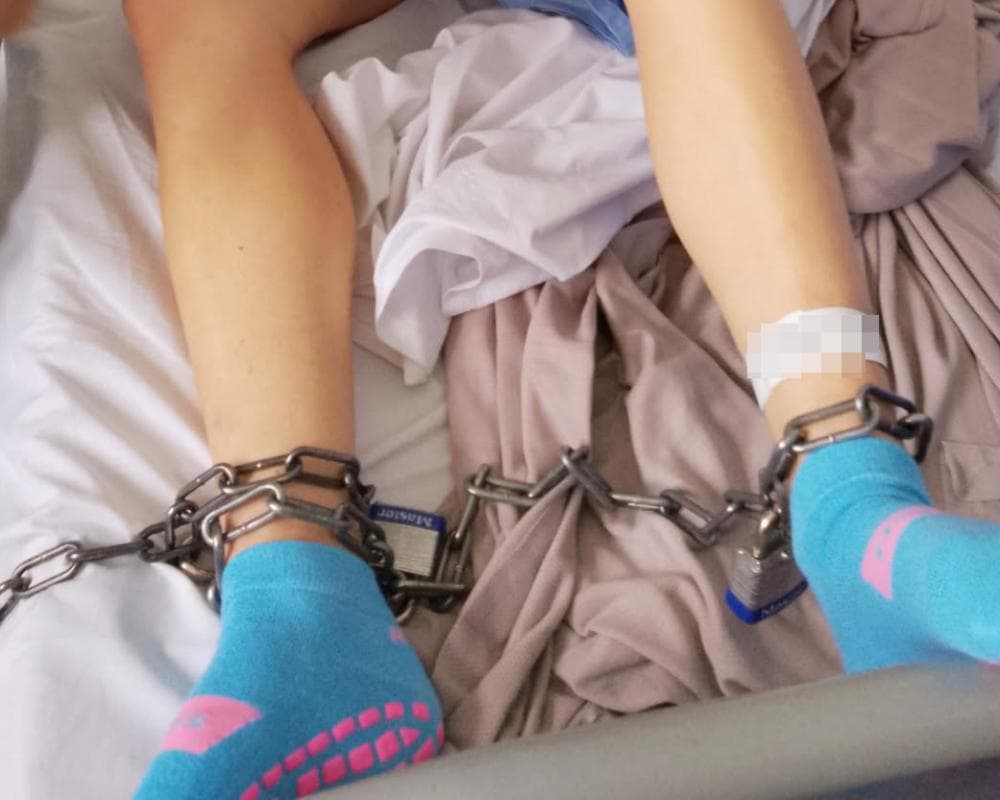
A photo shared by the family showed the teenager’s ankles bound in chains and locked to the underside of a hospital bed.
The girl’s grandmother, who cannot be named to protect the identity of her grandchild, alleged police used excessive force while arresting the teenager over allegations of child neglect, including dragging her while she was topless.
The teenager gave birth to a child several months ago.
The grandmother, who visited her granddaughter in hospital, where she was taken after the arrest in the custody of department of justice staff, for an undisclosed health issue, said her grandchild had scratches on her breasts and stomach from her handling by police. She said the use of the shackles in the hospital was appalling and called for the practice to stop.
“I would like for her to have been treated like a human being because she is one,” the grandmother said.
A spokesperson for the Western Australia justice department said it could not comment specifically on the girl’s case, but that restraining people in custody was in accordance with its policies and procedures.
“Where a person in custody is being treated in an unsecured medical facility, appropriate restraint measures are used as part of standard custodial management practices,” the spokesperson said.
“Medical practitioners can request that restraints be modified or removed where deemed clinically necessary. These measures are in place to ensure the safety of the person in custody, hospital staff, custodial officers, and the wider community.”
Mervyn Eades, a Noongar man and community advocate, said the practice of using shackles was an “abomination”.
“We’re talking about a child, not a serious criminal” he said. “With past atrocities against our people’s I look at those chains on her legs and I automatically think of colonisation and how our people were placed in them.”
In response to allegations excessive force was used to arrest the teenager, a spokesperson for WA police said: “A review of officer body-worn camera vision has been conducted and the officers were found to have acted within policy during the arrest.”
They said police went to the girl’s house in response to concerns about the welfare of her child, and found upon arrival the children was unharmed.
“After a short verbal exchange, it will be alleged the female, who was present at the time, resisted arrest by attempting to push past officers and enter the residential premises. She was subsequently brought to the ground and placed into custody,” the spokesperson said.
Police charged the girl with one count of breaching protective bail conditions, one count of endangering the life, health or safety of a person, and one count of failing to protect a child from harm.
Australian state and territory governments have been coming under pressure over their use of shackles on incarcerated people in hospital settings, including women while they give birth.
In October, Victorian senator Lidia Thorpe, a Gunnai, Gunditjmara and Djab Wurrung woman, introduced legislation to ban shackling of incarcerated women during childbirth and to stop children being strip-searched.
It’s passage was blocked by Labor and the Coalition, with Labor saying “the responsibility of the criminal justice system predominantly sits with state and territory governments”.
Days later, an incarcerated Indigenous woman was shackled to a hospital bed in Queensland while she was in labour.
In 2016, a Noongar man was handcuffed and shackled to a hospital bed in Western Australia while he was comatose after collapsing during a court appearance for a driving offence.
Debbie Kilroy, a spokesperson for advocacy group the National Network, said the latest incident in Perth demonstrates why the federal government needed to step in to regulate state actions.
“When politicians tell us that shackling is a state issue, what they are really saying is that they are prepared to leave women and girls at the mercy of police and prison officers,” Kilroy said.
“We need to ask ourselves what it says about this country that we can look at a 16-year-old mother and see someone who needs to be chained down rather than someone who needs care.”
The WA attorney general and police minister were approached for comment.