Hello and welcome to the weekend.
This week, we could not look away from the series Gaza: a week in the life. In the story linked below, a Palestinian mother recounts how she is rebuilding her future in the ruins and fragments of the past she lost. Across the rest of the reads in this newsletter, there is hope, resistance and rebirth in the history that continues to define our present.
I hope you enjoy them all as much as we did.
1. Gaza: a week in the life
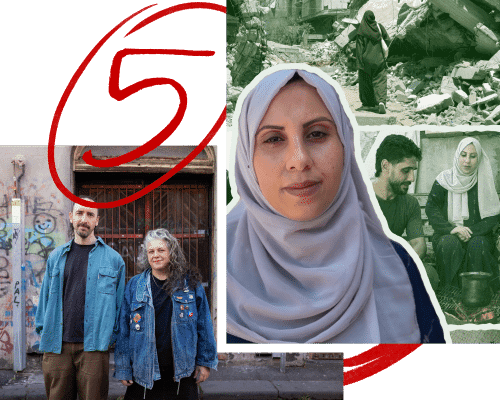
As the war in Gaza approaches its fourth year, this week the Guardian followed five ordinary Palestinians going about their daily lives. Each piece tells the story of their day, revealing the conflict’s terrible toll. On day one of the series, Alaa Hessi brought readers into her world. Hessi lives in a tent pitched on the ruins of her house, which was destroyed by an Israeli airstrike that killed all three of her children.
Life in the rubble: Gaza holds the memory of Alaai’s lost children, and she finds beauty in the ruins that surround the tent. In the late afternoon, Alaa scrolls through old photos and videos to hear their voices.
Notable quote: “I do not tell nurses at the clinic about my circumstances and my children who died, because even the healthcare workers are emotionally exhausted. They are unable to offer comfort or psychological support. My story is not unusual in Gaza. Many women here have lost their children.”
How long will it take to read: About three minutes.
Further reading: A week in Gaza day two, day three and day four.
2. A tale of two trap houses
You may not be familiar with the process of “cuckooing”. It’s where a drug dealing gang takes over the home of a vulnerable person, usually exploiting them to use their home as a base from which to operate. In the past couple of decades it has been increasingly used as a way for gangs to avoid detection. And just as it sounds, it’s grim and dangerous. But as the author and journalist Max Daly writes here, the reality is complex.
From misery to an unusual “friendship”: Daly’s friend Duncan, a musician, artist and father, ended up opening his doors to drug gangs – not once but twice – but his two experiences turned out to be completely different. The first brought him only misery; the second, in his telling at least, brought him a strange kind of friendship. Did it save him? The answer to that is perplexing.
How long will it take to read: 13 minutes.
Further reading: The history and the victims of cuckooing.
3. The controversial queen of toddler TV
Rachel Accurso, better known as Ms Rachel, has become a global star in the world of children’s entertainment. Accurso has been labelled a “toddler whisperer” and racks up billions of views on YouTube with her catchy videos. Having signed a deal with Netflix, Ms Rachel dolls, rattles, talking toy phones, books and pyjamas are now all available. But statements on everything from Gaza to LGBTQ rights have prompted criticism as well as support.
Why get involved in politics? In the beginning, Accurso was advised to keep quiet about political issues. She was told that if she avoided controversial topics, more viewers would follow, and she would eventually be able to help more kids. But after watching footage from Gaza and speaking to families on the ground, Accurso says, she doesn’t understand why anyone would not do all they can to stop the violence: “How could we not want to help everyone?”
Notable quote: “We’re the grownups of this world and we’re meant to keep children safe. And the fact that we are not is horrific.”
How long will it take to read: almost nine minutes.
Further reading: Matching Macklemore, and the TV event of the year.
4. Once banned at the request of Nazis, this anti-fascist play is back on its feet
Having made its debut on Broadway in 1935, the play Till the Day I Die found itself at the centre of controversy in Australia when it was banned by the federal government at the request of the Nazi party. Written by the US playwright Clifford Odets, the play is about a communist who was arrested by the Nazis for producing leftwing political pamphlets. But the ban created a groundswell of support, leading to a creative production being performed on the back of a truck in Melbourne. Ninety years on, it’s being staged again.
A symbol of rebellion and resistance: Theatre-makers Mark Wilson and Katie Sfetkidis were inspired by that surreptitious production, which took place in the bed of a pickup 90 years ago. Wilson and Sfetkidis view their modern-day production as “as an act of leftist solidarity with the past and a spur for future activism”.
Notable qoute: “The work is long and the work is ongoing, and fighting against the forces of fascism is going to be much larger than anybody’s lifetime.”
How long will it take to read: less than two minutes.
Further reading: When a theatre becomes a culture war.
5. Bunker mentality
Across the Nordic countries of Finland, Sweden and Norway, something is happening underground. Bunkers made during the cold war now have a new purpose as Russia’s war in Ukraine revives old fears of conflict across Europe. These once disused bunkers remain ready for a crisis.
“It was a debate before, but thanks to Putin, it no longer is”: For years, the legacy of underground shelters was viewed as a costly one. Jukka Lehtiranta, the head of Helsinki’s Civil Defence Association, who continues to train volunteers for wartime, says that has now changed. In addition to their renewed use as a civil-defence system, these spaces designed for conflict have become a part of Finnish everyday life. Across Helsinki, underground bunkers now contain a 300-metre karting track, a popular axe-throwing club, garages and a shooting range used by reservists.
Can you oppose a datacentre if it is underground? Sweden has found a different use for their neglected shelters. The cold war spaces beneath Stockholm have been transformed into datacentres. Deep beneath the earth, rows of servers stand beside granite walls lined with green vegetation.
How long will it take to read: about two minutes.
Further reading: The super-rich “preppers” planning to save themselves from the apocalypse.
Sign up
If you would like to receive these Five Great Reads to your email inbox every weekend, sign up here. And check out out the full list of our local and international newsletters.