Advocates accuse government of ‘cherry-picking’ welfare compensation reciepients
Welfare advocates have accused the DEWR of “cherry-picking” who might get compensation for having their payment unlawfully cancelled, after it was revealed the department had invited 50,652 to apply, when an estimated 310,000 people were impacted.
Antipoverty Centre spokesperson and member of the DEWR Targeted Compliance Stakeholder Reference Group Kristin O’Connell said:
All members of the reference group have repeatedly raised our concerns about this process with DEWR and urged them to ensure everyone subjected to these unlawful decisions receives compensation. It is not up to the department to decide whether or not these 300,000 people were harmed – if they made an unlawful decision, they should repay people as an act of good faith.
If people have not been approached but believe they were impacted, they can still apply, with more details here: https://www.dewr.gov.au/assuring-integrity-targeted-compliance-framework/compensation-cancellation-income-support-payments-under-targeted-compliance-framework
ABC reiterates call for One Nation to remove satirical Bluey cartoon
The ABC has doubled down on its call in Senate estimates for depictions of Bluey to be removed from a One Nation cartoon in which the beloved character repeatedly runs over politicians with an SUV.
The broadcaster’s managing director, Hugh Marks, said on Tuesday that he became aware of One Nation’s potential breach of intellectual property rights last week and sought legal advice.
An ABC spokesperson said on Wednesday.
As the managing director stated during Senate estimates, the ABC does not own the intellectual property for Bluey.
The ABC is considering available options.
In the meantime, the ABC considers the relevant cartoons should be immediately removed from One Nation’s platforms and no further use should occur.
Bluey’s international distributor, BBC Studios, and the Brisbane-based creators Ludo have been in discussions with the ABC about the issue.
Earlier today, the communications minister, Anika Wells, said the ABC is “well within its rights to be concerned” about One Nation’s use of Bluey, “one of Australia’s biggest, most loved, most well-known exports”.
Related: ABC to demand rightwing One Nation party stop using Bluey in ‘shocking and disrespectful’ cartoon
Updated
Jim Chalmers blames Middle East conflict for high inflation
Jim Chalmers has blamed higher global oil prices for intensifying cost of living pressures at home, after inflation jumped to 4.3% in the year to September.
The treasurer in a statement said inflation was “too high”, but that prices were rising faster across a range of countries, not just here.
Fuel prices were up more than 9% last month, and were 24% higher than a year earlier, he said.
We’ve seen higher oil prices driving higher inflation around the world and today’s figures confirm we are not immune from that. From an economic point of view, the [Middle East] conflict can’t end soon enough.
We know this doesn’t make it any easier for families who are under pressure.
The treasurer’s comments come after a sometimes heated debate earlier in the day between the Treasury secretary, Jenny Wilkinson, and Liberal senator Jane Hume around the extent to which government spending was to blame for high inflation.
Updated
Australia not heading towards recession, RBA chief economist says
Sarah Hunter, the RBA’s chief economist, says none of the bank’s real-time economic indicators “are suggesting that the economy is in, or heading into, a recession”.
Speaking at Senate estimates, Hunter’s assessment followed comments by her boss, Michele Bullock, that the Reserve Bank expects unemployment to “gradually move up”, but that “we’re not worried about the pace of increase in the unemployment rate at this stage”.
The key jobless measure has climbed to 4.7%, its highest in five years. But it’s still below the 5%-plus pre-Covid level, and the RBA officials’ comments confirm the central bank’s primary worry is high inflation rather than weak growth.
Updated
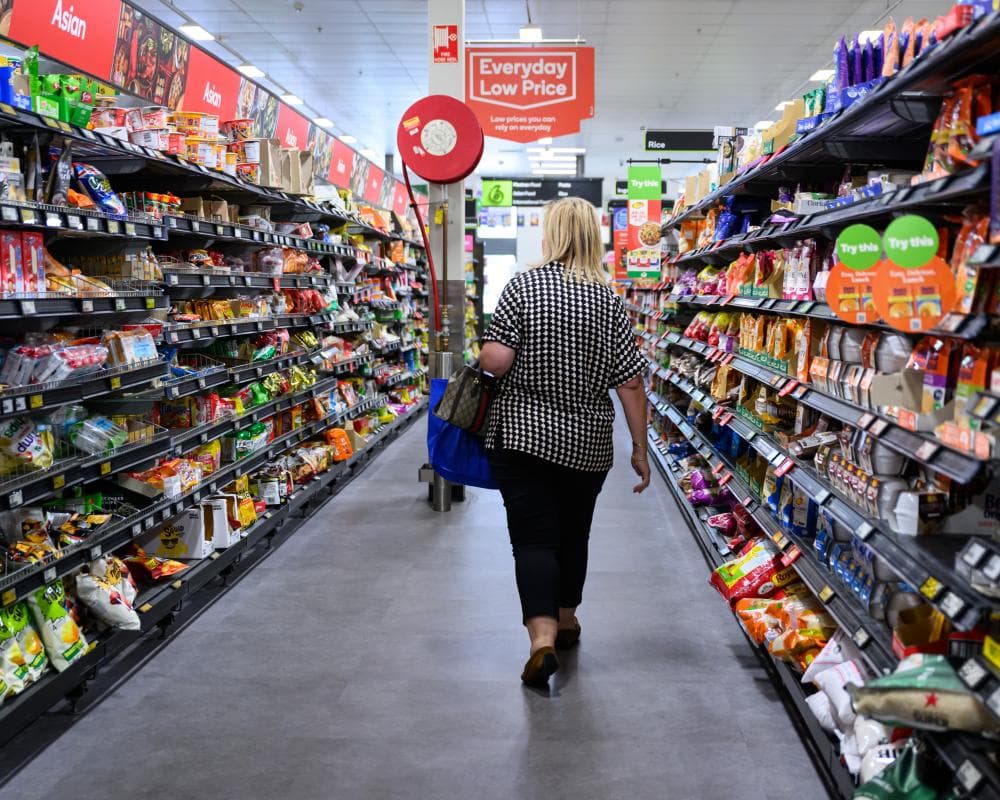
Woolworths CEO says she expects to see ‘modest inflation’ in grocery prices
The Woolworths group chief executive officer, Amanda Bardwell, says she expects “modest inflation” in grocery prices in the near future.
Speaking to journalists after the company released its results for the first quarter of the 2026-2027 financial year, Bardwell said:
Overall, what we’d expect as we go forward is to see some modest inflation in food, similar to what we will have seen in previous years.
There’s no doubt that as fuel continues stay at elevated levels and input costs continue to rise, that will cause some suppliers to need to ask for price increases.
Bardwell said there had been a surge in requests from the supermarket’s product suppliers to raise prices earlier in the year, immediately after the war on Iran began, but this reduced “fairly quickly” to a “normalised” number of requests.
Inflation in the food and non-alcoholic beverage sector rose again last month according to the latest official data released this morning by the Australian Bureau of Statistics (ABS).
The ABS’s consumer price index showed annual inflation in the sector was 3.2% in the 12 months to September 2026, up from 3% in August 2026.
Updated
Aged care algorithm leading to unfair outcomes for older Australians seeking at-home care, estimates hears
More from health estimates: Greens senator Penny Allman-Payne has challenged health and ageing officials at estimates over the aged care algorithm.
Referring to expert testimony and report findings, she argued it pushes critical health issues for older Australians such as dementia, frailty and medication management so far down the decision tree that they barely impact a person’s funding package.
The commonwealth ombudsman’s report examined the integrated assessment tool and found it is leading to unreasonable and unfair outcomes for older Australians when it assesses what level of home support older Australians need.
Allman-Payne questioned why complex cognitive and personal health needs are treated as secondary factors by the algorithm.
We’ve heard from functional assessment experts that these are critical domains, and yet, in the way the algorithm is designed … they come in so late in the decision-making tree that at best they move people up one or two levels.
Functional assessment experts are saying … they should be at the front of the algorithm, so that the questions people are being asked at the start.
Department deputy secretary Sonja Stewart pointed to the government’s recently announced independent review into the classification and prioritisation algorithms.
The government will consider and finalise terms of reference for the review that it has announced, in terms of the classification algorithm and the priority algorithm, and the points that you go to are particularly relevant to the classification algorithm and the involvement of experts in that review.
Updated
Inflation is ‘too high’, says RBA deputy governor
Andrew Hauser, the RBA’s deputy governor, said this morning’s inflation numbers were “too high”, but also “broadly in line” with what central bank officials and private sector economists were expecting.
Reserve Bank officials are appearing at Senate estimates this morning, and Hauser said the “nightmare” was that longer-term inflation expectations pick up, which would make it harder to get inflation out of the system.
Hauser said:
We don’t think it is necessarily crystallising yet, but it is a particular risk.
Updated
More on inflation data:
The consumer price index shows that costs for everyday goods and services are rising at the same time as unemployment lifts, making life uncomfortable for many households.
Transport costs have risen 8.7% over the past 12 months, due in large part to escalating fuel prices stemming from the US and Israel conflict with Iran.
Food prices have also jumped another 3.2% in a year, and housing costs are up 5.2%.
These are all big components of a typical household budget and are largely unavoidable.
The dynamic feeds into the growing political unease in Australia and elsewhere, as voters express their discontent over reigniting cost-of-living pressures.
Updated
Continuing from the previous post, Rothville was also asked about her husband driving off without paying for petrol last week. What was her reaction?
Oh look, it was you know the emoji with the hand on the forehead moment. But look, it happens.
She says she was “just upset” she didn’t return her daughter’s friend’s pencil case herself.
Ben Carroll’s wife joins him on campaign trail
Ben Carroll has a special guest on the campaign bus with him today – his wife, Fiona Rothville. He told reporters he’s lucky she’ll be joining him during the campaign as she’s a “great moral support”.
Rothville adds:
I’m very happy to be involved in the campaign. Not every day … It’ll be you know a couple of times of the campaign here and there again, just to support Ben and support my family and balance my responsibilities.
But her appearance comes amid tension at 1 Treasury Place over her involvement in the running of his office. The Herald Sun at the weekend reported Rothville attended briefings and guided policy.
She denied this:
We’re a family that discusses the news, and so you know it’s the standard conversations.
Reporter: “But is he getting your advice on policy?
Rothville: “No. I mean, I’ll have a view on certain things, and we’ll have a chat just like anybody does. “
Updated
RBA governor says more pain needed to bring inflation under control
Michele Bullock, the Reserve Bank governor, says “a further period of subdued growth” is needed to bring inflation back under control, ahead of next Tuesday’s decision on whether to deliver a fifth interest rate hike for the year.
Just minutes before the release of the latest inflation figures, Bullock in her opening statement to Senate estimates pointed to a re-escalating Middle East conflict and its impact on fuel prices. She said the AI investment boom was also playing a part in renewed cost-of-living pressures.
She said:
Importantly though, it is not just these global pressures that are driving inflation in Australia.
While they are certainly compounding the inflation problem, we still see inflation arising from domestic capacity pressures.
The labour market might be “a little bit tighter” than thought despite rising unemployment, and weak productivity is a “fundamental challenge” for the Australian economy, she said.
Against this backdrop, and despite growth in domestic demand slowing, a further period of subdued growth of aggregate demand is needed to reduce capacity pressures and bring inflation down sustainably.
Updated
Inflation acceleration sharpens expectations for interest rate rise
Australia’s headline inflation rate has accelerated to 4.3%, sharpening expectations of another interest rate rise next week.
The Reserve Bank of Australia’s preferred gauge of consumer prices that strips out volatile items, called underlying inflation, was also elevated at an annual 3.6% to the end of September.
The consumer price index release comes shortly ahead of the central bank’s next monetary policy decision on 3 November, when most economists are tipping another increase to borrowing rates.
The cash rate, which informs lending rates including mortgages, already stands at 4.6%, its highest level in 15 years, after four increases this year.
Updated
Pauline Hanson decries ‘hypocrites’ in push for early access to super
The One Nation leader, Pauline Hanson, has held a press conference as part of the party’s push to allow Australians early access to super to pay rent or make mortgage payments
She told reporters:
People are struggling to keep roofs over their heads. Have we got an obligation for people in this nation to do what we can to assist them now. It is their money.
I’ll raise another point what a bunch of hypocrites – [treasurer Jim] Chalmers and his staff – when members of parliament can access 3% of their super.

But the Super Members Council has estimated a typical 30-year-old worker on that income would end up $25,000 poorer by retirement if they opted in to the One Nation plan.
Poorer retirees would force the government to spend more on the age pension. The SMC estimated the Covid-era withdrawals, where 3 million Australians took out nearly $38bn, would cost taxpayers up to $85bn by the end of the century.
Updated
Aged care department grilled over decision to ban algorithm override powers
Returning to the aged care algorithm, senator David Pocock has asked Department of Health and Ageing officials a key question many have been left asking:
When the department discovered at the 11th hour – just days before the 1 November rollout, that the aged care rules 2025 had been drafted so rigidly that they legally prohibited clinical overrides, why did the government choose to enforce a complete ban on overrides and quietly change the user manuals?
Rather than owning up to the legal drafting error and amending the legislation to maintain its multiple public and private promises to assessors that they would have override?
The department revealed the decision to remove override was actually made in 2024. It just wasn’t communicated consistently between the multiple teams working on the tool, which is used to assess the level of support older Australians are entitled to.
Pocock put to the department officials: “It’s a huge error. Where is the accountability for this?”
First assistant secretary Greg Pugh responds: “We have accepted the recommendation of the ombudsman to be in a position to undertake a root cause analysis of exactly what occurred.”
Updated
Western Australians could be first to access plug-in solar
Renters and apartment dwellers in Western Australia could be the first in Australia to gain access to plug-in solar, with the state government opening consultation on the technology on Wednesday.
Plug-in solar systems, also called balcony solar, are small, standalone systems that can be attached to balconies or used in back yards and plugged into power points, offsetting the energy used by household appliances. Researchers from RMIT University have estimated Australians living in capital cities could save between $226 and $372 each year with a plug-in system.
The consumer technology has gained popularity overseas, and is available in the United Kingdom, Germany and New Zealand. While units can be sold in Australia, they are not yet legal to plug in and use.
The WA energy minister, Amber-Jade Sanderson, announced consultation on a safety standard, the first step of a move to legalise the technology. She said:
For too long, the benefits of cheap solar have been out of reach for anyone who doesn’t own their roof. That isn’t fair, and the Cook Labor Government is doing something about it.
Heidi Lee Douglas, chief executive of the advocacy group Solar Citizens, welcomed the announcement:
All Australians deserve to save money on power by harnessing the sun. We look forward to renters, apartment dwellers and low income homes being able to plug-in, switch-on and save, save, save.
In September, federal, state and territory energy ministers agreed to explore the safe deployment of plug-in solar.
Updated
Aged care algorithm under scrutiny in estimates
Greens senator Penny-Allman Payne is grilling Department of Health and Ageing staff about the aged care algorithm following a scathing ombudsman report, which found a tool used to assess support at-home entitlements for older Australians is unfair, unreasonable and leading to poor outcomes.
She asked why aged care assessors were assured for months before the rollout of the algorithm that if the tool made a wrong funding package recommendation they would have the ability to override the algorithm and make sure their client received the right level of support.
Despite those multiple assurances to the aged care sector both publicly and privately, the department of health updated user manuals for the tool to say overriding the tool would be illegal and was banned, shortly before the tool was launched in November.
The deputy secretary of the department of health, Sonja Stewart, admitted the decision to ban assessor overrides was locked in by government in 2024, but departmental officials spent months giving incorrect guidance to health workers that clinician.
First assistant secretary Greg Pugh admitted that different teams within the department were working under entirely different assumptions, some believing human override was banned, while another team built IT features and told the public and assessment agencies that clinicians could change incorrect scores.
Updated
Ambulance patients who abuse paramedics will have to pay for care, Victoian premier vows
Violent and abusive ambulance patients will be forced to pay for their care under a Victorian Labor election pledge to strip them of their membership.
The Victorian premier, Ben Carroll, has taken a ride on Labor’s big red campaign bus to Sunshine, in Melbourne west, to make the commitment.
He said:
If you assault a paramedic, if you threaten or intimidate a paramedic, it does not give you the right to have free public transport by that paramedic.
It is wrong, and we need to call it out and have a zero-tolerance approach.
Concession card holders whose ambulance bill is normally covered, even if they don’t have a membership, would lose their fee exemption if demonstrating such behaviour.
The government says there will be guardrails for patients with dementia, an acquired brain inquiry and other mitigating circumstances.
Updated
Treasury boss says government spending not to blame for high inflation
Jenny Wilkinson, the Treasury secretary, says government spending is not adding to the country’s inflation challenge, and the surprisingly strong pick-up in the private sector has contributed to the recent upswing in price pressures.
Since the middle of 2025 … we have observed public demand growth coming off and private demand growth lifting. So public demand has made less of a contribution to economic growth over this last period than private demand.
Jane Hume, senator and deputy opposition leader, pointed to numerous economists who have said high government spending was adding inflationary pressure.
But the Treasury boss also said changes in the overall budget position over the last 18 months “have taken some pressure from the government out of the economy”.
There is a separate argument about whether there’s additional activity that should be taken out.
But … if you’re asking me whether the changes in the net fiscal position have contributed to this increase in inflation that we have observed over the past 18 months, then I think it’s very hard to sustain that argument.
Updated
Racism affecting patients, GPs and healthcare workers, report reveals
One in three GPs reported witnessing racism towards patients in the past 12 months, according to data in the 2026 Health of the Nation report.
The report also showed that one in five GPs reported experiencing racism from a patient within their practice.
The Royal Australian College of General Practitioners president, Dr Michael Wright, said the results show that racism continues to affect patients, GPs and healthcare workers across Australia. He called for better monitoring and measurement of racism in the healthcare system.
No healthcare professional should face racism at work, and no patient should experience racism when accessing healthcare.
Every Australian deserves safe, respectful and culturally responsive healthcare. Racism has no place in our health system.
The RACGP has called on all levels of government to adopt the National Anti-Racism Framework and invest in its implementation.
The report also found the proportion of general practitioners bulk-billing all of their patients has more than doubled in a year.
Related: Almost two-thirds of Australians bulk-billed for all GP care amid extra incentives for doctors
Updated
Continuing on from last post …
Greens senator Barbara Pocock has criticised the high salaries at the Future Fund:
$2.2 million is an outrageous sum of money for a single public servant to earn.
What’s more, we see the number of highly paid people on more than a million bucks in the Future Fund leaping from 11 to 17, and only one woman among them.
Australians across the country, who can barely afford groceries, will share my outrage.
The government and the Future Fund have justified the remuneration based on the scale of investments being made, the risk involved, and the need to secure the best possible investment managers in a competitive and well-paid finance industry.
In the private sector, senior managers at major Australian banks commonly receive annual bonuses of more than $1m. But these salaries remain controversial with shareholders.
Updated
Million-dollar public servants: Future Fund staff paid more than $1m jumps from 11 to 17
The number of federal public servants being paid more than $1m at one government agency has increased from 11 to 17 in one year.
Guardian Australia reported 11 managers at Australia’s sovereign wealth fund, the Future Fund, were paid significantly more than the prime minister. One was paid $1.5m, more than double Anthony Albanese’s salary.
The Future Fund’s chief corporate affairs officer, Will Hetherton, told a Senate estimates hearing the number of staff receiving more than $1m increased in the last financial year.
Hetherton said one public servant at the fund was paid $2.2m, including a deferred short term bonus and a long-term incentive.
Greens senator Barbara Pocock said no other Australian government employee earned that much money. She asked Hetherton to justify the remuneration, who said:
The approach to remuneration is set by the board and has been in place since the fund was established. There have been some tweaks along the way, but it is largely the same approach.
The Future Fund is really quite distinct from other agencies and departments within the public service. Our job is to maximise risk-adjusted returns and we operate in competitive global markets both for investment opportunities and talent. The board’s remuneration strategy reflects that.
Short-term incentives and long-term incentives are tied directly to investment performance. A large part of the remuneration that is paid and reported in detail in annual reports is at risk and reflects the strong performance of the fund.
Hetherton told the estimates hearing the fund had delivered a return of 14.8% in the last financial year, adding $37.4bn to the portfolio.
Updated
Former secretary paid almost $900k after being sacked after welfare debacle
Former Department of Employment and Workplace Relations secretary Natalie James was paid an $828,980 “termination benefit” after being sacked by the Albanese government in February.
James’ contract was cut short by 18 months after two commonwealth ombudsman reports found the targeted compliance framework was operating unlawfully and cancelling people’s welfare payments when it should not have been.
Despite this controversy, and the huge amount of stress and financial concern for some of the most vulnerable Australians, it was just revealed in Senate estimates that James got paid almost $900,000 on her way out the door.
The payment was part of DEWR’s $12.9m redundancy costs for the 2025-26 financial year.
Updated
Likely compensation for at least 50,000 people for illegal welfare payment cancellation
The head of the Department of Employment and Workplace Relations, Simon Duggan, has defended the decision to turn the majority of the targeted compliance framework (TCF), the automated system that issues welfare penalties, back on.
The TCF was operating unlawfully, cutting off or reducing the income of an estimated 310,000 people between 2020 and 2024. Payment cancellations related to compulsory activities have now resumed.
Opening Senate estimates this morning, Duggan said the government had begun the process of offering compensation but that anyone who believes they are affected should apply:
The department will be proactively inviting 50,652 people to apply for compensation, who have been identified through data analysis as most likely to be eligible for compensation under the requirements of the CDA scheme.
He said the deponent is monitoring the system as payment cancellations begin to roll out. Duggan also said there were four other elements which have not been turned on yet:
The remaining four paused elements of the TCF, all of which relate to ensuring that legally required human discretion is supported in decision-making, will remain paused until further safeguards and assurance arrangements are in place.
At this stage, those elements are expected to resume in the first quarter of 2027, subject to completion of comprehensive system decision-making and assurance work.
Updated
Treasury boss blames higher interest rates for property slump
Jenny Wilkinson, the secretary of the Treasury, says the government’s tax reforms to capital gains and negative gearing have had “some effect” on property prices, but said the recent slump had more to do with “higher interest rates, heightened global uncertainty, and weak consumer sentiment”.
Wilkinson, speaking at Senate estimates this morning, said it was “important to distinguish between the cyclical and structural drivers of the housing market”.
“Interest rates have a particularly strong cyclical effect because Australia’s high share of variable rate mortgages means monetary policy passes relatively quickly to existing and new borrowers,” she said.
The budget tax reforms are expected to have a more structural effect through their impact on the relative attractiveness of housing to investors, as outlined in the budget papers, the impacts of the tax measures on house prices and rent are expected to be modest over the medium term, while shifting the ownership of the housing stock towards owner-occupiers.”
Home values were down 5.2% from their March peak, but they were still 6% higher than “a couple of years ago”, Wilkinson said.
The price declines have been sharper than in the early stages of most other housing slowdowns over the past 20 years, but the run-up in house prices was also more significant.
Updated
Woolworths claims demand for Ooshies assisting in 6.9% increase in revenue
Woolworths, Australia’s largest supermarket, has had a strong start to the financial year, with almost $15bn in grocery sales amid cost-of-living pressures.
The company posted its results for the first quarter of the financial year (July to September) to the ASX a short time ago, ahead of separate inflation data being released by the government later this morning.
Woolworths has attributed its strong results to growth in customer demand for groceries amid the ongoing success of its Ooshies collectable campaign rather than rising shelf prices.
Across the Woolworths group, which includes stores in New Zealand, the company sold $19.4bn worth of products, an increase of 4.7% from the same three-month period last year.
Most of the revenue came from Australian food sales, which amounted to $14.8bn, a 6.9% increase compared with the corresponding period.
Woolworths will hold two calls with journalists and investors this morning, and we’ll bring you more updates after that.
Updated
Man arrested after making false claims about Bondi terror attack injuries
A man who allegedly made false claims about getting injured in the Bondi Beach terror attack has been charged.
The 46-year-old is accused of making a false statement about getting injured during the mass shooting and making fraudulent claims for compensation after the event.
NSW police have charged the man with publishing false misleading material to obtain advantage and false representation resulting in police investigation after he was arrested on Tuesday morning.
He has been granted conditional bail and is set to appear at Parramatta local court today.
Updated
Continued from the previous post …
At a brief appearance late last night, the Australian federal police commissioner, Krissy Barrett, revealed the force had received 785 protective security reports regarding adverse content against federal parliamentarians in the first six months of this year.
Barrett said women politicians were three times more likely to report receiving offensive or threatening contact that was sexualised or gender-based in nature while those from culturally and linguistically diverse communities were also more likely to experience “frequent and varied offensive contact”.
Updated
Death threat emails received during Senate estimates, WA senator reveals
The Western Australian senator, Fatima Payman, revealed she had received yet another threatening email in a Senates estimates hearing last night, causing her to cancel a local event this weekend.
Federal politicians are continuing to sound the alarm about safety fears after the brutal alleged attack against Helen Haines last week.
Payman said her office had received an email yesterday evening, saying “watch your back, c***. You’re going to die very, very soon. You dog c***.”
Now, this is something we receive daily, but this weekend we were due to hold a community stall at a local market. We have had to cancel it because my staff told me they don’t feel safe after the AFP advised us, and I quote: “An assessment of all available information has been undertaken, and unfortunately, at this stage, the AFP won’t be in attendance to assist.” Can you please tell me how this assessment was made and with what rationale?
The AFP’s deputy commissioner, Scott Lee, responded he could not go into operational details but said:
I know our team is certainly looking to talk to your office and your staff as a matter of priority on that assessment.
Updated
Australia Post chief paid ‘mind-blowing’ $1.2m bonus
The outgoing chief executive of Australia Post, Paul Graham, was paid a $1.2m bonus on top of his $1.64m base salary in the last financial year, after the $139.4m sale of property owned by Australia Post pushed the organisation into a profit for the year.
Graham, who announced this month he will retire after five years at the helm in June next year, confirmed to Senate estimates on Tuesday night he had been paid the bonus based on two performance components, with one component related to the “property strategy we had to execute”.
He said the strategy was critical to Australia Post’s transformation:
We do have the great fortune of sitting on property that has been in the network for some time, and it was important for us to get an articulated, clear strategy … releasing those non-core properties from our portfolio and ensuring that they provided the cashflow that not only got us back into a profitable position, but enabled us to make the substantial investments we’re making as part of our transformation.
Liberal senator Sarah Henderson told Graham it was a “mind-blowing amount of money”.
Australia Post reported a profit before tax of $31.8m, but had the property sales been excluded, Australia Post would have reported a loss before tax of $107.6m, as the letter volumes fell a further 14.7% in the 2026 financial year.
Updated
Greens leader says people are disillusioned with Labor delivering for 1%
During his address at the National Press Club today, the leader of the Greens, David Shoebridge, is set to propose a $21-a-week tax cut by increasing taxes on gas exports.
Shoebridge told ABC News Breakfast:
We keep hearing that there’s nothing that the commonwealth government can do to deal with the urgent cost-of-living crisis that people are feeling.
People need to have faith in politics, and people need to believe that if the current lot you’re voting for are not going to help you in your daily life, if the current lot you’re voting for seem to be delivering for the 1% rather than the people they’re meant to be representing – the millions of Australians who are having trouble paying their daily bills – you have a choice here.
Ideas have a power, hope has a power, and we bloody well need that right now in politics.
Updated
One Nation must explain how Bluey cartoon is satire, Wells says
The communications minister, Anika Wells, said Bluey is one of Australia’s most loved and well-known exports and the ABC is “well within its rights” to explore legal options over One Nation’s use of the dog in its own cartoon series.
Australia’s national broadcaster indicated it would send a cease and desist letter to One Nation for using Bluey in a “shocking and disrespectful” cartoon.
Asked whether One Nation’s depiction goes “over the line”, Wells told ABC Radio National:
Satire is one thing, scrutiny is important … the people that are making this cartoon should explain why this errs on the side of satire and not something more.
Updated
Coalition must ‘go back to the drawing board’ on latest social media bill
Asked why the Coalition has not put forward amendments on the reforms, the opposition foreign affairs spokesperson, Ted O’Brien, said the government had to “go back to the drawing board”.
He told ABC Radio National the opposition was concerned about the amount of power offered to the e-safety commissioner, “ill-defined” definitions and harms, and risks to small businesses.
O’Brien said:
The government will not budge on this, which is why we have come to the point where we’ve just said, they have to go back to the drawing board.
The Coalition will always stand ready to be constructive on these things.
But when the governor of the day just refuses to engage, then unfortunately you end up with a bill, which is so untidy – in fact, I think it’s going to be counterproductive to the objects of the bill.
Note: this post has been amended after it was mistakenly attributed to Tim Wilson.
Updated
Opposition accused of ‘refusing to participate’ on digital duty of care
The communications minister, Anika Wells, has said she is discussing the government’s latest tranche of social media reforms and has kept her door open to all parliamentarians who want to find ways to improve the bill.
But she told ABC Radio National:
The oppositions say they care about kids’ safety online and I believe them – but parliament is where you prove it.
Where are their amendments?
The test is simple here, they should bring an amendment, not a slogan to kill the bill.
Updated
Online hate is spilling into the real world, AFP warns
AFP Commissioner Krissy Barrett began her late-night appearance at the Senate estimates hearing noting “a heaviness that hangs across Australia” after the alleged attack on independent MP Helen Haines.
She said it has aligned with a global trend of violence emerging with little or no warning from individuals largely unknown to authorities.
Lone actors are being motivated by a convergence of personal grievances, mental health vulnerabilities and ideological concerns …
What helped keep us safe in recent times, such as our geography, analogue systems and far away criminals, has been impacted by fully integrated technology, social media and artificial intelligence.
Barrett told the Senate estimates hearing on Tuesday night technology has enabled an “instant pipeline of hate” delivered to people’s homes, including teenagers, and workplaces because of the ubiquity of devices.
– Australian Associated Press
Updated
Racism going undercounted in Australia, report finds
Data on racism is inconsistent across jurisdictions and leading to people’s experience of discrimination being severely misrepresented, a report by the Australian Human Rights Commission has found.
The recommendation to develop a national anti-racism data plan was contained in the commission’s national anti-racism framework released in 2024, but to which the Albanese government is yet to respond.
The report also recommends strengthening the monitoring and evaluation of policies and programs designed to eliminate racism.
The race discrimination commissioner, Giridharan Sivaraman, said:
We hear about the devastating impacts of racism from communities every day. But many experiences go unreported or uncounted, and our systems often do not capture the full picture.
This is not about collecting more data to prove racism exists. We already know it does. It is about making inequality visible, holding institutions to account and giving communities greater agency over their data to drive real change.
Updated
PM did not mislead voters over golf club grant, Murray Watt says
The environment minister, Murray Watt, has backed the prime minister after he conceded “it was not correct” to say a $6m grant to the Marrickville golf club was for sewerage works.
Asked whether Anthony Albanese misled parliament over this grant, Watt told ABC News Breakfast:
The prime minister was correct in saying that the original announcement included that sewerage work to remove pollution going into the Cooks River. Obviously, the situation changed with the New South Wales government making a similar commitment
Updated
Australia pays biggest bill for global diesel crisis
Australia has paid more than twice as much as any other nation in additional diesel import costs during the global fuel crisis, with a report putting the toll at $9bn over six months.
The added cost equates to $324 for every Australian, exceeding the bills incurred by Brazil, South Africa, France and the UK.
The Climate Council released the figures from its energy security scorecard on Wednesday, which also found Australia paid an extra $1.6bn for petrol imports.
The findings come days after oil prices reached a six-month high amid escalating threats in the Middle East.
- Australian Associated Press
Updated
No new numbers on social media ban deactivations due to investigations
The eSafety commissioner won’t release updated figures on the number of accounts held by under-16s that have been deactivated or suspended in the social media ban.
In March, the commissioner, Julie Inman Grant, announced that TikTok, YouTube, Facebook, Instagram and Snapchat were under investigation for compliance with the ban, and with new powers to compel the companies to produce documents, that investigation is under way, Inman Grant told Senate estimates last night.
Anthony Albanese has said more than 5m accounts have been deactivated across 10 platforms, but no more updated figures will be coming while the investigations are ongoing as it may prejudice the outcome of those investigations, officials told Senate estimates.
No decision has been made as to whether to take any of the platforms to court to seek fines of nearly $100m for breaches of the law.
The government has resisted providing a public breakdown of the accounts deactivated across the 10 platforms but some companies – such as Meta and Snapchat – have provided their own figures.
Liberal senator Sarah Henderson requested the eSafety commissioner release the data publicly as “the numbers don’t add up”, indicating that the committee was provided much more detail privately by eSafety on the figures that had not been made public.
The question was taken on notice.
Updated
Thanks for kicking things off this morning, Martin Farrer. I’ll take us through the blog for another busy sitting day.
eSafety commissioner and family subjected to ‘onslaught of online abuse and threats’
Australia’s eSafety commissioner, Julie Inman Grant, said she and her family had been subjected to an onslaught of online abuse and threats in the 10 years she has been in the role.
In her final appearance before Senate estimates last night, Inman Grant said it was a “sensitive and pivotal moment” for the parliament in the wake of the alleged attack on Helen Haines, and the environment was “dangerously febrile for women in senior government roles.”
When public officials are used for political point scoring, a target goes on our backs and we are subjected to an onslaught of online abuse and threats.
As many of you know, this has been the normal state of affairs for me and my family for years, yet somehow this is meant to be accepted as part of public service.
Inman Grant did not name any people who have targeted her personally, but her work in the role has seen her labelled as a “censorship commissar” by the world’s richest person, Elon Musk. US Republican congressman Jim Jordan labelled Inman Grant as a “zealot for global takedowns”.
Inman Grant said more needs to be done for the next generation of leaders to feel safe in online spaces or public-facing roles.
Social media is no longer the once envisioned digital town square – it has become more like a gladiatorial arena.
Meanwhile, platforms continue to roll back abuse and violent speech policies that let some of the most egregious offenders out of digital jail.
Read our story here:
Related: Albanese promises ‘swift response’ on MP safety as he mulls panic buttons for politicians
Updated
Shoebridge to pitch increased welfare spending, hike in tax-free threshold
The Greens leader, David Shoebridge, will address the National Press Club in Canberra today, promising to help Australians struggling with cost-of-living and answering questions about allegations against senator Jordon Steele-John.
He will propose lifting the tax-free threshold from $18,200 to $26,000, meaning people earning a wage won’t pay tax on their first $26,000. He says that will save the average working Australian more than $1,000.
The Greens are also proposing a $1,000 annual boost for people on income support, including pensioners, carers, students, and job seekers.
No matter who you are, whether you’re working, studying, looking for work or on a pension, you’ll get more than $1,000.
Costings for the Greens from the Parliamentary Budget Office show the plan would cost about $22bn a year, with Shoebridge proposing to pay for it through higher taxes on gas exports and a market-based tax on resources companies.
Steele-John is on leave from parliament amid an investigation into allegations about his conduct towards women. He has denied the allegations.
Updated
Inflation expected to rise to 4.2%
Official data released at 11:30am are expected to show inflation accelerated to 4.2% in the year to September, from 4% in the month before, as rising fuel costs amid a worsening Middle East conflict compound cost of living pressures.
Look out for the Reserve Bank’s preferred gauge of underlying inflation, which removes the most volatile prices. That measure is predicted to hold at 3.6% in the year to the September quarter, economists say, but anything higher will virtually guarantee a fifth interest rate hike next Tuesday.
The RBA may feel the need to hike regardless, as recent comments from top central bank officials suggest they are more worried about high inflation becoming entrenched in the system than the rising rate of unemployment.
Financial markets are pricing in about a 65% chance of a Melbourne Cup day rate rise.
The latest inflation report also lands in the middle of a parliamentary sitting week, and the opposition will be quick to use the figures to attack Labor for its management of the economy.
Rising unemployment and accelerating inflation is not a situation anyone is comfortable with. But a more benign set of numbers today will take the heat off mortgaged households, the Reserve Bank and the Albanese government.
Updated
Good morning and welcome to our live news blog. I’m Martin Farrer with the top overnight stories and then it’ll be Kat Wong with the main action.
Australia’s eSafety commissioner, Julie Inman Grant, told Senate estimates last night that she and her family had been subjected to an onslaught of online abuse and threats in the 10 years she has been in the role. More details in a minute.
The latest inflation figures will be released at 11.30am and are expected to show an increase in prices of 4.2% in the year to September. That means the chances of a rate hike on Melbourne Cup day next week will also rise. More coming up.
Updated