In his speech to supporters, Benjamin Netanyahu also spoke about the Iran war, saying that Israel had a “unique opportunity” to work with Donald Trump to end the “existential threat”.
His comments come after days of brandishing threats of a new bombing campaign against Iran.
He celebrated the death of Iran’s supreme leader, Ayatollah Ali Khamenei, saying of “Iran is weaker than ever, Israel is stronger than ever.”
He continued to claim that working with Trump he could remove the threat from Iran once and for all.
Israel’s defence minister and Likud member, Israel Katz, has warned the opposition bloc to “wait for the true results” before they declare their “willingness to form a minority government with the support of the Arab parties”.
Palestinian parties are projected to dramatically increase their representation in the Knesset, with predictions they could win as many as 18 seats, up from 10.
Experts have said that if Eisenkot has fallen short of a majority, as the exit polls suggest, he would be obliged to sit down to talk with the Palestinian groupings, the Joint List and Ra’am, to try to form a government – which could take weeks.
Katz appears to be laying the groundwork to rally support among conservative Israeli Jews, to claim Netanyahu’s campaign slogan, “the Right or Palestine”, has been vindicated.
Netanyahu tells supporters 'Likud is the largest party in Israel'
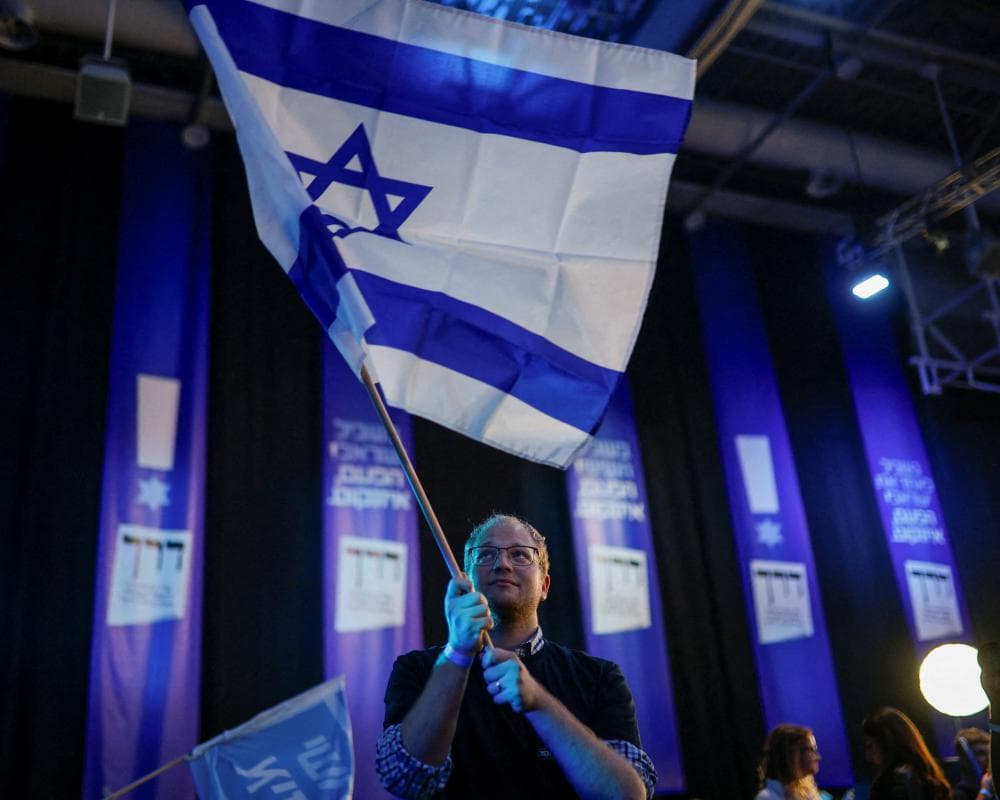
Benjamin Netanyahu has finally taken the stage at the Likud election night party in Jerusalem, just after 3am local time, telling his supporters official results will show that “Likud is the largest party in Israel”.
He has claimed that the right-wing bloc has a clear majority among the Jewish public, despite exit polls showing his grouping tied with the opposition bloc led by Gadi Eiesnkot.
He has told supporters that the country must “establish a strong, right-wing national government” – adding that a government that relies on the support of Palestinian parties must not be formed.
While Netanyahu’s Likud could emerge as the largest party, voters appear to have shrunk his bloc’s majority in parliament, jeopordising his return to power and pointing to potential weeks of political wrangling to form a government from either side.
Updated
A record number of Israeli’s are expected to have voted at “special polling stations” in 2026, casting more confusion into the mix as the results as these ballots are not expected to be announced before Thursday.
Under Israeli electoral law, each voter is assigned to a specific polling station and can only vote at that station. However in exceptional circumstances, some voters are allowed to cast their ballot at special polling stations they are not registered at. Among those afforded this exception are soldiers stationed at IDF bases, diplomats working abroad, prisoners and prison guards and people in hospital.
Ballot boxes from these special polling stations are transported directly to the Knesset where they undergo a series of checks before they are counted.
According to some reports, Israel’s Central Elections Committee expects between 600,000 and 650,000 people to vote in such a way, almost 10% of elegible voters and an unprecedented number in Israeli electoral history.
Netanyahu to speak soon, Israeli media report
More than four hours after polls closed, party faithful are waiting for Netanyahu to address his Likud party’s headquarters in Jerusalem.
Israeli media is reporting that the Israeli prime minister is set to speak soon, and live images on local TV show crowds of supporters and journalists gathering to hear from Likud's leader.
On a giant screen at the event a video montage has been playing showing the prime minister hugging Donald Trump alongside footage of military strikes from the assorted wars he has led since the Hamas attack.
Elie Pieprz told Agence France-Presse he was feeling optimistic about Netanyahu’s chances.
Usually things move more in our favour as the night goes on and as the morning approaches … I’m very optimistic. I feel the prime minister has performed better than some of the pre-campaign polls suggested.”
Nadav Eyal, a columnist in the daily newspaper Yedioth Ahronoth, has said that the revised exit polls show its going to be a long night for election watchers.
Historically, Israeli exit polls have tended to underestimate Likud, but shifts between blocs are usually limited to 2–3 seats at most.
Meanwhile a minister from Netanyahu’s party has told the Associated Press he’s cautiously optimistic about the results.
Amichai Chikli, minister for diaspora affairs for Israel’s government, said it was too early to celebrate the initial poll results but that the party was optimistic and had to be patient.
“One thing we know for sure, those who said Netanyahu is over, the Likud is over, celebrated too early,” he said.
Yair Golan, the leader of the Democrats, has hinted that the opposition bloc could include Palestinian parties in its coalition, according to Haaretz.
Golan, who represents the last remnants of Israel’s once dominant Labour party, has policies on Gaza and a two state solution, that track towards a more centrist position in Israeli terms.
Speaking to supporters, Golan said “every Knesset member elected in the democratic, legal process is a legitimate part of our political system. If there is a democratic majority to replace the government of destruction – we must actualise it.”
“We are ready to work with all our partners, bridge the gaps and take responsibility,” Golan added in a statement. “The public has spoken. Now it’s our turn to do the work.”
Updated
Two Israeli networks update exit polls to show Netanyahu and opposition blocs tied
Two Israeli TV networks have now updated their exit polls and are predicting that Netanyahu’s bloc will be tied with Eisenkot’s opposition grouping.
Kan 11 and Channel 13, two of the country’s leading broadcasters, have revised their exit poll to put the Netanyahu and Eisenkot blocs tied on 51 seats each. Channel 12, the other main broadcaster, has Netanyahu’s bloc on 50 seats and the opposition on 52 seats – narrowing their projections from earlier in the night.
A candidate needs 61 parliamentary seats to form a majority coalition government.
Exit polls released earlier on Tuesday evening had Eisenkot winning most seats in the Knesset by a slight margin. Israeli exit polls are often revised after publication and are notoriously imprecise, with the final count often swinging by several seats.
Earlier in the evening, Avigdor Lieberman, head of the Yisrael Beitenu party, warned supporters that the final results could still change after hundreds of thousands of absentee ballots cast by on-duty soldiers are counted in the coming days.
Updated
The Israeli election commission has began to release official results.
The commission has published the first batch of results. It says it has tallied just 2,670 of the more than 7.3 million ballots cast.
Ballots will be counted throughout the night, with clearer results expected in the coming hours.
Eisenkot: the Israeli public has voted for change and against Netanyahu
Gadi Eisenkot, the leader of the main opposition bloc, has said the Israeli public has voted for change and against Benjamin Netanyahu.
Speaking to supporters at his election headquarters, he said another election would be a mistake – and he would do everything to “fulfil the will of the people.”
Exit polls suggest that Eisenkot’s bloc has secured the largest number of seats, but has fallen short of the majority needed to form a government.
Today, Israel went out to a referendum over the leadership that will lead Israel in the coming years … The people decided in favour of change.”
In his speech, he also warned Netanyahu not to “use Israel’s security” for political ends, playing on fears that the prime minister could use this period of uncertainty to launch a new attack on Iran.
Updated
Analysis: Rise of Palestinian parties in Knesset will redraw Israel’s political landscape
The big gains made by Palestinian parties in Israel’s general election pose an urgent and fundamental challenge to the country’s mainstream opposition: either cooperate with Arab Israelis or hand Benjamin Netanyahu a roadmap to political survival.
In the wake of Tuesday’s exit polls, the leader of the opposition bloc, Gadi Eisenkot, declared them a victory for “Israel’s Zionist national majority” but the real outcome looks as if it will be far more complex than that.
The greatest change between the new Knesset and the old will be the dramatically increased representation of Palestinian parties, currently projected to win 17 to 18 seats, up from 10. That redraws the battle lines on Israel’s political landscape. Arab Israelis will not so easily be sidelined and ignored.
Eisenkot will argue that he commands the bigger overall bloc and has the better chance of negotiating his way to a Knesset majority. To do so, however, he and his partners in the “change” bloc would be obliged to sit down to talk with the Palestinian groupings, the Joint List and Ra’am (an acronym for the United Arab List).
They would probably find Ra’am and its leader, Mansour Abbas, easier to talk to. Abbas has already participated in a right-leaning government of Naftali Bennett, now a junior partner in the Eisenkot bloc. Abbas has shown willingness to make political compromises and stated emphatically on Tuesday that his priority is to “bring down Benjamin Netanyahu, Smotrich, and Ben Gvir in this election”.
However, most estimates based on the exit polls show Ra’am as the smaller of the two Palestinian groupings, with seven projected seats in the new Knesset and it is not clear that would be enough, even if a pact was made with the consent of the other members of Eisenkot’s bloc, to produce a majority government.
Negotiations with the Joint List, with 10 or more projected seats, would be tougher. Eisenkot has laid down four conditions: recognise Israel as a Jewish and democratic state, accept the values expressed in Israel’s declaration of independence, accept conscription for Palestinians Israeli citizens, who are currently exempt, and denounce Hamas as a terrorist organisation.
Speaking on Tuesday as the votes were being counted, Amjad Shbita, the general secretary of Hadash, the socialist party that is the biggest faction in the Joint List, said Eisenkot would be in no position to impose terms for coalition talks.
Related: Rise of Palestinian parties in Knesset will redraw Israel’s political landscape
Among the more surprising outcomes of the exit poll has been the forecast for the far-right Otzma Yehudit (Jewish Power) led by public security minister Itamar Ben-Gvir,
Ben-Gvir’s extremist, ultranationalist party was expected to better their result of six seats from the 2022 elections.
But there was stunned silence at the group’s watch party in central Israel as results from the exit polls flashed across the screen, with most channels suggesting the party would captur just six or seven seats.
Ben-Gvir attempted to revive his supporter’s spirits by reminding them of all he had achieved in the past four years to further their agenda, including passing a law approving the death penalty for Palestinians convicted of murdering Israelis and worsening conditions for Palestinian prisoners.
Ben-Gvir denounced other members of Netanyahu’s coalition for who had suggested a unity government with his main rival, Gadi Eisenkot, which the audience booed loudly.
This is precisely the scenario we warned against – it is a terrible mistake.”
-
This is Jonathan Yerushalmy, picking up our live coverage from Lucy Campbell.
Updated
The day so far
-
Counting is under way in what many Israelis have described as the most consequential election in their country’s history, and we expect the first round of official results to come through around 1am local time on Wednesday. It comes after record turnout had reached 77.7% as of 10pm on Tuesday, with the historic election marked by a record participation by Israeli Arab voters.
-
Exit polls suggest that a majority of Israelis have voted against Benjamin Netanyahu’s coalition, issuing a sharp rebuke to the prime minister, whose political and personal future hangs in the balance. His coalition bloc is projected to win only 50 seats, a loss of 14 since the 2022 election. And while his Likud party is narrowly projected to come out as the largest party by one or two seats, this still represents a loss for the party of 25% of its seats compared to the last election in 2022. Netanyahu is thus likely to fall short of the support required to form a new coalition. In an election widely seen as a referedum on his leadership since the 7 October 2023 Hamas attacks, Netanyahu has certainly lost his mandate.
-
His main challenger Gadi Eisenkot’s bloc, meanwhile, is projected to win 52 or 53 seats, and therefore also remains short of the 61 Knesset seats needed to make a majority. The former IDF chief would thus have to try to form a government with the support of the Israeli Arab parties, who are projected to win an unpredented 17 or 18 seats, though it is unclear whether that would alienate some of his political allies.
-
There is therefore no outright winner and no simple path to power for either Eisenkot or Netanyahu, and this result is likely to set off weeks of jockeying over who can form a coalition government before a prime minister is declared or another round of elections is called.
Voter turnout as of 10pm reaches 77.7% - highest in almost three decades
As we’ve been reporting all day, this election has seen historically high voter turnout.
As of 10pm local time, when the polls officially closed, turnout had reached 77.7%, per the Central Election Committee’s latest update.
The figure represents 5,695,682 individuals having cast their vote by this time. The committee said that is the highest percentage recorded at that time since 1999.
Updated
Israeli voters issue sharp rebuke to Netanyahu - snap analysis
So, Benjamin Netanyahu’s far-right coalition is indeed projected to lose its parliamentary majority.
If the exit polls are correct, his Likud party narrowly comes out as the largest party by a projected one or two seats, but this still represents a loss for the party of 25% of its seats compared to the last election in 2022. And what is more, Netanyahu’s coalition bloc is projected to win only 50 seats this time around, a loss of 14 since the 2022 election.
Gadi Eisenkot’s bloc, meanwhile, is projected to win 52 or 53 seats, and therefore also remains short of the 61 Knesset seats needed to make a majority. The former IDF chief would thus have to try to form a government with the support of the Israeli Arab parties, who are projected to win a staggering 17 or 18 seats, though it is unclear whether that would alienate some of his political allies. Eisenkot himself had ruled out such an arrangement before the election, but there is precedent for a deal still being made in what will no doubt be intense negotiations to come.
By contrast, analysts have argued that if the exit polls are correct, there is no clear pathway to power now for Netanyahu, unless he could somehow convince centrist parties to join his coalition. If not, he would also of course stay on in a “caretaker” capacity while opposition parties try to forge a governing coalition.
Updated
Israel foreign minister says opposition celebrations 'premature'
Israeli foreign minister Gideon Saar has said that opposition celebrations were “premature” after initial exit polls in this historic election projected a slight edge over Benjamin Netanyahu’s right-wing bloc but still short of a majority.
“The celebrations on the left are premature. The smugness of the biased commentators – ridiculous. One thing seems quite clear: [Netanyahu’s] Likud is the largest party in Israel,” he said on X, posting a video showing Likud’s first election win in 1977.
Israel election too close to call as exit polls give Netanyahu bloc slightly fewer seats
Israel’s election was too close to call on Tuesday night after a historic turnout by voters for an election described by some as the most consequential in the country’s history, and marked by a record participation by Israeli Arab voters.
Exit polls published on Tuesday evening suggested that the opposition bloc of parties led by the former chief of staff of the Israel Defense Forces, Gadi Eisenkot, would win most seats in the Knesset by a slight margin, edging out Benjamin Netanyahu’s right and far-right coalition despite the prime minister’s Likud emerging as the largest party.
The result is likely to set off weeks of jockeying over who can form a coalition government before a prime minister is declared or another round of elections is called.
After a day in which Israelis streamed to polling stations across the country, exit polls suggested Netanyahu’s ability to command the loyalty of a large core of Likud party voters remained undimmed despite his rejection by large numbers of his Israelis.
The predicted haul of up to 18 Knesset seats for Israeli Arab parties is likely to make them the kingmakers in what seem certain to be protracted talks to form a new government, with Netanyahu likely to fall short of the support required to form a new coalition.
The exit polls – if they prove accurate – suggest a struggle for either Likud or Eisenkot’s Yashar to find a road to a majority in the 120 seat Knesset. Likud’s projected showing, not for the first time, appears to have defied predictions in the run up to the vote.
What is clear, however, is that Netanayhu no longer has a claim to a mandate with his political fate in the balance.
Related: Israel election too close to call as exit polls give Netanyahu bloc slightly fewer seats
Former Israeli prime minister and Beyachad (Together) party canddiate Yair Lapid has said that Benjamin Netanyahu’s bloc has been told “to go home” in this election.
He wrote on X:
Don’t let anyone mislead you: the Netanyahu bloc suffered a crushing defeat. It is a total collapse, and the public has told them to go home.
in Tel Aviv
At the election night headquarters of the Yashar party, activists cheered the TV broadcast of exit polls showing parties making up the Jewish Israeli opposition bloc were ahead of Netanyahu’s coalition.
“There’s a lot of excitement and a lot of hope for Israel’s future now,” said Itay, a 28 year-old startup founder who had flown back from the US to campaign for Gadi Eisenkot, his first time getting involved in politics.
The excitement felt real, among activists and prospective Knesset members gathered at the National Sports Centre in Tel Aviv, even though Eisenkot’s own party was forecast to come in a couple of seats behind Benjamin Netanyahu’s Likud party.
“I’m really happy,” said Lia, 23, a medical student and activist, adding that she is still waiting for figures from the count, which might give Eisenkot a larger mandate. “I hope we can be even happier when the full results come in.”
The balance of seats in the Knesset are forecast to go to parties supported by Palestinian citizens of Israel in a historic high. Eisenkot has ruled out going into coalition with the Palestinian parties, but they have indicated they might support a minority opposition government.
Itay welcomed the strong Palestinian vote, which he said was a sign to the world that “this is a country where every citizen is equal”, and said he was hopeful deal could be reached to form a working government.
“I’m optimistic with the results everyone can have a shared vision, all the parties can come together. Everyone has to budge, because together we are stronger.”
Voters have ‘dismissed’ Netanyahu’s government, says Golan
The leader of the Democrats party, Yair Golan, has also given his reaction to the exit polls, declaring that Israeli voters have “dismissed” Netanyahu’s government.
He wrote on X:
The public has spoken; it has dismissed the Netanyahu government. We have been granted a historic opportunity to form a government of genuine change in Israel, and we have no intention of letting it slip away. We represent a vast public—people who have been fighting in the streets for four years, joining political parties, and going out into the field to persuade others. We will do everything in our power to ensure that such a government is established.
We are ready to work with all our partners, bridge the gaps, and take responsibility. The public has had its say. Now it is our turn to do the work.
Here are some reactions to the exit polls, which have projected that the opposition bloc led by Gadi Eisenkot’s Yashar party is set to win more total seats than Benjamin Netanyahu’s coalition.
Eisenkot says exit polls indicate 'complete lack of confidence in Netanyahu'
Here is Gadi Eisenkot’s reaction to the exit polls. He wrote on X:
Initial exit poll results indicate a complete lack of confidence in Netanyahu and the “October 7th government” among the Zionist majority and the majority of Israeli citizens.
If these are the final results, it constitutes a victory for the mainstream Zionist majority in Israel.
I will act immediately to carry out the will of the people, to replace the Netanyahu government, and to establish a Zionist government of national mobilisation as soon as possible.
Updated
Israel’s Channel 13’s exit poll also projects no clear winner, with the opposition bloc projected to win 53 seats, the Netanyahu bloc 50 seats and the parties representing Palestinian citizens of Israel 17 seats.
Broadcaster Kan News projected the same numbers.
Updated
Exit polls project no clear winner, as anti-Netanyahu bloc leads but Likud remains biggest party
Exit polls from Israel’s major TV stations have projected that a majority of Israelis have voted against Benjamin Netanyahu’s coalition, but his Likud party has emerged as the largest party.
The Channel 12 exit poll shows that the bloc of Jewish-led parties opposing Netanyahu has the biggest bloc, and is projected to win a total of 52 seats, compared to 50 seats for the parties supporting Netanyahu.
It also projects that Netanyahu’s Likud party will win 24 seats in the Knesset, while Gadi Eisenkot’s Yashar party is projected to win 22 seats.
Neither bloc is close to a 61-seat majority in the 120-seat Knesset without the support of the Palestinian-led parties, which also oppose Netanyahu and are projected in that poll to win a total of 18 seats, a record number for them.
Updated
Polls close in Israel after historic turnout in election that will determine Benjamin Netanyahu's future
It’s now past 10pm in Israel, which means polling stations across the country have closed after Israelis turned out in record numbers on a high-stakes election day that will determine the future of Benjamin Netanyahu.
A reminder that Israelis waiting in line at polling stations will still be allowed to cast their vote.
Israeli broadcasters are now set to air a set of exit polls, which will provide first estimates of the results. We’ll bring you all the latest on that as those come in.
What happens after polls close?
Polling stations across Israel are set to close in less than 35 minutes, when news tv stations will release their first exit polls giving preliminary estimates of how many seats each party has won.
The first lot of official results then won’t be released until after around 1am local time on Wednesday. And while the exit polls usually provide a reliable indication of how people have voted, they can also vary.
The current coalition is expected to lose its majority, but we won’t expect clear results quickly as the coalition nature of Israeli government means that even small changes in vote share will change coalition calculations. We therefore may not get fuller results until the next day or the day after.
The final tally is expected by 30 October and official election results are formally published a week after the election, on 4 November.
After the final tally is in, Israel’s president, Isaac Herzog, will consult party leaders on whom they want as prime minister and then tap the candidate he believes has the best chance of forming a government.
That nominee has up to 42 days to form a government.
No single party in Israel has ever won an outright majority, so governments are formed by a coalition of parties who can get to 61 seats – and negotiations on forming a government often take weeks. Every Knesset seat counts and small parties can have a big impact by becoming kingmakers.
If the nominee fails, others can get a chance to try. If no government emerges, another election is called, meaning Benjamin Netanyahu and his cabinet would remain in place as a “caretaker” government.
Updated
Voter turnout as of 8pm surpasses total of 2022 election day
It’s now just gone 9pm in Israel, and nationwide voter turnout as of 8pm was 74.3%, per the Central Elections Committee.
That is not only up from 66.3% at the same time in the 2022 election; that figure surpasses the 70.6% total recorded turnout on election day in 2022.
The governor of New York, home to the world’s largest urban Jewish community outside of Israel, has said that her job would get “a lot easier” if Benjamin Netanyahu loses this election.
In an interview with Politico, Kathy Hochul said:
I represent the largest [urban] Jewish population in the world outside of Israel. And I know they’re suffering. A lot of people are anxious about antisemitism, which is sky-high right now …
I went to Israel right after October 7. I saw a lot of pain there. But I actually cautioned the government there, in private conversations, not to overreach.
The world is with you when it comes to the brutal assault by … Hamas on innocent Israeli people. An overreach could change that dynamic, and that’s what’s happened.
We have to have leadership there that understands the security of Israel is paramount - critically important to me, but also the world - but to have a safe Palestinian state as well, which has been talked about my entire life.
I still believe that this can happen. I believe we have to get people of goodwill who can make this happen, and as long as Netanyahu is sitting there, that is not in his interest to do that. It’s just not, and it won’t happen.
Voter turnout by 6pm is highest on record
Voter turnout as of 6pm local time reached 66.7%, the highest ever by that hour since voting hours were first recorded, the Central Elections Committee said.
That is a 9% increase from the 2022 election at that time and Israel’s highest recorded turnout by 6pm.
Updated
Election committee rejects Netanyahu bloc request to extend voting hours
The Central Elections Committee decided not to extend voting hours beyond 10pm, rejecting a request submitted by Netanyahu bloc parties, Haaretz is reporting.
In a statement, the committee said it met this evening and decided “the current circumstances do not justify an extension”.
It added that the high turnout “reflects strong public engagement in the democratic process” and “no need to extend voting hours was identified”.
A reminder that, under Israeli law, the current rules do allow for a voter to cast their vote past the polling time, just as long they arrive at a station by 10pm.
Updated
As we’ve been reporting, a record number of Israelis cast their ballots in the first half of polling day, voting at polling stations across the country and in the Israeli-occupied West Bank.
By 2pm local time (it is now after 8pm), 44.9% of voters had cast their ballot – the highest turnout since record-keeping began in the 1970s.
My video colleagues have this report:
Is this the end for Benjamin Netanyahu? – podcast
It’s been described as an existential moment; a battle for the soul of a nation. With voting under way in Israel today, public opinion is divided on what the future of the country looks like. To his supporters, Benjamin Netanyahu has protected the country in a way no other leader could, taking on Iran, Hamas, Hezbollah and Houthis.
To his critics, Netanyahu is to blame for a catastrophic failure of security, leaving Israel more isolated, traumatised and no safer. Today, his most serious challenge comes from a candidate with little experience in office. Gadi Eisenkot is seen as humble, approachable … and honest. The former chief of staff for the Israeli military is promising a future without corruption. Thirteen months ago, his party didn’t even exist.
But after three years of war and upheaval, it’s clear that the consequences of today’s elections go way beyond Israel’s borders.
In the latest edition of our Today in Focus podcast, Emma Graham-Harrison tells Nosheen Iqbal about the stakes of the election and what it could all mean for the future of Israel – and for the Palestinians living under occupation.
Related: Is this the end for Benjamin Netanyahu? – podcast
Palestinian Israeli turn-out strong despite far-right's delaying tactics
In the Palestinian Christian town of Taybeh, Ahmed Tibi, the leader of another Joint List party, Ta’al, had a shouting match with one of the Israeli right wing party representatives over delays, complaining that a woman had fainted while waiting in line.
At a polling station in a Nazareth school this afternoon, an election worker, Bilal Sha’awan shrugged off the far right’s tactics as “childsplay”.
At 3pm there were no queues and a steady flow of voters. A representative of Itamar Ben-Gvir’s Jewish Power party, a young man dressed in the style of settler “hilltop youth”, dressed casually, with a knitted kippa and long sidelocks, strode past Sha’awan, but gave no comment.
Manar Hassan, an observer from Ra’am, the other significant Palestinian Israeli party, described the turnout as “amazing”.
“It’s never been this strong,” she said, adding that the reasons for the higher level participation were not hard to find.
“We witnessed a catastrophe in Gaza,” Hassan said. “Here we live in fear and anxiety. We need drastic change.”
Updated
Another hourly voter turn-out update. As has been well established by now this is the largest turnout on record (since the early 1970s when such things were first measured).
As of 6pm local time, 66.7% of eligible voters had cast a ballot. That’s a 9% increase since the last election in 2022.
We can also expect a surge in the Palestinian Israeli vote – which accounts for about 20% of the population – as they tend to vote after work.
We should hear shortly the decision of the Central Electoral Committee on whether they will grant the Netanyahu bloc’s request to extend voting hours past 10pm local time. At the moment, polls are due to close in about 2.5 hours.
Many Israelis abroad have flown back to vote out Netanyahu
Tens of thousands of Israelis who live overseas have flown back to Israel to vote. Around 800,000 eligible Israeli voters live outside the country, over 10 percent of the potential electorate, according to Ha’aretz newspaper, but only diplomats can cast a ballot overseas.
For everyone else, taking part in elections requires investing considerable amounts of time and money to fly back.
Yuval Schwarzfuchs, 26, travelled from Rio de Janeiro via Ethiopia, to vote for the Palestinian-led Joint List. “For me, its about equality for all,” he said. “I did what I had to do.”
He came to the Jerusalem polling station wearing a T-shirt with an image of Luiz Inácio Lula da Silva, the left-wing President of Brazil, who defied polls to win re-election at the weekend.
That victory gave some hope to opponents of Israel’s right-wing government.
“Netanyahu does have a good campaign but I think he will loose,” said Schwarzfuchs, who was at the polling station with his brother, who also voted for the Joint List.
Up to 67,000 voters may be returning to Israel, according to AID Coalition, a U.S.-based nonprofit focused on strengthening Israel’s democracy, so this constituency could be key in a tight race.
In Israel’s proportional representation system, a few thousand votes can have a significant impact on results and around 40,000 votes is expected to secure a seat in the Knesset.
AID coalition organised a “Fly&Vote” initiative to support Israelis who wanted to return for this election, and their figure is based on surveys and registration data. About half of returnees are flying in from the United States, with others from Europe, Canada, Australia and New Zealand.
The project is bipartisan, and not everyone returning to vote opposes the current government, but anecdotal evidence suggests many are opposition supporters who share the view that Israel faces an existential choice.
Monica Moria, 58, and her husband Ron Moria flew in to Tel Aviv from Barcelona. Then they took a train to the kibbutz Kabri in northern Israel, where she is registered to vote, where Moria cast her ballot for the most left-wing of the Jewish Israeli parties, the Democrats.
There were at least five other people at the kibbutz who had flown in to vote, including one who came from Australia and another from the United States.
It feels like Israel has lost its way, there are deep divisions and hatreds that will be very difficult to heal. The idea is to bring a political change so that we can bring Israeli society together again. I want to be optimistic, but I am also afraid.
Kobi Mizrahi, 35, who’s been completing a PhD in New York said he had paid more than $1,600 to come back to Israel for just a few days.
Given the fact that it feels like a “now or never” moment, where if we lose these elections to the Bibi coalition, this might be the turning point we can’t come back to. I felt like I have to do anything in my power to help.
He said the Netanyahu government had abandoned their basic responsibilities, in security, education, transport. “The government isn’t working for us [but] only to maintain political power”.
Unfortunately in the past years things have become worse and worse, and in particular after October 7th, when we needed the government the most. Continuing in this direction may bring us, in every aspect, to a point of no return. This is true politically (with extreme parties gaining more power), economically, and morally. The goals of politicians like Betzalel Smotrich to expand settlements in the West Bank hurt all other Israelis in every aspect of our life.
More right-wing, Netanyahu-bloc parties request voting time extensions
Amid the record turnout, other parties in the Netanyahu coalition camp have joined his Likud party’s request for voting hours to be extended. At the moment, polls are due to close in just under three hours, by 10pm local time.
Shas, led by Aryeh Deri, and Amcha Yisrael, led by Ofer Winter, have requested one-hour extensions until 11pm.
Shas said it had requested the extension to “prevent a situation in which citizens waiting in line would be unable to vote.”
However the current rules do allow for a voter to cast their vote past the polling time, just as long they arrive at a station by 10pm.
What had polls shown?
Most polls show Netanyahu’s Likud and his current coalition parters losing their majority. That fall in voter support has been fairly consistent for more than two years.
They also show a clear anti-Netanyahu majority.
However, those opposition seats are divided between the bloc of Jewish Israeli parties, led by Eisenkot’s Yashar, and parties representing Palestinian citizens of Israel.
The Jewish Israeli parties are unlikely to have a majority on their own, but have mostly ruled out going into coalition with Palestinians.
Palestinian politicians have indicated they might support a minority government of the Jewish Israeli parties in order to unseat Netanyahu’s far-right coalition.
While Jewish Israeli and Palestinian Israeli parties teaming up to form a coalition is seen as a bit taboo – particularly after anti-Arab sentiment rose in the wake of the October 7 attacks – it is not unprecedented.
The Ra’am leader, Mansour Abbas, in 2021 took his party into a historic coalition government with Naftali Bennett, now part of the opposition bloc, and Netanyahu himself had previously started coalition negotiations with Abbas.
Polling from Channel 12 on the weekend showed too that among the ‘Change’ bloc – what Eisenkot, Bennett, Galan and Liberman are calling their alliance – 60% of voters would prefer a minority government formed with the support of Ra’am from the outside, compared to 20% who would favour repeat elections, and 10% who would want the opposition to unite with Netanyahu.
Related: What you need to know about the most consequential election in Israel’s history
Here’s a round-up of the some of the party leaders and politicians casting their votes today. If I’m missing a few that’s because I haven’t seen pictures of them voting yet.
Netanyahu bloc
The anti-Netanyahu bloc
Opposition calls Netanyahu request to extend voting hours 'groundwork to challenge election integrity'
His Likud party said in the past hour they’d requested an extension to voting hours from electoral authorities.
He and far-right allies have been running a racist scare campaign today, urging their base to show up to a vote which they claimed was being “stolen”.
The main opposition party leading in the polls, Yashar, has come out saying it “firmly opposes” any extension to voting hours. Polls are open for roughly another 3.5 hours, until 10pm local time.
Gadi Eisenkot’s party called it an attempt to “lay the groundwork for allegations challenging the integrity of the election”.
The Central Election Committee (CEC) – the country’s electoral authorities – is meeting in an hour to consider the request.
There have also been several complaints filed by political parties in the anti-Netanyahu bloc to the committee today.
-
Yashar said it had contacted the CEC following reports some of its ballot slips had been removed or damaged at polling stations
-
Naftali Bennett’s Together ( B’Yachad) party said it had received reports that an app was being used to monitor voters at polling stations in northern Israel
-
The Civil Election Guard, a volunteer force of election monitors, said ballot slips for the Haredi Public party in ultra-Orthodox communities had been removed from voting booths or hidden underneath other parties’ papers, according to Haaretz reporting.
Updated
Israelis are turning out in record high numbers to vote in an election that many describe as critical. The urgency among opposition voters is even higher than supporters of Netanyahu and his coalition, analysts say.
One of the voters who considers this an existential moment for Israel is Nir Honi, who changed his name by deed poll and has spent eight days inside a small stone circle outside the president’s residence, dressed in biblical- style clothing, in a one-man call for change.
His protest harks back to the story of a first-century Jewish scholar named Honi who convinced God to end a drought with a similar protest.
“(Honi) drew a circle around himself with a stick, and said ‘dear God, I will not move from here until you have mercy on your children and bring us rain’,” the newly renamed Nir Honi said. “My problem is not rain, its a more spiritual issue.”
“We have been in a continuous disaster since October 7th 2023,” he said.
We did not learn anything, we did not investigate, the same government continued and they want to continue for four more years.”
So eight days ago the long-term activist changed his last name to Nir Honi and launched his protest. He has left only once, to vote.
On Monday, which is called the day of the prayer for rain, I came here, I drew a circle in front of the residence of the president of Israel and I said, ‘Dear God, I will not move from here until the October 7th government moves’. From that moment on I have lived in this small circle.”
The Palestinian Israeli vote is a critical camp in this election, representing about one fifth of all eligible voters.
Their votes are expected to go to either Ra’am, led by Mansour Abbas, or Joint List, an electoral alliance of Palestinian-Israeli parties.
But for them them, change will not be straightforward, as my colleague Julian Borger in Nazareth writes.
Even if the opposition bloc led by Gadi Eisenkot wins more seats than Netanyahu’s coalition, it is not expected to win an outright majority on its own, and it has so far ruled out going into coalition with the Palestinian Israeli parties, who could well hold the balance of power ones the votes are counted.
Amjad Shbita, the general secretary of Hadash, the leading party in the Joint List coalition, thought that the Eisenkot’s approach might change after the elections.
“He cannot sit down [in coalition] with Netanyahu, and he won’t want to go back to another round of elections, so we think he can be flexible,” he said.
Updated
'We feel racism at all levels - today we have the opportunity to change the government' - Palestinian Israelis
In Nazareth, the largest Palestinian-majority town in Israel, the turnout at polling stations has been noticeably stronger than last elections.
By 2pm the turnout was over 32%, up from 28% at this time four years ago.
That was still below the average Jewish turnout across the country, but a surge of evening voting is expected here as voters come home from work.
At the headquarters of the Joint List, the biggest coalition of Palestinian-Israeli parties, the most pressing concern was the spoiler tactics of far-right election monitors at the predominantly Palestinian polling stations.
“They can say that they want to check all the voter numbers and identity and everything, so they can slow things down, so that people wait a long time and give up. That’s their intention,” Amjad Shbita, the general secretary of Hadash, a socialist movement which is the leading party in the Joint List coalition.
At the worst, these tactical ploys have slowed the process down so that it took 30 minutes to vote, rather than just a couple, he said.
The Joint List sent its workers out to the polling station to provide water and folding chairs so that voters would not lose patience and go home.
Shbita said that Palestinian Israel motivation is strong enough to overcome such obstacles.
“It is the first time for a long time that a government has stayed in office for its full term, four years,” he said.
“We are talking about one of the worst governments when it comes to Arab society. We feel racism at all levels of Israeli society, in hospitals, in buses, in public transportation, in the media. So people understand that today we have the opportunity to change the government.”
Voter turn-out is shattering all records. 55.7% of eligible Israelis had cast their votes by 4pm local time, according to the latest numbers from the Central Elections Committee.
That’s an 8.2% increase from the 2022 vote.
Polls are open until 10pm local time, after which the first exit polls will come out.
Updated
Israel goes to the polls – in pictures
Voters have turned out in droves at polling stations across the country.
Related: Israel goes to the polls – in pictures
Robo calls and a socials onslaught: The Israeli right's racist scare tactics on election day
Amid the highest voter turnout in decades, Israeli Prime Minister Benjamin Netanyahu and his allies resorted to racist scare tactics, including unsubstantiated allegations of election fraud, to urge their own voters to the polls.
“We’re in a war for our home,” Netanyahu said in a social media post in the early afternoon, with unsourced claims of low voter turnouts in strongholds of his Likud party. “Muslim Brotherhood supporters are raiding the polling stations and stealing the elections. Go out and vote, recover it!”
In 2015, Netanyahu claimed that “Arab voters are coming out in droves to the polls” in a bid to motivate his party’s base. The comments drew a rebuke from then-US President Barack Obama and Netanyahu apologised for them soon after winning another mandate.
A decade later he is doubling down on that political tactic. A robo-call to voters purporting to come from the prime minister made groundless accusations that Palestinian citizens of Israel were trying to “steal the election”. A spokesman for Netanyahu did not respond to questions about the call.
In the call, a man who sounds like the prime minister falsely claims that three leaders of the Ra’am party had been caught with envelopes full of cash. He also says that left wing women were driving Palestinian women to polling stations, which is not illegal under Israeli law.
He finishes by urging his own voters to turn out. Polling day is a holiday for most Israelis, who often use it to go to the beach, hiking or other activities with their family.
“You need to go to the polling stations. Everyone needs to vote. There is no beach. No barbecue, there is nothing (else) now,” it says. “Everyone must go out to vote to ensure the victory of the right against the left.”
Earlier he shared photos that purported to show empty polling stations in Likud-supporting areas, and long lines in opposition strongholds. The Guardian saw long queues on Tuesday morning in areas with high support for Netanyahu and his allies, including parts of Jerusalem and the settlement of Efrat.
After casting his own ballot, far right Jewish supremacist Itamar Ben Gvir went to a Palestinian- majority town to make similar claims. “Now in Kfar Qasim. Don’t let them win”, he posted above a social media video filmed on the outskirts of the town, the site of a notorious massacre by Israeli border police in 1956.
“Voter turnout in the Arab sector is off the charts, unprecedented.” he says. “If you want this country to remain Jewish and Zionist...then get out and vote.”
Updated
US ambassador clarifies 'Arabs vote same as Israelis' post
The US ambassador to Israel Mike Huckabee has just issued a clarification on his election day tweet this morning which prompted a few raised eyebrows. Earlier he’d written on X:
Today is election day in Israel, which is a national holiday. All voting is in person, ID required. No mail-in or absentee ballots. Arabs vote same as Israelis. Contentious process, but it’s a democracy-not many of those in this region!
The “Arabs vote same as Israelis” phrasing was perceived by some as appearing to imply that Arab voters in Israel aren’t Israeli or due the same vote.
Huckabee’s since posted a follow-up, agreeing with Axios journalist Barak Ravid who pointed out “Mr Ambassador, the Arabs who vote are Israelis…”.
"Correct and I should have stated it that way!” said Huckabee.
10 million ppl in 8m Jews, 2m Arabs. ALL are Israeli citizens-Jew, Muslim, or Christian. All vote, serve in IDF, in Knesset, & proudly have Israeli passports. Women equal to men. All have free speech.
As we reported earlier though, there are serious concerns about voter intimidation of Palestinian citizens in Israel - who represent about 21% of the population – and suppression of Arab parties.
So far today, Ra’am, the party headed by Mansour Abbas, has filed a complaint to the Central Elections Committee, saying their activists were detained by police this morning before voting began and there weren’t enough Arab language ballot papers being distributed, according to Haaretz reporting.
Huckabee’s comments were also likely only referring to the roughly 7 million Jewish Israelis and 1.7 million Palestinian citizens of Israel who live within the country’s pre-1967 borders and have full voting rights.
Of the 15 million people who live in areas under Israeli control, more than 5.5 million Palestinians have no vote including 3.1 million Palestinians in the occupied West Bank, 350,000 Palestinians in occupied East Jerusalem and 2 million Palestinians in Gaza.
Voter turn-out for first half of day highest on record
We’ve reported on how many Israelis are viewing this election as one of the most important of their lifetime, and politicians across the spectrum have characterised it as “existential” for the future of the Israeli state.
That urgency does appear to be translating into record turn-out at the polls according to latest figures from the Central Elections Committee.
As of 2pm local time, 44.9% of voters had cast their ballot. This is the highest turn-out since record keeping began in the 1970s.
The voting level at this hour is also about 6% higher than the last election in 2022, where Netanyahu was ultimately able to scrape together a slim majority coalition with far-right and ultra-Orthodox parties.
The queues are so long today that the electoral authority has also issued fresh guidance on how to ease congestion; advising polling staff to start verifying voters’ IDs while they’re still in line.
Voting is open until 10pm local time and any eligible Israeli who arrives by a polling station by then can cast their vote. As we’ve reported, many eligible voters have also flown back into the country for the sole purpose of making their ballot count today.
Updated
Summary of the day so far...
It has just gone past 3pm in Tel Aviv and 1pm in London, where we are currently blogging from. Here is a summary of where things stand:
-
Turnout is at its highest so far in decades as Israelis vote in what is widely considered to be one of the most consequential elections in the country’s history.
-
Polls have opened in the first election since the Hamas-led attacks of 7 October 2023, Israel’s subsequent destruction of Gaza, and the launch of its war with the US against Iran.
-
Tens of thousands of Israelis living abroad have flown in for the elections, according to Aid Coalition.
-
Exit polls are released at 10pm Israeli time (8pm GMT), and the first indication of actual voting counts usually emerges in the early hours of the morning.
-
Israeli prime minister Benjamin Netanyahu’s main rival is Gadi Eisenkot, a former head of the Israeli military and relative political newcomer.
-
A consistent majority of Israeli polls show Netanyahu’s coalition bloc with the ultra-Orthodox and the far right will fall below the threshold of 61 seats needed to form a government.
-
But even though there is a clear anti-Netanyahu majority, polls indicate that the Jewish Israeli opposition bloc will also fall short of the required seats, meaning weeks or even months of political wrangling may be in store as parties make deals and trade concessions.
-
There was a suspected attempted stabbing of the leader of the Democrats party, Yair Golan, at HaMesila park in Tel Aviv, earlier today, the party said. The security guards “subdued” the suspect before he could do anything, the party said in a statement. The suspect was subsequently arrested.
-
The Central Elections Committee told reporters earlier that there had been no indication of widespread irregularities.
Updated
Israeli prime minister, Benjamin Netanyahu, has continued to urge right-wing voters to go out and vote, claiming that if they don’t then a new government will be formed with parties representing Palestinian citizens of Israel.
“Buses are heading to the polling stations, and huge lines are being reported in the Arab settlements,” he wrote in a social media post that appears as if it is part of a scare campaign.
“If we don’t go out to vote now, we’ll find ourselves with a government of the Arab parties. We must not stay home. Every vote counts!”
The Central Elections Committee told journalists earlier today that there had been no indication of widespread irregularities.
In an earlier post, we mentioned that, as of 10am local time, turnout in the Israeli general election was at its highest point at that stage of voting since 1981.
We now have some more figures from the Central Elections Committee, which appear to confirm the trend, with the new data showing that 31.5% of Israelis voted by noon, the highest voter turnout by midday since 1977.
In the settlement of Efrat near Jerusalem, Shani, 19, had come to the polling station with her parents, to cast her vote for the far-right party of finance minister Bezalel Smotrich.
She is part of a large cohort of first-time voters who are more rightwing than older generations, and may help bolster support for Benjamin Netanyahu and his far-right coalition partners.
More than 500,000 Israelis have reached voting age since the last election in 2022, and three-quarters of first-time Jewish voters define themselves as right or centre-right, a recent poll for Channel 12 television found (it did not survey Palestinian citizens of Israel).
Shani said she chose Smotrich, a settler himself, for his promises to expand Israel’s footprint in occupied Palestine. “Smotrich is pushing forward with settlement expansion and improving security,” she said.
Her mother, kindergarten teacher Rivka, also voted for Smotrich, and said her priority was to return Netanyahu’s coalition to office.
“The right must win, because otherwise there is a chance of a Palestinian state, which will be very bad for Jews,” she said. Her husband Motti, who runs a healthcare standup had voted directly for Netanyahu. “He’s a diplomat, he’s strong. He’s got whatever leadership should have.”
Spiralling attacks by militant Israeli settlers on Palestinians, and the growing threat of sanctions on settlement goods and construction, were not a key election issue for voters in Efrat who spoke to the Guardian.
Software engineer, Yitzchak Schwarz, 36 is an activist for far-right libertarian Moshe Feiglin, running on a joint slate with Smotrich for this election. “If there are sanctions, it’s going to hurt a bit, but we have to think about our own survival and our own national rights,” he said.
Sue and Tom Rosenfelt, who have lived in Efrat for over 30 years and have three sons in the reserves, said national unity and the unequal burden of military service are their main concerns. “I think that at this point getting another foothold and another hilltop isn’t the thing that’s going to strengthen the country as a whole,” Tom said. “We need to work more on unity.”
In an election which many Israelis describe as critical, turnout was so high at their polling station at a school in Efrat that they had left the long lines, and planned to come back later.
Both plan to vote for the party of Naftali Bennett, a rightwing settler and tech multimillionaire, who joined forces with centrist Yair Lapid. “I feel like this is a time when we need to come together,” Sue Rosenfeld said. “You know, Bennett and Lapid are on different sides of the spectrum, but they’ve come together and that’s something I want to support.”
Updated
Suspected stabbing attempt against Yair Golan foiled at Tel Aviv event, party says
There has been a suspected attempted stabbing of the leader of the Democrats party, Yair Golan, at HaMesila park in Tel Aviv, the party has said in a statement.
During a voter mobilisation tour, the party said “an unidentified man wearing a jacket” approached Golan in a “threatening manner”.
A statement from the party read:
Golan’s security guards blocked the man, and as they moved toward him, a large knife slipped from beneath his clothing and fell to the ground.
The security guards immediately subdued him before he could do anything. Police were called to the scene and arrested the suspect.
In a statement, Golan said:
“Incitement and violence will not deter us. This is the direct result of the poison machine operated by Netanyahu and his Qatari agents. I call on everyone who cares about security and democracy to go out and vote now, so that we can ensure the country we love so dearly becomes a free and safe place once again.”
Golan fought a long legal battle to get security protection from the Shin Bet security service. They only resumed responsibility for his security on Monday, the day before the elections.
Updated
While the media attention has been focusing on the country’s parliamentary elections, Israel’s assault on Gaza has continued, a year after the signing of a so-called ‘ceasefire’ with Hamas.
A UN commission said yesterday that Israel was continuing to commit genocide in Gaza despite the signing of the US-brokered ceasefire last October.
The report by the UN Independent International Commission of Inquiry on the Occupied Palestinian Territory, including East Jerusalem, and Israel, rejected a claim in May by Donald Trump’s Board of Peace that the truce had “largely held”.
It said Israeli authorities had kept committing “genocidal acts with the genocidal intent to destroy, in whole or in part, the Palestinians in Gaza”. The report said:
The perception of Palestinians and a possible Palestinian state as a threat to Israel and the desire to reduce the Palestinian population contribute to a permissive military culture where Israeli soldiers, with or without directives from commanders, directly target Palestinians whether or not they pose a real or immediate threat.
Testimonies by Israeli soldiers in Gaza display a disregard for Palestinian lives and a military culture where Palestinians are dehumanized, equated with “terrorists”, trivializing the killing of civilians.
The report noted that between the 10 October ceasefire in 2025 and 30 September 2026, Israeli attacks killed at least 1,431 Palestinian people in Gaza, including 300 children and 130 women.
In its latest update, Gaza’s health ministry said that 74,561 Palestinian people have been killed in Israeli attacks across Gaza since October 2023, when Isreal launched its assault on the territory following the Hamas-led attack on southern Israel on 7 October 2023, in which about 1,200 people were killed.
The report also accused Israeli forces of having committed crimes against humanity in the West Bank. It lists extermination, torture, rape and other forms of sexual violence. Israel has dismissed the findings of the report and has denied committing genocide in Gaza.
Netanyahu casts his ballot and urges his supporters to vote, saying 'this is an emergency hour'
Benjamin Netanyahu, who is fighting for his political survival, has just cast his ballot in Jerusalem.
In a post on X this morning, the Israeli prime minister wrote “right-wing voters, this is an emergency hour” as he urged them to get out and vote to counter any left electoral gains.
“Higher-than-usual turnout rates in the left’s strongholds. Right or Palestine, for real,” Netanyahu wrote.
Updated
Police believe the arrest of three people in southern Israel who are suspected of being involved in voting bribe attempts was a single incident and not part of a larger campaign, according to Dean Livne, acting director-general of the Elections Committee.
Updated
Early voting figures show highest turnout in decades
Citing figures released by the Central Elections Committee, the Israeli newspaper Ynet is reporting that voter turnout in the election reached 16.68% by 10am local time (8am GMT), the highest level recorded at that hour since 1981.
Over 1.2m Israelis had cast their ballots by 10am, according to the data, a rise of 0.78 percentage points compared with the same stage of the previous election in 2022.
Updated
In Sanhedria cemetery in north Jerusalem, ultra-orthodox voters came to the tombs of revered rabbis before they cast their ballots. There was no question of which way they were going to vote: for the parties representing Ashkenazi and Sephardic ultra-orthodox. But some at the Sanhedria cemetery, the young especially, made clear they only would do so reluctantly.
Yair Shuker, aged 19, said only one issue was important to him. “The election is about whether we will live by the Torah, or there will be no Torah. There will be a Jewish state or there will be no Jewish state,” he said.
And for him - as with almost all Israel’s ultra-orthodox (the Haredim) - the critical measure of the state’s level of observance is whether the Haredim would continue have exemption from military service.
“There are some who study the Torah, and some who stand and defend the land,” Shuker said.
The exemption for ultra-orthodox religious students dates back to the founding the state, but has long been a sort of tension among Israeli Jews, all the more so since the 7 October attack in 2023 and the start of the Gaza war. Israel’s supreme court ruled in 2024 that the blanket exemption for haredi men had no basis in law.
In return for their support in keeping him in power, Benjamin Netanyahu promised the ultra-orthodox parties (the Sephardic party Shas and the Ashkenazi United Torah Judaism) new legislation that would perpetuate the exemption, but has failed to deliver on that promise due to splits in his coalition. As a result both parties left the government, though Shas remained part of the coalition.
Whatever their feelings about Netanyahu, both would vote against a secular-led government led by the current opposition parties, which have pledged to end the exemption once and for all, and enforce military service if necessary.
Shuker said he did not trust either coalition, but would vote because he had been told to. “The rabbi has asked us to vote for Shas, so I will vote,” he said. A 23-year-old Ashkenazi ultra-orthodox, who identified himself as Yaacov K, expressed the same sense of disillusion mixed with duty. He said:
I’ll tell you the truth. To me and most of the people around me, we don’t believe in anyone.
If you’re asking me, I’ll never go and vote. But I have a rabbi and the rabbi told me listen, you have to go and vote. And if he says you have to go and vote, then that’s what I do. I don’t even start thinking if it’s worth it for me or not worth it for me.
The open distrust and contempt for Netanyahu, coupled with obedience and party discipline, could be one reason that the prime minister’s bloc has over-performed by a seat or two in past elections, compared to his poll numbers. That could be crucial if the pattern is repeated.
Azriel Zadok, a rabbi who had come for morning prayers at the Sanhedria cemetery, argued that the mass ultra-orthodox vote was essential to preserve Israel’s Jewish identity from “the left”.
“We have no problem with the secular. We pray for them, and we pray for the soldiers,” Zadok said. “Our problem is with the leftists we are trying to decide for us how we should live.” “They want us to go to the beach on Saturday and they want us to marry outside our faith. We want to remain Jews,” the rabbi added.
The centre left is only a small part of the opposition bloc, and it does not propose to change the ultra-orthodox lifestyle. But the bloc is united on the insistence that the Haredim should do their part in the defence of the nation. It is the most divisive issue among Israeli Jews voting today.
Updated
According to Israel’s Hareetz newspaper, United Arab List (Ra’am), an Islamist party headed by Mansour Abbas, has filed a complaint to the Central Elections Committee, alleging that a systematic campaign has been launched to disrupt voting for the party.
In a statement, the party said police arrested several of its leading activists in southern Israel’s Negev region before dawn with no clear justification, according to Hareetz.
The party also said there is a widespread shortage of its Arabic-language ballot slips in several areas, including the cities of Nazareth and Shfaram in northern Israel. We have not yet been able to independently verify these claims.
Updated
About 15 million people live in areas under Israeli control. Just over 7 million Jewish Israelis and 1.7 million Palestinian citizens of Israel live within the country’s pre-1967 borders, known as the “green line”, and have full voting rights.
In the occupied West Bank, more than 500,000 Israeli settlers can vote. They live among 3.1 million Palestinians who are subject to military rule and do not have the right to vote.
In occupied East Jerusalem more than 230,000 Israelis with voting rights live among 350,000 Palestinians who cannot vote.
Two million Palestinians in Gaza, who live under Israeli military occupation, according to the international court of justice, also have no vote.
How does the system work and when might we get results/a new government?
The Knesset, the Israeli parliament, has 120 seats, with lawmakers voted in through a system of proportional representation. No single party has ever claimed a majority of 61 seats, so Israel has always been governed by coalitions.
When the results are in, the president invites the party with the largest number of seats to try to agree a governing coalition. Exit polls are released at 10pm Israeli time (8pm GMT), and the first indication of actual voting counts usually emerges in the early hours of the morning.
Getting full results could take much longer, with the outcome potentially hanging on the electoral fortunes of two small parties, which need to win 3.25% of the overall vote to take up seats in the Knesset. Polling puts both around this threshold. If they cross it, they each get four seats, which would have a significant impact on coalition building options.
The far-right Amcha Yisrael is led by the former general Ofer Winter, who has pledged to back Netanyahu for prime minister if he gets into the Knesset. The Reservists is a rightwing Zionist party focused on ensuring universal conscription whose leaders sit between the two blocs.
They have ruled out joining any government supported by either the ultra-Orthodox – key Netanyahu allies – or Palestinian parties whose backing Gadi Eisenkot is likely to need. If it goes down to the wire, counting could take more than a day.
Updated
Palestinians with Israeli citizenship constitute about a fifth of the population but are consistently under-represented in the parliament.
Benjamin Netanyahu and most of his chief rivals have said they won’t form a coalition with parties (broadly) representing Palestinian citizens of Israel - even if that means political gridlock.
But after the votes are counted these parties could hold a critical balance of power, as my colleagues Emma Graham-Harrison and Quique Kierszenbaum highlight in this story. Here is an extract from their report:
Palestinian citizens of Israel are forecast to secure between 12 and 15 seats, divided between the Islamist Ra’am and the Joint List alliance of three smaller parties, Hadash, Balad and Ta’al.
The mathematics of power are clear, even though most of the Jewish Israeli opposition has ruled out a coalition with Arab politicians, and Netanyahu and his allies have been doing everything they can to make such an alliance politically toxic.
There is recent precedent for breaking promises not to work with Palestinians, however. The Ra’am leader, Mansour Abbas, in 2021 took his party into a historic coalition government with Naftali Bennett, now part of the opposition bloc, and Netanyahu himself had previously started coalition negotiations with Abbas.
One prospective voter, Mohammed, works at a hi-tech company, managing both Jewish and Arab employees, which he sees as a template for a different future for Israel.
Although disappointed that most Jewish Israeli opposition parties have ruled out a coalition with Palestinian parties, he understands the political logic, and he expects their position to shift once results are in.
“At the end of the day, everything is mathematics, right? One plus one is two. They cannot do anything without [those seats]. So they must do [some kind of deal] and they will do it.”
Updated
Who are Netanayhu's main opponents in the general election?
A consistent majority of Israeli polls show prime minister Benjamin Netanyahu’s current coalition bloc with the ultra-Orthodox and the far right will fall below the threshold of 61 seats needed to form a government.
But even though there is a clear anti-Netanyahu majority, polls indicate that the Jewish Israeli opposition bloc will also fall short of the required seats, meaning weeks or even months of political wrangling may be in store as parties make deals and trade concessions.
So who are Netanyahu’s leading rivals in the race?
-
As we have mentioned in a previous post, the man leading the field to potentially replace Netanyahu, Gadi Eisenkot, is a former head of the Israeli military who formulated the notorious Dahiya doctrine of using “disproportionate force” to cause damage and destruction.
-
Naftali Bennett is a former prime minister and former chair of the settler council, who supports annexing much of the West Bank.
-
Avigdor Lieberman wants to dismantle the Palestinian Authority and replace it with an Israeli-Jordanian confederation (though apparently he did not consult the Jordanians about this plan).
-
The Democrats, the only remaining political home for Israel’s Zionist left, are led by Yair Golan, a former general and deputy head of Israel’s military.
Across Israel, voting is now under way. Here are some of the latest images being sent to us over the newswires:
Updated
Tens of thousands of Israelis living abroad have flown in for the elections, according to Aid Coalition, a US-based nonprofit focused on strengthening Israel’s democracy. Israeli law generally requires citizens to vote in person in the country, with narrow exceptions for diplomats and certain official emissaries abroad.
It’s unclear what effect these voters might have, but many liberal Israelis who don’t support prime minister Benjamin Netanyahu have left the country in recent years, suggesting that those returning to cast ballots may not support him.
Aid Coalition estimates that as many as 67,000 voters are returning to Israel. It says about half are flying in from the US, with others from Europe, Canada, Australia and New Zealand.
The Associated Press spoke to some Israelis planning to travel, who said they felt a sense of obligation to try to preserve Israel’s democracy.
Yael Natra said she had never considered returning to vote in her home country’s elections as she felt it wasn’t right to cast a ballot in a place she no longer lived. However this year she plans to cast her ballot for parties not aligned with the current government led by Netanyahu.
The Israel that I grew up in is disappearing … If something won’t change this time, I don’t know what’s going to be.
Hadar Susskind said he wants a new Israeli government to reverse course in the West Bank and Gaza. He and four relatives who live in the US were flying back to “reaffirm Israel’s democracy,” he said.
This government is digging the hole deeper every day … The first thing the new government needs to do is put the shovel down.
Updated
Israel’s president Isaac Herzog has voted in Jerusalem.
Herzog will play a crucial role in the days to come. After the final results are in, he will consult party leaders on who they want as prime minister and then invite the candidate he believes has the best chance of forming a government to try to form a coalition.
That nominee has up to 42 days to form a government.
Updated
Families bereaved in the 7 October attacks began election day with a protest at 6.29 am, the same time Hamas launched its attack just over three years ago.
They gathered in the Tel Aviv plaza that has become known as “hostages square”, because it was the centre of demonstrations demanding the return of over 200 captives from Gaza.
Holding pictures of their loved ones, they observed a minute of silence, then called on voters to remember the losses and betrayals of that day as they choose the next government.
“Three years after the massacre, our loved ones will not be voting today. Go out and vote – remember them at the ballot box. This is what these elections are about!” the group said in a statement.
They are not explicitly backing any political party, but one of their key demands is a State Commission of Inquiry into the attacks.
Prime minister Benjamin Netanyahu has strongly resisted the prospect of an impartial probe, and it has become a rallying point for the opposition parties trying to unseat him.
Two days before the vote, relatives of the dead released a video making the same demand.
‘There’s a lot of racism, a lot of hatred’: Far right gains predicted as Israel heads to the polls
Four decades ago, when the extremist rabbi Meir Kahane won a single seat in Israel’s Knesset, other legislators passed a law to prevent him running again, left the chamber when he rose to speak and worked together to block discussion of his ethnonationalist proposals.
These ranged from mass expulsions of Palestinians to apartheid provisions such as segregated beaches and the criminalisation of sex between Jews and gentiles.
This month, Kahane’s political heirs may claim more Knesset seats in national elections than the remains of the once mighty Labor party, home of Yitzhak Rabin, Shimon Peres and Golda Meir.
At an election rally this week, Israel’s national security minister, Itamar Ben-Gvir, mixed calls for ethnic cleansing and jokes about starving Palestinian prisoners with a proud anecdote about his conviction in 1998 over bumper stickers that read “Rabbi Kahane was right”.
A poll for the Israel Hayom newspaper, published on 16 October, forecast his Jewish Strength party would win nine seats in the 27 October election. The Democrats, successor to the Labor party led by former general Yair Golan, were predicted to claim eight seats.
Ben-Gvir’s rise is one of the more extreme manifestations of a broad shift to the right among Jewish citizens of Israel. It is particularly pronounced among the young and will shape the country’s next government, regardless of who becomes prime minister after closely fought elections.
More than 500,000 Israelis have reached voting age since the last election in 2022, and three-quarters of first-time Jewish voters define themselves as right or centre-right, a recent poll for Channel 12 television found (it did not survey Palestinian citizens of Israel).
The generation voting for the first time came of age after the Oslo process collapsed, when the prospect of negotiating a political resolution to the Israel-Palestine conflict seemed to be fading.
They were teenagers during the Hamas attacks on 7 October 2023, which resulted in the deaths of about 1,200 people, the majority of them civilians. Militants took 251 living hostages and dead bodies to Gaza, leading to a two-year hostage crisis.
Erez Uzan, vice-chair of the Young Democrats, said:
There’s a lot of people, especially young people, who think that there is no solving the conflict, that we’ll always be at war. There’s a lot of racism, a lot of hatred, but most of all, there’s fear.
Bucking global trends, young Israelis are more rightwing than older generations and are likely to vote in a new Knesset with more rightwing members than the current chamber, said Dahlia Scheindlin, a political analyst and public opinion researcher.
Consistently rightwing ultra-Orthodox and nationalist religious communities make up a growing proportion of Israel’s Jewish population but still account for only around a quarter of the electorate, so demographics alone do not explain the growing age gap on political issues.
“All Israelis, and particularly younger people, have been living in a political environment where not only is the government rightwing but the general terms of debate are really populist and ultra-nationalist. That’s all they know. They’re socialised into it,” Scheindlin said.
There’s been a real downplaying of anything to do with democracy, universal values or human rights. Those are seen as weak, if they’re discussed at all, possibly as bad as betrayal. And very few politicians talk about peace, concessions, negotiations, Palestinian self-determination, or even Palestinian wellbeing.
The far right is on the rise globally, but Israeli politics that “revolve round constant conflict” heighten the appeal of ethnonationalist messages, Uzan said.
“We grow up in fear, seeing war all around us – and that leads to a certain perspective. In the last 20 years, our leadership in the centre-left camp has avoided talking about security issues,” Uzan said, adding they had ceded that ground to the right.
The rise of the far right and religious fundamentalism, combined with Netanyahu’s assault on institutions protecting Israel’s partial democracy (Palestinians living under Israeli military rule in the occupied West Bank do not have the rights of citizens), mean many Israelis on the centre and left see this vote as existential.
David Harel, the president of the Israel Academy of Sciences and Humanities, says the country’s current path leads towards a bleak future as a corrupt, impoverished pariah state, dominated by messianic fundamentalists maintaining a “violent, cruel occupation”.
“We are already in ‘stoppage time’. If we lose this time, there will be no second chance. The country we love so dearly will breathe its last. Plain and simple!” he told a rally in the northern city of Haifa.
Related: ‘There’s a lot of racism, a lot of hatred’: Far right gains predicted as Israel heads to the polls
Updated
There are more than 12,000 polling stations opening across the country. In Jerusalem, some voters were lined up before polls even opened at 7am, ready to cast their ballots.
Updated
Unpolished, anti-Bibi, but evasive on peace: who is the Israeli opposition candidate Gadi Eisenkot?
He has been called the man who is everything that Benjamin Netanyahu is not. Gadi Eisenkot, a former general and the main opposition candidate in Israel’s elections, is unpolished where Netanyahu is slick.
To Israelis he is both menschy (decent) and schlumpy (unkempt), his crumpled appearance contrasting with Netanyahu’s hair rinse, makeup and obsessive need to control his media depiction. In the Israeli commentator Anshel Pfeffer’s framing, he is the anti-Bibi among a roster of wanna-Bibis.
And in an era of Israeli politics that has been defined by betrayals, dirty tricks and public and private smears, Eisenkot’s brand is rectitude. He only entered politics four years ago, and the name of his party – Yashar – means “straight” or “honest”.
But on key issues, an Israel under Eisenkot may not look very different, as he has been non-committal on crucial issues – including the two-state solution and Israeli settlement of the occupied West Bank.
For many voters, Eisenkot’s appeal is less about ideology than the vibe around him. Key to his appeal, said Dahlia Scheindlin, an Israeli pollster and political analyst, is his “very modest background”. While Netanyahu is the son of a Polish-born academic, Eisenkot’s family were Mizrahi Jews from Morocco. He joined the army as an infantryman, and worked his way through the ranks to become the Israeli military’s chief of staff.
But what precisely does Eisenkot believe in? On the domestic front, he is pushing for a full investigation of the intelligence failures that allowed Hamas’s deadly 7 October 2023 attack. More divisive is his support for the end of the military draft exemption for the ultra-Orthodox, long a source of friction in Israeli society.
On the biggest issues, not least a two-state solution that would create a Palestinian state – he is ambiguous.
“I’ve never said that the solution is two states for two peoples,” Eisenkot said on the campaign trail. “There is a very deep religious-national conflict here, and anyone who thinks an agreement can be reached now is gravely mistaken.”
On the broader issue of Jewish settlements in the West Bank, Eisenkot is also evasive. He opposes the planned E1 settlement block that is seen as a potential obstacle to any future Palestinian state, but he supports settlement in general.
Where Eisenkot separates himself from the current government, is over Netanyahu’s decision to place the far-right, pro-settler minister Bezalel Smotrich in charge of the occupied West Bank, where there has been a surge of settler violence, prompting widespread international condemnation and sanctions. Eisenkot has said he would immediately “reverse” that situation and put the army back in charge of the West Bank.
“What Eisenkot and the rest are basically saying,” said Prof Yossi Mekelberg of the Chatham House thinktank, “is we’ll be better CEOs. We’ll manage the country better, not take it in a different direction … They are not really talking about the Palestinian issue.”
Eisenkot is unequivocally not a dove in his views on the use of military force. As Israel’s northern front commander during the 2006 second Lebanon war, he was the architect of the notorious Dahiya doctrine, promising that Israel would wield “disproportionate power … and cause immense damage and destruction” – a policy that would see its fullest expression in the current Gaza war.
On Gaza, he has been more of a military realist, insisting two years ago that Israel was unlikely to win “total victory” over Hamas, and calling for a strategy that prioritised the lives of hostages still held by Hamas. His son Gal Meir Eisenkot, 25, died of his wounds in late 2023 after an operation in Gaza to recover the bodies of Israeli hostages.
But while observers say an Eisenkot administration would be likely to crack down on settler violence in the West Bank, they wonder if it would go much further.
Read Peter’s full profile of Eisenkot here:
Related: Unpolished, anti-Bibi, but evasive on peace: who is the Israeli opposition candidate Gadi Eisenkot?
Updated
Gadi Eisenkot, Netanyahu’s main challenger in Tuesday’s elections, has already been out greeting voters at a polling station in Ofakim, in Israel’s south.
The former army chief of staff spent four decades rising through the ranks of Israel’s military. He now leads the largest opposition party – Yashar.
Ofakim was one of the communities that was attacked by Hamas on 7 October 2023. Eisenkot’s visit was likely aimed at reminding voters of the security failures ahead of that attack, and of Benjamin Netanyahu’s refusal to launch a state commission of inquiry into them.
Updated
Explainer: What you need to know about the most consequential election in Israel’s history
In Jerusalem
Israel is holding its first election since the 7 October 2023 Hamas attacks, the deadliest day in the country’s history, which resulted in the deaths of about 1,200 people, the majority of them civilians.
Since then Israel has pursued a war of annihilation in Gaza, launched two inconclusive wars with Iran, and intensified a campaign of state-backed ethnic cleansing in the occupied West Bank.
Domestically the coalition formed by Benjamin Netanyahu has taken aim at democratic institutions, including the supreme court. Many Israelis have described this election as the most consequential in their country’s history.
Here, Emma runs through everything you need to know – from the key players and issues, to when we can expect the results:
Related: What you need to know about the most consequential election in Israel’s history
Polls open in elections for Israeli parliament
Hello and welcome to our coverage of the Israeli elections. Polls have opened in the first election since the Hamas-led attacks of 7 October 2023, Israel’s subsequent destruction of Gaza, and the launch of its war with the US against Iran.
Most polling shows prime minister Benjamin Netanyahu’s coalition will lose its majority in the 120-seat Knesset, but the opposition bloc will probably also fall short of the 61 seats needed to form a government.
For Netanyahu, 76, who has led the most far-right government in Israel’s history, the stakes are both political and personal. He is on trial for corruption in three separate cases, despite interventions from Donald Trump, who called for a pre-emptive pardon in the long-running saga and even wrote to Israeli president Isaac Herzog on Netanyahu’s behalf. The cases are ongoing.
It was on Netanyahu’s watch that Hamas militants broke out from Gaza three years ago to kill nearly 1,200 people, the majority of them civilians, on the deadliest day in Israel’s history. This election is widely seen as a referendum on Netanyahu’s leadership since those attacks.
The IDF’s globally condemned assault on Gaza, which has killed at least 75,000 people and been deemed a genocide by a UN commission, academics, legal scholars and Israeli and international rights groups, has left Israel a pariah on the world stage.
Three years of regional conflict followed the 7 October attacks, including this year’s war on Iran, which sparked an ongoing global energy crisis and has killed thousands of people, mainly in Lebanon and Iran.
What is more, under Netanyahu’s government there has been an unprecedented, aggressive surge of deadly extremist settler violence to bolster Israeli control in the occupied West Bank, as settler militants and their political backers – who have propped up Netanyahu’s government – exploited their seat at the cabinet table and expanded with impunity.
Indeed, settlement expansion has been a key feature of Netanyahu’s re-election campaign. However, it is also a driving force behind Israel’s growing international isolation, with many of its traditional allies condemning “settler terrorists” and announcing plans to impose sanctions.
Updated