Despite surging by $1tn today, Nvidia has not recovered all its losses since the crisis over Jensen Huang’s activities began.
Its shares were worth $186.64 each just before news broke earlier this month that the US government believed Huang had a romantic relationship with a woman [Alice Huang] who was recruited to spy for China’s main intelligence agency.
They fell to $173.73 before Huang’s resignation a few days later, which triggered sharper losses. And with the wider tech sector also weakening, they hit an 18-month low on Friday, closing at $125.53.
Wealth Club: Jensen Huang is the AI comeback kid
‘Jensen Huang is the “AI comeback kid”, says Susannah Streeter, chief investment strategist at Wealth Club:
Nvidia’s share price has jumped sharply since the board voted unanimously to reinstate him. That doesn’t mean the volatility is over. The company is still under scrutiny from investigators, from the FBI to Capitol Hill, over the spy scandal that brought him down. But his return does remove uncertainty and fills the leadership void at the top. CFO Colette Kress had stepped in on an interim basis, yet there were deep concerns about how Nvidia could stay at the frontier of AI without his vision, his global reach and his strategic know-how.
Today’s maket reaction shows how crucial investors consider him to Nvidia’s success, Streeter continues:
Nvidia’s dominance of the AI chip space is what makes it such a dominant AI player in the world today. Its processors power much of the world’s data centre buildout, and it carries immense weight on the indices. His return has helped give Wall Street a boost after last week’s dramatic sell-off, with the Nasdaq firing up again.
Nevertheless, concerns remain and are set to keep the wheel of volatility turning. The board has set up a national security and export control committee made up solely of independent directors, to oversee trade compliance. That shows how seriously the company is taking the allegations about chip exports. There’s also still worry about a slowdown in data centre development and rollout, and it’s unclear how far Democrats, who will hold the majority in Congress, will move to tighten up other parts of AI regulation.
The market has welcomed back its AI figurehead, but with investigations ongoing and regulators circling, the comeback kid has everything to prove.'’
Nvidia leads the S&P 500 top risers after $1tn surge in value
Nvidia is leading the risers on the S&P 500 share index as traders hail the return of Jensen Huang.
They’re now up 33.5% at $167.56, which I calculate has added just over $1tn to Nvidia’s value today, lifting it to $4.03tn.
They’re followed by other tech companies – Dell are up 21.8%, then clean energy firm Bloom (+19.8%), Lumentum (+19.4%), Super Micro Computer (+18.1%), and Marvell (+17.7%)
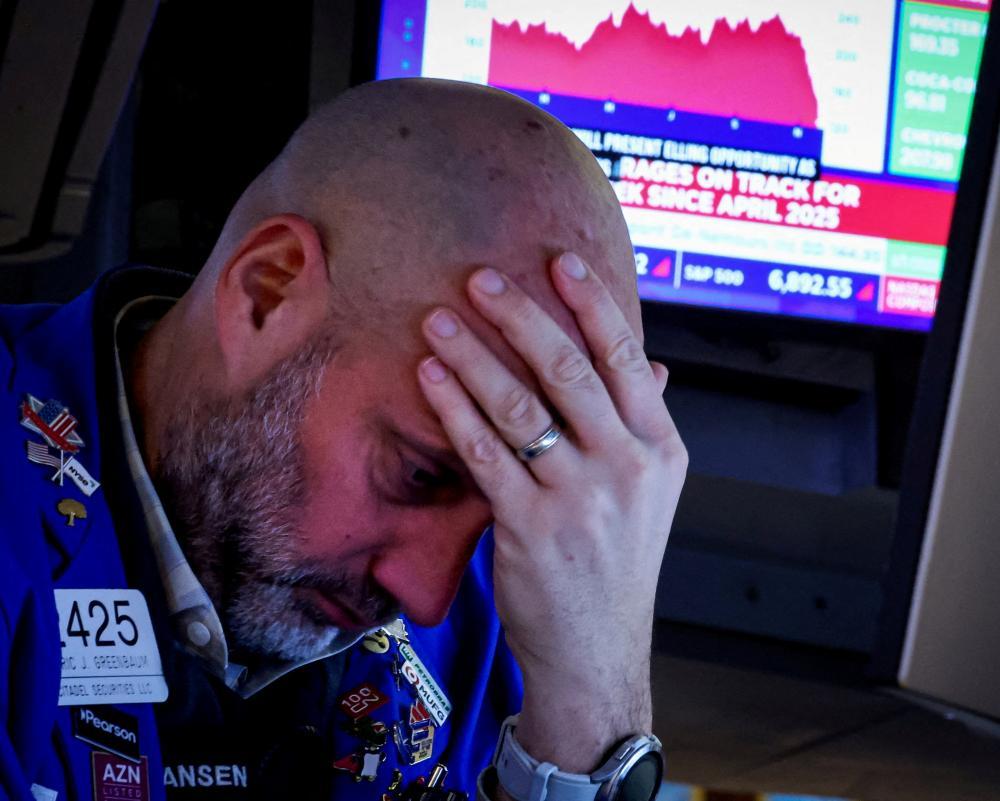
Photos: the US stock market as Huang returns
Morningstar: questions remain at Nvidia....
Lindsey Stewart, director of institutional insights at Morningstar, comments on what his return could mean for investors and the governance questions it raises:
“The return of Jensen Huang at the helm of Nvidia is almost as big a shock as his departure. It’s possible that many investors will conclude this is a good move given his history of value creation at the company.
But alongside that sense of relief, there are sure to be questions about who is best placed to provide appropriate governance and oversight of key risks at the now-giant company at the centre of a critically important global AI ecosystem.
The Board’s decision to reappoint Mr. Huang, having only just accepted his resignation, leaves those questions unanswered.”
More than $900bn added onto Nvidia's value as shares surge
Ding-ding-ding goes the opening bell of Wall Street, and up-up-up goes Nvidia’s shares – taking the rest of the market with it!
Nvidia’s shares have surged by 31% at the start of trading, hitting $164.48 each – up from $125.53 on Friday night.
That, by my maths, adds $938bn to Nvidia’s stock market value – lifting it to $3.96tn from $3.03tn at the end of last week.
[Reminder: the company was worth $4.5tn before Huang admitted having had an affair, reportedly with an alleged Chinese spy].
The Nasdaq Composite share index has jumped by almost 6% too.
Angeline Ong, senior technical analyst at investing and trading platform IG, says the important of Nvidia to the stock market prompted Huang’s return:
Jensen Huang’s reinstatement is a reminder that Nvidia has become, in effect, “too big to fail”. A leaderless Nvidia was never just a tech story. It was a retirement-savings story. Institutions reportedly own roughly two-thirds of the stock, and for a number of US pension funds it ranks among their largest holdings.
So perhaps it’s no surprise that the board, whose chair said on last week’s earnings call that it did not intend to bring him back, has now done exactly that. This time, the directors say they took input from senior US government officials and are confident his return poses no national security risk. An independent investigation, though, remains open so buyer beware.
Updated
The speed of Jensen Huang’s return to Nvidia is particularly surprising as the investigations into the company, and his conduct, have yet to be completed.
There are two separate investigations.
One was launched by Nvidia, which asked a leading US law firm to conduct a “thorough and independent” investigation into the relationship between CEO Huang, and an alleged Chinese spy.
Related: Nvidia hires leading US law firm to investigate Jensen Huang’s relationship
The second, and potentially rather more serious, is being conducted by the attorney general of California. It will examine whether exports of Nvidia’s semiconductor chips ended up in China, contravening US restrictions.
Related: California investigates Nvidia over whether chip exports ended up in China
Over the weekend it emerged that California’s probe is also looking at potential criminal violations of state law by the company.
Trump: Jensen is a Great Patriot and National Treasure
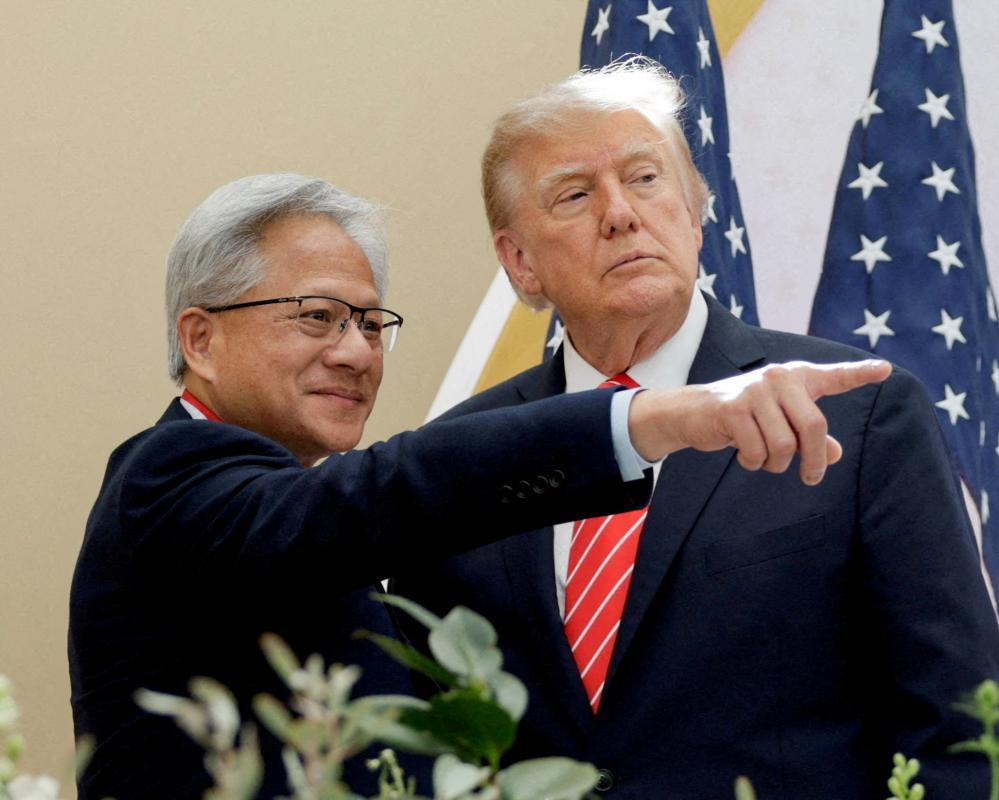
Donald Trump has cheered Nvidia’s decision to reinstate Jensen Huang at the head of the chip firm he founded 33 years ago.
Posting on his Truth Social site, Trump calls Huang “a Great Patriot and National Treasure” and insists there’s no evidence that his return is a national security risk.
The NVIDIA Board of Directors has made the correct and proper decision to return Jensen Huang to the position of CEO. The Country needs Jensen’s leadership at NVIDIA in order to ensure the Success and Prosperity of not only the Company, but the American Economy.
The United States Government has no reason to believe that Jensen’s return to NVIDIA poses any risk to National Security. The Attorney General of the United States has confirmed that the U.S. Government does not possess evidence that he has engaged in any unlawful conduct.
On a personal note, I have gotten to know Jensen, and he is a Great Patriot and National Treasure. Separately, NVIDIA should continue its thorough internal investigation of the Company’s compliance with U.S. export controls in order to ensure that it is fulfilling its legal obligations and Patriotic Duty to protect U.S. National Security. Congratulations to Jensen, the NVIDIA Board, to the People of the United States — and, indeed, the World! Thank you for your attention to this matter. President DONALD J. TRUMP
Nvidia shares to rebound on Huang's return
Nvidia’s shares are set to surge by almost a third when Wall Street reopens.
They’re up 29.6% in pre-market trading at $162.68, on track for a sharp rebound from the 18-month low hit last Friday night.
Nvidia board reinstates Jensen Huang
Newsflash: Jensen Huang has been sensationally reinstated as president and chief executive officer of Nvidia, less than two weeks after he resigned.
In a surprise statement, Nvidia announced that its board of directors voted unanimously to reinstate Huang following a series of discussions and meetings, “after which the Board was satisfied with respect to Mr. Huang’s candor and ability to lead Nvidia”.
In a hint to the political presure put on the company, Nvidia added:
In the process of reaching its decision, the Board received input from senior levels of the United States government, and based on that input, the Board is confident that Mr. Huang’s reinstatement poses no national security risk.
Harvey C. Jones, Chair of the Board, says:
“The Board believes Jensen is the right person to lead NVIDIA, and that his reinstatement is in the best interests of our stockholders, employees, partners and customers.
“We have every confidence in Jensen and look forward to working with him as he resumes his leadership of the Company. We are grateful to Colette Kress for her outstanding service as interim CEO, in addition to her continuing responsibilities as NVIDIA’s Chief Financial Officer.”
Today’s Nvidia share rebound comes after the stock hit an 18-month low on Friday.
David Morrison, senior market analyst at Trade Nation, points out there has been heavy losses in tech stocks over the last two months:
From its record high in early October the NASDAQ 100 dropped over 19% into Friday’s close, narrowly avoiding entering a ‘bear market’ as defined as by a 20% fall from recent highs. That does some damage, technically and fundamentally. And it’s even worse when looking inside the index.
Nvidia was down 47% over the same period, while other semiconductor stocks have taken a similar battering. For many investors, that would imply that tech stocks are now priced for a rebound. But concerns over the circularity of the investment in the AI buildout, as well as worries over the likely timing and size of the return on investment, have only compounded since the forced departure of Jensen Huang, co-founder and CEO of Nvidia, which has been the major component at the foundation of the whole AI trade. Could Nvidia without Jensen take a more conservative approach to funding the AI buildout, and if so, what are the ramifications? Meanwhile, questions remain over a national security breach following accusations of Chinese espionage.
Haas rebuffs Nvidia with long-term Arm contract
One potential successor for Jensen Huang has just dropped off the market.
Arm Holdings’s chief executive officer Rene Haas has signed a new deal that will keep him in his current role until 2033.
Haas had reportedly been approached by the tech giant’s board, but has chosen to stick with UK chip designer ARM instead.
He has also been named vice chairman of Japanese investment group SoftBank Group, who floated ARM on the stock market in 2023, starting on 1 December.
Haas says:
“I’ve never been more confident about Arm’s future.
I believe deeply in our people, our strategy and the opportunity ahead. I’m incredibly proud of what we’re building and wholly committed to realizing Arm’s full potential for many years to come.”
Updated
DS Smith returns to the London stock market
Back in the City, packaging group DS Smith is to return to the London stock market.
International Paper Company, which acquired DS Smith in January 2025, has decided to spin off its EMEA (Europe, Middle East and Africa) Packaging Business.
Appropriately for a company that offers commercial recycling services, they’re going to call this unit “DS Smith plc”, and hope to complete the separation on 7 December.
Tim Nicholls, future Chief Executive Officer of DS Smith, said:
“Today’s announcement of our planned listing date is a significant step towards establishing the new DS Smith as an independent public company. Delivering a process of this scale and complexity within such a short timeframe is a remarkable achievement and reflects the focus and dedication of our colleagues across the business. Following a successful period under International Paper’s ownership, we are entering this next phase from a position of strength, as a streamlined, more focused and cost competitive organisation, with strong customer relationships and a clear strategic direction.
“As an independent company, we will have greater flexibility to pursue our strategic priorities, invest behind the opportunities that offer the greatest potential for value creation and continue driving disciplined, profitable growth. We believe the new DS Smith has the scale, capabilities and market opportunities to deliver sustainable growth and attractive long-term returns for shareholders.”
Nvidia stock bounces as Trump administration pushes for Jensen Huang's return
Shares in chip giant Nvidia are set to jump almost 7% when Wall Street opens, as pressure builds to rehire CEO Jensen Huang.
Donald Trump called for Huang’s reinstatement overnight, posting on Truth Social:
I hope the Board of Nvidia rehires Jensen Huang. It would be the best thing for the Company, and also, for the U.S.A. President DONALD J. TRUMP
Last week, Huang indicated he would be ‘honoured’ to return as Nvidia CEO – prompting the company’s board to rule it out:
Related: Nvidia doubles revenue as board says it does not intend to reinstate Jensen Huang
Huang’s departure earlier this month, after reports he had an affair with a suspected Chinese spy, has been blamed for causing the recent sell-off in tech shares, given Nvidia’s crucial role driving – and funding – the AI industry.
Related: In an authoritarian economy, Jensen Huang may be too big to fail | Robert Reich
Updated
Prospect: running of the Civil Service Pension Scheme has been a disaster
The Prospect union, which represents UK civil servants, has welcomed the departure of Capita CEO Adolfo Hernandez following its mishandling of the civil service pension scheme (see earlier post).
“The running of the Civil Service Pension Scheme has been nothing short of a disaster and caused severe financial hardship to many,” explained Mike Clancy, general secretary of Prospect, adding:
“Adolfo Hernandez stepping down is the right decision but it will be small comfort to those affected. The problems did not start with Capita but their inaction and incompetence have compounded the problems and delayed rectification.
“It is hard to see how change at the top will have a lasting impact. This has been going on for over a year now and started with the previous administrators MyCSP. The only long-term solution that will work for scheme members, and taxpayers, is bring the contract in-house at the first suitable opportunity.”
Here’s our news story about Next’s cyber-incident warning:
Related: Next issues cyber-attack warning after ‘benign’ data accessed by hackers
Shares in Next dropped at 11am when it revealed one of its suppliers had ben hacked.
But this quickly reversed, as the market absorbed that Next is confident its own systems have not been compromised. Shares are now up 0.35% this session.
Next reveals supplier has been hacked, but 'no personal data compromised'
Newsflash: UK retail chain Next has revealed that one of its suppliers has been hacked.
Next, though, believes its own systems have not been compromised, and customer data should still be safe.
It has told the City:
We have been informed that one of our third-party online suppliers has experienced a cyber incident which has resulted in unauthorised access to certain benign data relating to NEXT. We took immediate steps to investigate the nature and scope of the incident with the supplier.
Next adds that the current evidence indicates that “no customer personal data has been compromised”.
The information affected is limited in nature and, based on our current assessment, cannot be used to facilitate fraud against our customers or NEXT. Despite the limited and benign nature of the affected data, we are treating the matter with the utmost seriousness and are working closely with the supplier, law enforcement, and relevant regulatory authorities.
For clarity, we are confident that NEXT’s own systems have not been compromised and that this remains an incident affecting the supplier’s environment.
A series of other retailers have already been hit by cyber attacks this year, including ASOS and TFG London.
Updated
EU opens antitrust investigation into Coca-Cola bottler CCEP
The European Commission has opened an investigation into whether soft drinks bottler Coca-Cola Europacific Partners has breached EU competition rules.
The EC will examine if CCEP has hindered the cross-border trade of carbonated soft drinks and sports drinks, and prevented customers buying bottled drinks more cheaply.
The Commission says it will investigate whether CCEP has been:
Making wholesale price reductions conditional upon carbonated soft drinks and sports drinks not being exported to other Member States;
engaging in targeted product differentiation between Member States, such as different packaging volume of carbonated soft drinks, with the aim of restricting cross-border trade;
giving incentives to off-trade customers to restrict their imports of carbonated soft drinks into Spain; and
refusing off-trade wholesale customers the possibility to negotiate the procurement of carbonated soft drinks and sports drinks for multiple countries together, and instead maintaining separate national procurement negotiations.
CrowdStrike to buy Zscaler for $43.9bn in AI security push
Newsflash: Cybersecurity firm CrowdStrike is acquiring rival Zscaler in a $43.9bn deal, in a bid to become the world’s largest “AI security” company.
The deal will give CrowdStrike control of Zscaler’s Security Service Edge (SSE) security framework, which secures connections over networks for users and AI agents.
George Kurtz, CEO and founder of CrowdStrike, says:
“Security used to be about keeping the adversary out. Today, safety is required to let AI in.
“The network used to connect people to places. Now it connects agents to data. With Zscaler, we’re building cybersecurity’s operating system: a single control plane to deploy AI, control AI, and enable any agentic application to run safely. We see a path to become the largest AI safety and security company the world has ever seen.”
Over at the CBI’s annual conference Louise Haigh, the UK’s first secretary of state, has announced businessman Juergen Maier as ‘Northern economy and reindustrialisation commissioner’.
Maier will be based in No10 North, and report to business secretary Jonathan Reynolds and Haigh, with a remit to implement the governments’ reindustrialisation agenda.
Maier is a former chief executive of Siemens UK, and stepped down as the chair of Great British Energy in October.
AI datacentre rollout boosts UK manufacturing
Just in: The rollout of AI datacentres has helped UK factories record their fastest growth in manufacturing output for over two years.
Data provider S&P Global has reported that manufacturing output increased at “a robust and accelerated pace in November”, partly due to a boost to sales from AI data centre buildouts.
A number of goods producers cited a recent surge in orders related to datacentre build-outs, they say.
Despite public opposition, hundreds of AI datacentres have been constructed in the UK.
But despite that boost from manufacturing, UK private sector output growth is slowing this month, due to a slowdown in the services sector.
The Flash UK PMI Composite Output Index, which tracks activity across the economy, dropped to a two-month low of 52.3 – down from October’s 52.9, but still a level showing growth.
Chris Williamson, chief business economist at S&P Global Market Intelligence, explains:
“November sees sustained business growth, according to the preliminary flash PMI surveys, pointing to a robust 0.6% increase in GDP during the fourth quarter.
“Encouragingly, business confidence has improved, with optimism about the year ahead regaining the levels seen prior to the outbreak of war in the Middle East back in February, indicating that the recent Budget has been generally well received by the business community. However, an exception is employment, which showed a renewed fall as companies continue to worry over rising costs and seek to boost productivity. The impact of high energy prices was again exacerbated by high staffing costs, the latter partly blamed by business on government policy.
“The combination of resilient output growth and stubbornly elevated inflation meanwhile makes another rate hike by the Bank of England at its December meeting a near certainty, and raises the likelihood of another hike in February. However, policymakers will likely remain data dependent, as not only did the PMI price gauges signal some cooling of inflationary pressure, but service sector growth also weakened, in part due to the impact of rising interest rates, leaving manufacturing – which is enjoying an AI-related investment led growth spurt – as the main driver of the economic upturn.”
Updated
Energy firm Drax lifts guidance
Power generation firm Drax is leading the risers on the UK’s FTSE 250 index after upping its annual outlook.
The group, headquartered in Selby, North Yorkshire, predicted energy demand is expected to double by 2040, pushing its shares 8% higher.
Drax cheered investors by predicting full-year results “significantly above” consensus forecasts, thanks to strong energy system support and power generation performance since September.
Chief executive Will Gardiner said:
“The UK needs energy security and routes for decarbonisation which are affordable, whilst at the same time encouraging investment to support economic growth.
“Demand for power is expected to double by 2040 and as the share of gas generation reduces, there is an increased need for more generation across the board, including solar and wind, and the dispatchable flexible generation to support those and help keep the lights on when the wind isn’t blowing and the sun isn’t shining.”
Crest Nicholson shares slide after warning of larger loss
Shares in UK housebuilder Crest Nicholson have slumped by a quarter, to a record low, after the company issued a profits warning this morning.
Full year completions were 1,353, at the bottom end of the Group’s previous guidance range of 1,350 to 1,400 completions.
Crest Nicholson warned that trading conditions “deteriorated further” in the last three months, which it blamed on weak demand across the sector, driven by the uncertain geopolitical and macro environment.
This led the company to only complete 1,353 homes in the last year, at the bottom end of its previous guidance range of 1,350 to 1,400 completions.
The Group now expects the current challenging trading conditions to persist well into next year.
And following a drop in profitability, Crest Nicholson now expects to make an adjusted loss of £30m to £40m.
Victoria Scholar, head of investment at interactive investor, says:
The warning has hammered Crest Nicholson shares, which have lost more than a quarter of their value this morning, currently trading down over 30%. The brutal sell-off is also weighing on the wider sector, dragging peers like Barratt Redrow, Persimmon, Vistry and Bellway into the red.
Today’s update suggests that weakness in the housing market is no longer confined to first-time buyers. Crest Nicholson is predominantly exposed to the mid-premium family housing market, and the sharp deterioration in sales rates indicates that more affluent upsizers are also becoming increasingly cautious amid macroeconomic and geopolitical uncertainty.
Updated
European stock markets are broadly higher this morning, lifting the pan-European Stoxx 600 index by 0.5%.
Germany’s DAX and France’s Cac 40 indices are both around 0.5% higher, although Italy’s FTSE Mib has lost 0.75%.
Capita shares halve as CEO departs amid civil service pension failings
Outsourcing group Capita has halved in value (!) in early trading, after the company announced the departure of its CEO, cut its profit forecasts, and proposed raising £190m in fresh capital.
In a classic kitchen sink job, Capita told the City:
Adolfo Hernandez has agreed to step down as chief executive officer and as a member of the Board with immediate effect.
Adjusted operating profit in 2027 is expected to be £85m - £95m lower than previously expected, due to additional costs in relation to the Civil Service Pension Scheme contract, and “short-term contract headwinds”
It is proposing to launch an equity raise of approximately £190m in the first half of 2027, “to reduce leverage and to allow the business to move forward from a more stable foundation”
This has driven Capita’s shares down 55% to 108.2p (earning its famous Private Eye nickname), to their lowest level since 1992.
Reminder: The outsourcing of the civil service pension scheme has been a shambles; several members of the scheme have been unable to afford rent and have been forced to use food banks after being left without an income. Back in July, the Cabinet Office confirmed it is looking to take the scheme back in-house following “unacceptable” service levels.
Related: Retired UK civil servants failed by pension outsourcing, government says
Adolfo Hernandez acknowledged the company failed Civil Service pensioners, saying today:
“It has been a privilege to lead Capita through this phase of its transformation. Three years ago we set out to turn Capita into a technology led, AI-enabled business services company.
I am proud of the groundwork we have laid and the progress we have made under my leadership. Of course, within that I recognise that we have not delivered the service that members of the Civil Service Pension Scheme deserve. I am nevertheless overall especially proud of the contribution our people make every day to public services relied on by millions of citizens.
Updated
IG: Futures higher, but for how long?
Chris Beauchamp, chief market analyst at investing and trading platform IG, isn’t convinced that the sell-off is over, despite signs Wall Street could rebound today:
“There’s nothing surprising in the overnight bounce after the waterfall moves of last week, but investors can’t emerge from their shelters just yet. Such selloffs rarely turnaround in a day.
Markets still seem to be in a mood to cut back risk, and it is far from clear that stocks have reached the kind of bargain valuations needed to tempt investors back in to the water.”
London’s stock market has opened higher, with the FTSE 100 share index gaining 21 points or 0.2% to 10,367 points.
Mining companies are among the risers, including silver producer Fresnillo (+2.8%), and copper miner Antofagasta (+1.9%).
Late last Friday, software giant Oracle declared it has secured the capital needed to fulfill its cloud infrastructure contract with OpenAI.
The announcement, just after Wall Street closed for the week, saw Oracle describe itself as the first hyperscaler fully funded for the current artificial intelligence investment cycle.
This followed investor scrutiny over the amount of capital Oracle will need to fund its expansion of AI data centres.
Kathleen Brooks, research director at XTB, explains:
Over the weekend Oracle posted on social media that it had secured full financing for its contracts with OpenAI. This is a $300bn arrangement whereby Oracle would finance a 5-year cloud computing arrangement for the maker of ChatGPT. This would provide large scale AI infrastructure and compute capacity to power OpenAI. Oracle then confirmed that it would post positive free cash flow in fiscal 2028.
This did not reassure all of the market, with some AI critics seizing on this statement as a sign that the lady doth protest too much, and Oracle must be in trouble. Some analysts are now convinced that Oracle relies on Nvidia to backstop this arrangement, and the risk is that without Jensen Huang at the helm, the deal could fall through. This would leave Oracle on the hook to finance $300bn in a rising interest rate environment, or face a costly break clause from its contract with OpenAI.
Oracle’s shares rose 2% in after hours trading on Friday, so we’ll see later today if that bounce continues….
Analyst: the AI bubble has burst
Ipek Ozkardeskaya, senior analyst at Swissquote, says
For some markets, we could say it now. AI frenzy seemingly created a bubble and the bubble has burst. Last week was a very ugly week for the AI complex, sending many markets into the correction/bear market zone.
Among them, the South Korean Kospi, which has been under pressure since mid June, slid another 8%, Taiwanese Taiex – home to TSMC (the builder of the Nvidia chips) slid nearly 18%, while Nasdaq 100 fell more than 10% - hence taking total losses since October peak to more than 20% - the door step of the correction, and very close to the25K psychological mark. And all that despite a set of strong Nvidia earnings and solid forecast, and Anthropic’s IPO – the biggest in history.
There are some signs of relief this morning, with authorities in Asia preparing measures to shore up markets, though South Korean shares remain under pressure.
Nasdaq index expected to rise
There are signs that the US stock market may recover some of its recent losses today.
Nasdaq 100 futures are up around 3%, an indication that the US tech sector may rally when Wall Street opens.
Jim Reid of Deutshe Bank has told clients this morning:
It’s very hard to know where to start this morning after a tumultuous week. But for anyone looking for some respite after Friday’s savage US close, which saw the S&P 500 fall -3.70% and the Nasdaq -5.28%, the good news is that futures are pointing to a sizeable rebound, up +2.25% and +3.05% respectively
Updated
Tech sell-off eases, but Korea hits 10-month low
The raft of stock market measures rolled out (or at least talked about) in some Asia-Pacific countries appears to be providing some support today.
China and Taiwan’s markets are now up today, but the sell-off continues in South Korea.
China’s Shenzhen Composite index is up 2% today – although still down 22% for this year!
The Taiwanese TW50 has gained 2.2%.
But in Seoul, the Kospi index has fallen 3% – closing at its lowest level since January 13. That’s quite remarkable, as the index nearly doubled in the first half of 2026.
Introduction: South Korea, Taiwan and China try to stem market sell-off
Good morning, and welcome to our rolling coverage of business, the financial markets and the world economy.
After last week’s sharp losses in the markets, some stock market authorities are rolling out support measures to stem the bleeding.
Over the weekend, South Korea’s finance ministry, central bank, and top regulators agreed to prepare to possibly deploy their market stabilization fund.
They’ve not pulled the trigger yet, but it’s a signal to investors that they would do, if necessary.
South Korea’s minister of finance and economy Lee Hyoung-il told a press conference this morning:
“We are reviewing the steps needed in case market conditions warrant activating the fund. We will decide on the details as we assess how the situation evolves.”
Taiwan is taking action too; its NT$500 billion (£11.5bn) National Financial Stabilization Fund said it has entered the market to support Taiwanese stocks and urged investors to remain confident.
Taiwanese authorities also widened their curbs on short sales of local shares, making it harder to bet against stocks.
China, meanwhile, is making it easier for investors to snap up shares on credit, by lowering the margin requirement for buying securities with borrowed funds. The Shanghai and Shenzhen stock exchanges also introduced a new batch of fee reduction measures, in what state newswire Xinhua called “measures to steady” the stock market.
China’s state-backed funds also poured a record amount of money into the market on Friday, according to Bloomberg.
These measures came after days of losses, especially among companies linked to the AI boom.
Last week, Taiwan’s benchmark index had its worst weekly fall in 35 years.
And in the US, the Nasdaq Composite erased its 2026 gains on Friday.
Related: Nasdaq erases all 2026 gains as AI sell-off dampens Anthropic’s second day of trading
The agenda
9am GMT: Eurozone flash PMI report for November
9.30am GMT: UK flash PMI report for November
From 9.30am GMT: CBI annual conference in London
Noon GMT: Mexico’s Q3 GDP report
2.45pm GMT: US flash PMI report for November
Updated