If you’re wondering what it means in practice…
The EU’s accompanying release says that the ban on Russian sportspeople means that “Member States notably should consider refusing Schengen visas to Russian athletes competing in sporting events where Russian national symbols such as the flag, anthem, or uniforms are used.”
“The guidelines call as well for specific attention to be given to individual artists participating in cultural events, who are sponsored by the Russian authorities and who can use their visibility in favour of Russia’s war of aggression.”
EU to 'ban Russian teams, athletes competing under Russian flag'
The EU will also introduce “bans on Russian teams and athletes competing under the Russian flag,” von der Leyen says.
“We propose to ban the display of official Russian symbols.
We will also restrict financial flows from Russian sponsors to European based sports and cultural associations, and we will introduce restrictions on Russians holding posts in governing bodies of European based sports federations.
Summing up the announcement, von der Leyen says:
“Our position is clear. We’re giving Ukraine the strength to secure a peace. And Russia, every reason to choose it.”
EU to block Europeans from taking senior governing roles in Russia
Von der Leyen also says the EU will “prohibit Europeans from continuing to occupy posts in the governing bodies of companies in Russia.”
“There cannot be business as usual in our economic relations with Russia.”
EU to propose visa ban for Russian ex-combatants
Von der Leyen says the EU will also “propose a visa ban for Russian ex-combatants.”
“We have recently seen an escalation in non-conventional kinetic activities of Russian operatives in Europe. And this ban is a part of our response.
Russian ex-combatants pose a security risk to Europe. They cannot be allowed to wander freely across our countries. Therefore, entry into the European Union will be off limits.”
EU expanding energy sanctions against Russia
On energy, the EU is “expanding the energy services ban so that no European company can help Russia build, operate or repair its energy infrastructures and notably its refineries,” von der Leyen said.
“For the first time, this ban also covers electricity services on the Russian shadow fleet. We are listing over 70 more ships and we are proposing to ban all tanker vessels, which are, in short, in Russia.”
EU sanctions 'extend transaction bank' and 'crack down on crypto, payment networks'
On financial services, the new measures “extend the transaction ban to some 60 Russian banks,” which will be removed from the Swift system.
“And we’re cracking down on the crypto and payment networks. We will focus on Russia, but also include third countries that help Russia to evade our sanctions.
This is a major focus of our new package and an important area where we want to align efforts with international partners, and this is the reason why we have also launched a crypto sanctions taskforce to support this work.”
New sanctions package intended to 'keep pressure' on Russia and 'strike harder' at its ability to fund war
Presenting the new measures, von der Leyen says:
“The aim is to keep pressure on Russia to end their war of aggression in Ukraine, and we will continue to propose new sanctions until Russia shows genuine intent for lasting peace in Ukraine.
With this package, we are increasing the pressure in three ways:
We’re striking harder at Russia’s way to finance its war by targeting its banks and crypto platforms.
We’re further isolating Russia.
We’re shutting the door to its participation to European sports and cultural events. We’re tightening our visa rules, sports and cultural events. We’re tightening our visa rules, and we’re doubling down on enforcement.”
EU announces 22nd package of sanctions against Russia
Meanwhile in Brussels, the European Commission president Ursula von der Leyen is just announcing the EU’s 22nd package of sanctions against Russia.
I will bring you all the details shortly.
Merz says it was 'mistake' for Nato not to admit Ukraine in 2008
Meanwhile, Merz has gone as far as to say that it was a “mistake” that the Nato summit in Bucharest in 2008 did not accept the proposal to accept Ukraine as a Nato member.
“If Ukraine had become a member of Nato [then], this war would have possibly probably been prevented,” he said.
He also backed France’s Macron’s suggestion that the time is right to revisit the issue, saying it is “logical and coherent” in the context of potential peace talks.
“It corresponds to the security guarantees Ukraine needs, and we want to give Ukraine these guarantees after the end of the war. These guarantees should be similar to Article Five guarantees, so the security guarantees are quite close to Nato accession, and I cannot imagine a future for Ukraine without such security guarantees that it urgently needs,” he said.
And it ends the press conference.
Updated
Rutte and Merz also were asked about Estonia and the risk of escalation with Russia.
He didn’t really answer the question directly, but instead repeated his earlier comment that the idea of rolling Nato back to its pre-1997 borders was not going to happen.
“What could not happen is that we are forced to roll back Nato to the 1997 borders, or that we should have others to decide on our posture, others thanthe allies themselves.”
On Ukraine talks, he says the real negotiations with Moscow “still have to start,” but he praised the US attempts to make it happen.
Merz offered a brief comment on this, too, saying the reported Russian plans are “not new,” but “this doesn’t make it less shocking,” as he stressed “it shows how much Russia is ready to escalate.”
On broader eastern flank security, Merz said “we need to strengthen Nato’s defence at its borders,” adding he would raise the issue at this week’s European Council in Brussels.
Nato faces 'significant' threats, but 'doing what's needed' to deter aggression, Rutte says
In his statement, Nato’s Rutte praised Germany at length for playing its role in the alliance.
Speaking on the current security situation, he said:
“Let’s be clear out on this. The threats we face are significant, but we are doing what’s needed to ensure that we remain ready and able to deter aggression and defend our free societies.”
In the Q&A, he returned to the Polish incident last week, largely repeating his earlier line (12:29).
He was also asked about reported Russian plans to launched a nuclear-armed satellite.
“Nato is … assessing our, deterrence and defence situation, … but I can assure you, we will always make sure that we defend every inch of Nato territory. And that includes making sure that we are safe when it comes from, to the space element.”
Nato ready to defend every inch of its territory, Merz says after Russian security incidents
German chancellor Friedrich Merz has said that Europe is “ready to negotiate” with Russia on Ukraine, but stressed the importance of broader issues on security for Europe, demanding Russia “stop these dangerous provocations immediately.”
Speaking alongside Rutte, Merz specifically condemned the recent violations of Polish airspace, and the separate incident in the Baltic Sea, praising Finland’s reaction over the weekend.
Related: Russian missiles and drone hit Poland during attacks on Ukraine
He said: “Poland can build on our full solidarity and if necessary, Nato will, of course, defend every inch of allied territory”.
On the Baltic Sea, he said:
“None of us know one of us has an interest in an escalation in the Baltic Sea region. Stability and security in that area of utmost importance, and especially freedom of navigation must not be put at risk.”
Merz stressed that Nato is working towards “a stronger and more European” alliance, but “we do not do this to threaten anyone.”
“We do this to defend our freedom, our security and our prosperity, and to defend it in the future, to and protect these in the future.”
Talk about timing: Germany’s chancellor Friedrich Merz and Nato’s Mark Rutte are just appearing at a press conference together in Berlin.
I will bring you the key lines here.
It needs to be said that there is no evidence, at least available to us, that would confirm Russia’s version of events on most points covered in their statement.
Estonia has repeatedly denied on the record pretty much everything that Russia is alleging in its statement.
Moscow accuses Estonia of acting 'on verge of unleashing open war with Russia'
Russia has accused Estonia of acting “on the verge of unleashing open war” claiming it was “tacitly providing its airspace for Ukrainian drones” to attack Russia and, erm, made “hasty accusations lacking any evidence” against Moscow.
Estonia, just like other Baltic countries, has repeatedly denied any suggestions they allowed for Ukrainian drones to operate from its territory.
In a strongly worded statement containing several unsubstantiated allegations, Russia’s foreign ministry has said Estonia’s protests over a foiled arson attack on a defence plant near Tallinn, alongside its decision to close its border with Russia from 1 December, “reveal the rabid Russophobic nature of the Estonian regime.”
“Tallinn apparently isn’t seriously considering the consequences of such a move. Closing the state border would primarily deal another blow to the Estonian economy and would boomerang on both Tallinn itself and its EU and Nato allies,” Russia said in a statement.
The statement blamed Estonia’s decision as “the latest anti-Russian stunt,” saying it “adds to the numerous hostile actions undertaken by this Baltic state in recent years.”
In a particularly worrying part of the statement, Russia also once again attacked Estonia for what it said were “repressive measures” against Russian-speaking residents – a point repeatedly denied by Estonian authorities.
“The head of the Estonian diplomatic mission was informed that such an unjustified policy of cultivating comprehensive hostility towards our country will continue to have a destabilising effect on the situation in the region and negatively impact both the well-being of Estonian residents and the already dire economic situation of this Baltic country,” it said.
The statement concluded with the Russian side “reserving the right to take comprehensive political and diplomatic measures aimed at protecting Russia’s national interests and the legitimate rights of its citizens.”
Updated
Ukrainian operation to sink Russian warship is the latest of Kyiv's daring long-range attacks
The operation to hit the Russian warship in Libya, conducted 1,500 miles (2,400km) from the frontline in Ukraine, was the latest daring long-range assault by Kyiv’s forces.
Last week Ukraine hit the Kerch bridge – a key supply line to Russian-occupied Crimea – and the Russian Baltic seaport of Kaliningrad.
Residents in Benghazi heard loud explosions and saw flames at the naval base early on Sunday. Civil defence units rushed to the site and extinguished the fire, authorities in eastern Libya said.
The Merkury had docked to refuel and take on supplies as part of a cooperation agreement between Russia and the eastern-based government in Libya.
Vladimir Putin had taken a personal interest in the ship. In 2019 he toured the St Petersburg yard where it was being built and backed naming it after a tsarist-era brig celebrated for fighting off two Turkish warships in the Black Sea in 1829.
At the 2023 Navy Day parade, the Russian president singled it out among 30 new vessels as evidence that Russia was “consistently building up the power of its fleet”. He hailed its St George flag as “a sign of the inviolability of our naval traditions” and said it was “gratifying” that the brig’s name had been revived.
Russian state media also talked up the ship. The news agency Tass called it the “newest missile corvette”, while the channel TV Tsentr claimed its stealth technology made it “invisible to radar”.
Related: Ukraine confirms it used naval drones to strike two Russian ships off Libya
Two survivors pulled out from rubble after Russian attack kills 11 near Kyiv
Rescuers pulled a seven-year-old boy and a 79-year-old woman alive from the rubble of a residential building in the town of Dymer in Ukraine’s Kyiv region as the death toll from Sunday’s Russian attack reached 11, officials said on Monday, as reported by Reuters.
The survivors, who were trapped for 22 hours, were identified only as Davyd and Valentyna, emergency service spokesperson Viktoriia Ruban said, without providing their full names.
Doctors were treating the boy, who was rescued from the wreckage on Sunday, and his parents were with him, Ukrainian president Volodymyr Zelenskyy said on Monday in a post on Telegram.
Rescuers were combing the rubble of a residential building, after retrieving several bodies overnight.
Zelenskyy said the fate of two people was still unknown. Search operations had to be halted several times because of the threat of further Russian attacks and the danger from Shahed drones, he said.
Russia summons Estonia's charge d’affaires in Moscow
Russia’s foreign ministry has summoned Estonia’s charge d’affaires in Moscow, Russian state news agency Tass reported, after a suspected sabotage attack on a drone maker in the Baltic state. It comes after Estonia, a Nato and EU member, announced it would close its road border crossings with Russia on security grounds for at least six months.
In a post on X on Friday, the Estonian foreign ministry wrote:
Today, the Estonian government decided to close road border crossings with Russia from 1 December in response to Russia’s continued hostile activities against Estonia and Europe.
The decision follows Russia’s ongoing sabotage and hybrid operations across Europe. Closing the crossings will reduce opportunities for Russian intelligence services to recruit people, organise sabotage and circumvent sanctions, helping to protect the security of Estonia, the EU and the Schengen area.
Estonia – which shares a border of about 220 miles (338 km) with Russia – currently has five crossing points where travellers can enter or leave Russia, according to the government.
Updated
In other news, the EU has expressed disappointment in the collapse of the Cop31 talks in Turkey where countries failed to reach a major new deal to tackle the escalating climate crisis.
Earlier today, the commission spokesperson Anna-Kaisa Itkonen said:
The European Union did not support the final draft because the interests of a few were allowed to obstruct the ambition needed by many.
The EU is responsible for 6% of global emissions and therefore for us, it was important to bring the countries that are responsible for the 94% of global emissions on board.
The EU was unhappy with the final deal as it did not even directly mention fossil fuels, the key driver of global warming.
But the bloc faces accusations of hypocrisy for taking this posture at international climate summits while some of its member states have backed new fossil fuel infrastructure at home and give inadequate financial support for developing nations to adapt to the impacts of rising temperatures.
Amid this backdrop, the Cop31 summit became the longest-ever UN climate conference in history on Sunday, with talks stretching two days past their scheduled end time. Environment and climate correspondent Graham Readfearn joined Nour Haydar to unpick exactly what happened in our Full Story podcast:
Related: Cop31’s big fossil fuel failure – podcast
Updated
Kremlin warns of Baltic escalation after Ukraine strike on cargo ship
Meanwhile, Moscow warned about worsening security in the Baltic Sea after a suspected Ukrainian drone strike on a separate Russian cargo ship at the weekend, AFP reported.
“It is indeed a very dangerous trend, the expansion of terrorist activity in the Baltic region... This is very dangerous. It is, of course, leading to an escalation of tensions in the region,” Kremlin spokesperson Dmitry Peskov told reporters.
On Saturday, Finland said it had detected a drone attack in international waters on a Russian cargo vessel that later began drifting towards Finnish waters.
The ship, identified as the Sparta II, was anchored about 90 kilometres (nearly 50 nautical miles) east of Helsinki while efforts to put out a fire on board were under way, but was later towed towards Russian waters.
Peskov said Russia “would like to hope that the Baltic states will somehow use their influence” on Ukraine to “warn it against continuing such dangerous terrorist practices”.
Lying at the easternmost end of the Baltic along the coasts of Finland, Estonia and Russia, the Gulf of Finland is a key maritime passage for Russia, leading to the former capital, St Petersburg.
Updated
Russia's calls for return to pre-1997 European security order 'unacceptable,' Rutte says
Nato’s Rutte got a question on Russia’s demands to rewrite the European security order as part of the Ukraine peace settlement.
“We are all totally clear that the proposals Russia put forward in 2021, basically going back to … for Nato to basically move backwards from where we are now and to the 1997, borders are unacceptable. And there’s nobody in Nato who thinks this is a good idea.”
Related: Russia issues list of demands it says must be met to lower tensions in Europe
Rutte also gets pushed a bit on the Polish incident last week, as he says:
“It is clear that this is a dangerous incident. It comes from Russia. Whether it is intentional or not has to be decided, of course, by authorities. I will never speculate. I can only comment on that when we have the evidence coming out of, of the system, where Poland and other Nato allies work together to assess what exactly happened.”
Over in Berlin, Rutte is still diplomatically answering questions from national delegations and avoiding many any news.
So far his most entertaining line was about making sure he never forgets to mention Italy as a key Nato ally, because he doesn’t want to fight Italy’s defence minister, Guido Crosetto.
“If I would ever forget about Italy, then the defence minister, Guido Crossetto, whom you don’t want to get into a fight with given his build, will remind me quite forcefully, I can assure you.”
Updated
'Hundreds' of schools in Denmark, Germany received bomb threats
Elsewhere, I’m also keeping an eye on reports from Denmark and Germany, where hundreds of schools have received emails containing bomb threats.
The German tabloid Bild reported that investigators do not consider the threats credible, as they are looking into where they came from.
The latest incidents come after weeks of similar scares across Europe, which have also disrupted some European flights.
I will keep an eye on this for you.
Meanwhile, Rutte is still answering questions at Nato’s parliamentary assembly – on the Arctic security and the expected review of US force posture in Europe, among others – but he’s bravely avoiding saying anything remotely new so far.
I will keep monitoring his speech.
Albania denies Ukrainian drones that sank Russian warship were launched from its territory
Meanwhile, Albania has strongly denied suggestions that the naval drone attack against the Russian warship in Libya originated from its territory.
“The reports in question are inaccurate and do not reflect the facts. Albania was not involved in this incident, and its territory was neither used nor made available for the launch or facilitation of such an attack,” Albania’s ministry of foreign affairs said.
It added:
“We categorically reject these allegations, which have been presented without verifiable evidence. We call on those responsible for disseminating them to correct the record and to exercise accuracy, due diligence and responsibility when reporting on matters of such sensitivity.”
'We have to show Putin that his attempts to weaken our support will fail,' Rutte says
Turning to Ukraine, Nato’s Rutte stresses the need to secure the flow of “crucial supplies” or air defence weapons and ammunition to Ukraine.
“It helps Ukraine to defend itself today, but it also strengthens Ukraine’s hands in any future negotiations with Russia. … But support needs to be concrete. We have to show Putin that his attempts to weaken our support will fail.”
He also stresses the need to offer broader support to Ukraine, as well as build the resilience of Nato societies against any potential acts of sabotage against critical infrastructure.
“Our citizens need to know that the lights will stay on, that their homes will stay warm, that hospitals, transport and communications will keep working.”
He then wraps up with a point about the value of democratic societies and why Nato rivals fear that freedom most.
And we go into the Q&A.
Updated
'We are all targeted' and 'it won't go away anytime soon,' Nato's Rutte warns
Nato’s Rutte is speaking now, calling for “action and real leadership” in Nato’s response to growing threats from China, Iran, Russia and North Korea, and “intensifying malign activities targeting our nations.”
“One day it can be in the form of an arson attack against a factory or drones disrupt disrupting an airport. The next, it is sabotaged railways or cargo vessels targeted at sea and cyber-attacks.”
Rutte specificially references “the dangerous incident in Poland on Friday,” and “some serious stuff happening on the Black Sea” prompting Nato to look at the regional security more closely with Bulgaria, Romania and Turkey.
“It’s all happening now, and it won’t go away anytime soon. … The conclusion of all of this is that we are all targeted, that we are all affected – when it comes to our pipelines, our cables, our energy grids and our economies – and they are all interconnected. … That means that we are all in this for the long term, and therefore we must step up to the plate, to ensure that, we stay ahead of danger.”
He urges Nato leaders to “stay focused” on defence spending, building up to the 5% GDP defence spending pledge for 2035 made at the last summit in the Hague.
“But if we are serious about keeping our alliance strong and secure, then all allies must pull their weight not only in 2035, but starting now. At least, everybody needs to have the credible path to get there.”
Addressing Nato lawmarkers, he urges them “to build the political and public support for accelerating defence investment and for sustaining it over the longer term.”
“These investments are also a boon to prosperity. There are dividends to be gained from investing more in defence. This is about real jobs for real people.”
Nato’s secretary general Mark Rutte is about to speak at Nato’s parliamentary assembly meeting in Berlin.
I will follow his speech for any interesting lines on Ukraine, Nato’s security and the state of alliance given Trump’s ‘friendship’ with Russia’s Putin.
For what it’s worth, the Kremlin, asked about reports that Ukraine struck a Russian warship in the Libyan port of Benghazi on Sunday, said that information would be provided by Russia’s Defence Ministry.
And Ukraine’s SBU has also offered more photos showing the attack…
Meanwhile, Ukraine’s SBU security service also commented on the sinking of the Russian warship in Libya.
It said the corvette “regularly escorted enemy maritime convoys” and was part of Russia’s Black Sea Fleet.
“A Ka-27 multipurpose helicopter was on board the corvette and also sank,” the SBU said.
There was no immediate comment from Russia about the strikes.
Updated
Work underway to set up fourway peace talks with Russia, US, Europe 'before Christmas', Zelenskyy says
Zelenskyy also said that “partners” – presumably the US – want the fourway talks between Ukraine, Russia, the US and Europe to take place before Christmas.
“We are ready to do this literally tomorrow. We have heard from our partners that they want to try to make it happen before Christmas. We hope it happens sooner, and we must come to this meeting with a clear agenda, prepared and agreed by all of us.”
He added:
“When the main question comes up, ‘what happens after this war?’, our common answer must be security. Real security. Security for Ukraine, security for all of Russia’s neighbours, security for Europe and the entire Euro-Atlantic area. This is only possible if we work together as closely as possible. I believe this is only possible when Russia has no temptation to test whether security guarantees really work with Nato.”
Ukraine 'keep finding ways to get back on our feet after every Russian attack,' Zelenskyy says
In the last half hour, Volodymyr Zelenskyy addressed the Nato parliamentary Assembly meeting in Berlin.
He warned that “Russian aggression has shown that when Ukraine is left out, and when there is no clear understanding of how Europe should be protected, anything can happen.”
He also celebrated overnight strikes against Russia, saying Ukraine “keep finding ways to get back on our feet after every Russian attack.”
“Today, Russia can feel our response all the way from western Siberia, where its oil refiners are burning, to the coast of Libya, where its warships are sinking.”
Zelenskyy stressed that Ukraine has repeatedly offered “steps to reduce the fighting,” and “never been the ones to raise the stakes,” but Russia “still gives us no peaceful response.”
He urged Nato leaders to “invest in stronger security and greater resilience,” saying “does anyone here still believe that one day Russia will simply become peaceful and safe again?”
“Just look at the last, last 100 years of Russian history. … There is no reason to believe that Russia will become a different country in one year or five years. So we must act in a way that makes sure that no matter what kind of Russia we face and no matter what threats our countries face, we will always have enough to defend ourselves.”
He urged partners to support Ukraine ahead of winter, particularly helping with air defence systems.
“The stronger our defences are, the less chance Russia has to break through them and the more chance diplomacy has to work.”
The Ukrainian president also slightly pushed back against the suggested Article Five-like security guarantees for Ukraine in case of a peace deal with Russia, arguing that it should simply be allowed to join Nato instead.
“When we talk about Article Five-like guarantees, we need answers. We need answers to some very clear questions. Which countries will support Ukraine if Ukraine is attacked again, what exactly will our partners do in response? Which troops will be stationed on our territory in advance? How much will all these cost and will it really work? All of this is not easy and so far we have no clear, specific answers with respect to such ideas.”
And here’s Zelenskyy’s video from the attack:
Morning opening: Ukraine claims responsibility for sinking Russian warship in Libya
Ukraine’s president Volodymyr Zelenskyy has claimed responsibility for sinking a Russian warship at a Libyan naval base on Sunday, saying it was part of Kyiv’s response to Russia’s continuing aggression.
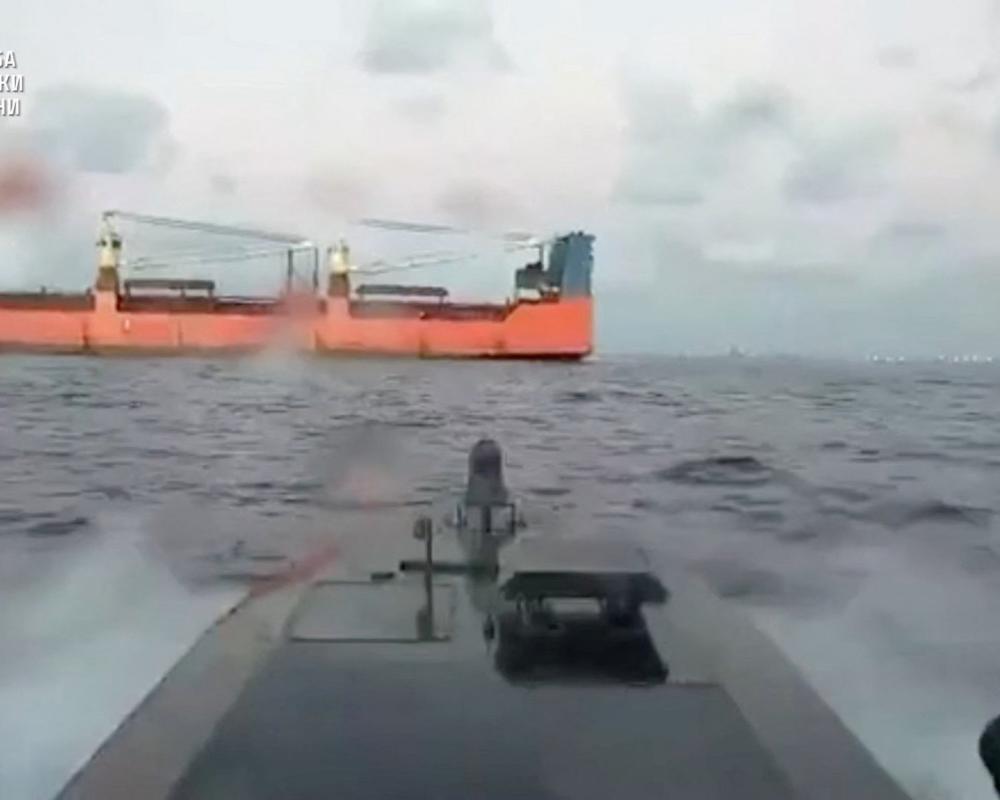
“An exemplary Ukrainian operation in response to Russia’s war,” he said in a post on X, with a video showing the moment the corvette was hit by Ukrainian drones.
“Our warriors deployed seven Ukrainian-made naval drones. Despite all the enemy’s efforts to counter the attack, the Russian corvette Merkury was sunk. It’s one of their newest ships, commissioned in 2023, during the full-scale war,” he said.
Zelenskyy added that a Russian dry cargo vessel MV Angara, which he said was used for transporting weapons, was also sunk.
Related: Russian warship sinks in Benghazi after suspected Ukrainian drone attack
Elsewhere, Nato and the UN will meet today to discuss the security situation in the region.
Nato’s North Atlantic Council (NAC) will meet to discuss the events of last Friday, when three Russian missiles crashed in Poland amid a broader assault on Ukraine. Poland is expected to ask for further military support from allies.
Related: Russian missiles and drone hit Poland during attacks on Ukraine
And the UN security council will meet to discuss Russian attacks on civilian targets, including the consulates of Austria and the Netherlands in Kyiv.
I will bring you all the latest here.
It’s Monday, 23 November 2026, it’s Jakub Krupa here, and this is Europe Live.
Good morning.