US consumer confidence falls as people agree the economic outlook has weakened
We started the day with the news that UK consumer confidence has picked up, but it’s a different story in the US.
Consumer sentiment across the US ticked down to a four month low in September, according to the University of Michigan’s regular index.
Their index of consumer sentiment dropped to 48.1 this month, down from 51.7 in August. That’s 12% lower than a year ago.
Worryingly for Donald Trump’s party, Republican sentiment is now 20% lower than January 2026; Democrats are down 13% over the same period.
Surveys of Consumers director Joanne Hsu explains:
Views of current and year-ahead expected personal finances both weakened about 10% this month, with concerns over high prices continuing to climb.
Buying conditions for durables improved a bit, in part due to a perception that completing such purchases now would help consumers avoid higher prices in the future. The short-run outlook for business conditions plunged amid renewed worries that elevated fuel prices and re-escalating trade disputes could pass through to the economy as a whole.
Overall, interviews reveal broad agreement across the political spectrum that the outlook for the economy has weakened since the beginning of the year.
Updated
Closing post
Time to wrap up…
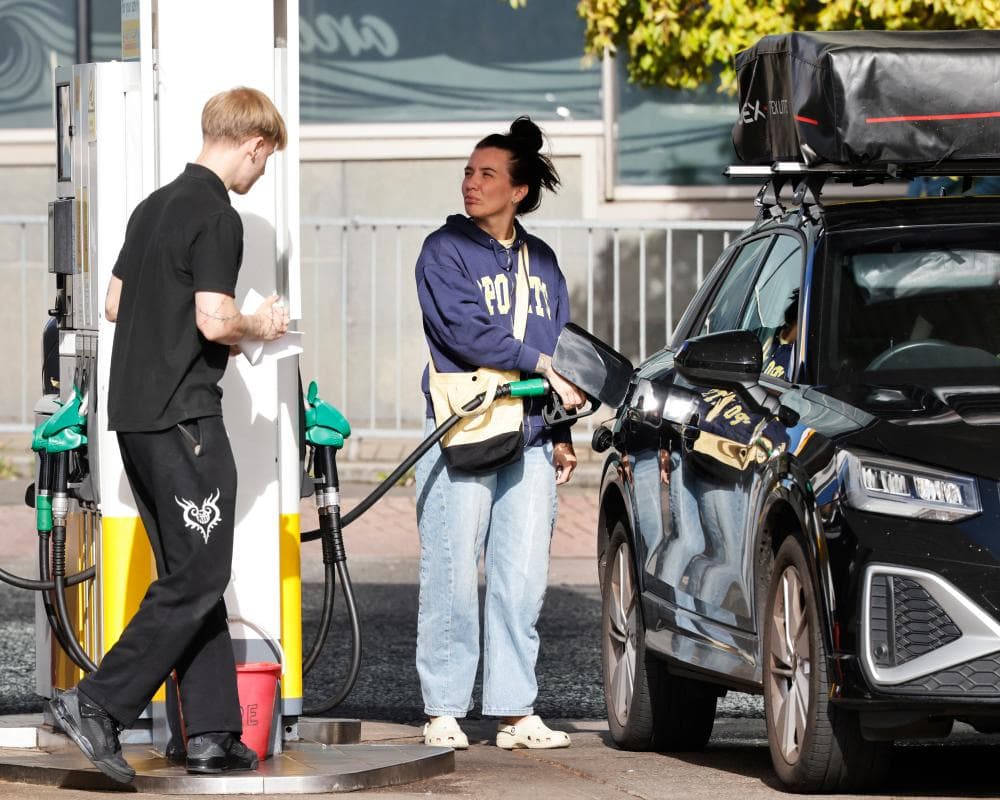
UK diesel drivers have been warned to expect record costs at the pumps within days.
The average price of a litre of diesel has risen to 198.32p a litre today, near to the previous record of just over 199p a litre, set in 2022.
RAC head of policy Simon Williams says:
“The record of 199.09p will almost certainly be surpassed over the weekend as retailers continue to pass on the increases they’re seeing when they buy new supply. Petrol is now averaging 173.6p – its highest price in more than four years.
Petrol has risen nearly 12p in September and more than 40p since the Iran War began. Diesel is up 14.5p this month alone and 55p since 28 February.
The governor of the Bank of England has warned that it will be hard to avoid raising interest rates if energy prices remain high.
Andrew Bailey told an economics conference in Oxford:
We’ve made it quite clear… that it’s going to be harder to maintain that stance, the longer we have high energy prices.
Bailey also revealed that the BoE has been using large language models to test how its communications will be received by the markets.
The oil price has dipped slightly today, following reports that US and Iranian negotiators in New York are exploring “a phased path out of war”. Brent crude is down 0.4% at $106.15 a barrel, having been down over 1% earlier in the day.
UK consumer confidence has picked up – but there are concerns that the recovery may be fading.
And in the US, consumer sentiment has hit a four-month low amid agreement that the outlook for the economy has weakened since the beginning of the year.
And in other news:
Related: David Beckham takes £39m dividend as World Cup deals drive record profits
Related: UK food and drink trade deficit largest since 2000 at £21bn
Related: Healey appoints Labour manifesto writer, adding to election speculation
Related: TalkTalk races to sell consumer and broadband arms as administration looms
Updated
US 30-year bond yield hits 22-year high
US government borrowing costs are hitting new multi-year highs today.
The yield on 30-year US Treasury bonds has just hit 5.5185%, the highest since 2004.
Stocks have opened higher on Wall Street, where the Dow Jones industrial average is up 267 points or 0.5% at 51,617 points.
Investors may be cheered that Donald Trump and Xi Jinping have agreed a two-month extension of the US-China trade truce, removing the immediate risk of a tariff escalation soon.
Lynn Song, ING’s chief economist for Greater China, says:
The summit delivered plenty of symbolic goodwill, including closer people-to-people exchanges and China’s announcement that it will send two pandas to the US.
However, there was little substantive progress on tougher issues including trade barriers, AI competition, Taiwan and broader geopolitical tensions.
Over in the US, durable goods orders were flat month-on-month in August new data shows.
That’s better than expected. In another boost, core capital goods orders (which strip out defence orders) rose by 1.6%.
This points to further strength in business spending on equipment in the second half of this year, according to Bernard Yaros, lead US economist at Oxford Economics.
Updated
Greece’s prime minister has spoken about Athens’s push to attract hedge funds.
Kyriakos Mitsotakis told Bloomberg TV:
“We did something relatively simple: we went to London, New York, we asked the big wealth creators, hedge fund managers, what would it take for you to come to Greece?
“And of course this contributes significantly to the Greek economy.”
Earlier this month, it emerged that hedge fund billionaire Chris Rokos is poised to leave the UK and open an office in Athens.
Related: Billionaire Chris Rokos, who paid £330m in tax last year, to quit UK
Healey appoints Labour manifesto writer, fuelling election speculation
Ravinder Athwal, the economist who wrote Labour’s 2024 manifesto, is taking on a senior role as an adviser to John Healey, in a move likely to fuel speculation about an early general election, my colleague Heather Stewart reports.
The chancellor is keen to beef up his team before the critical budget on 28 October, as the economy is buffeted by high oil prices and rising government borrowing costs.
Healey has poached Athwal to be his senior special adviser from the business advisory group Flint Global, previously run by Andy Burnham’s chief of staff, the former Blair-era cabinet minister James Purnell.
Athwal, a Cambridge economics graduate, was closely associated with drawing up Labour’s manifesto, and devising Keir Starmer’s five “missions”, which were meant to shape Labour’s approach to government.
Related: Healey appoints Labour manifesto writer, fuelling election speculation
Elon Musk’s X has reported its first increase in UK revenues since the controversial billionaire sparked an advertiser exodus after buying the social media platform four years ago.
X, formerly known as Twitter, reported UK revenues of £46.4m last year, an increase of 61% on 2024. Pre-tax profits also surged more than doubling to £1.58m, according to the latest annual accounts filed at Companies House.
Commenting on events this year the company revealed that it took a $4.5m advertising revenue hit in the first quarter due to the Iran war and “related disruption in the Middle East and North Africa region”.
The rebound in revenues last year suggests that X may have finally weathered the worst of the widespread advertising boycott after Musk completed his $44bn takeover of the platform at the end of 2022.
Related: Elon Musk, world’s richest man, reaches deal to buy Twitter for $44bn
Total revenues plummeted by two-thirds to £69.1m in 2023, from £205.3m in 2022, as Musk moved to axe 80% of the then 399 UK staff.
However, the latest set of accounts indicate that advertisers remain concerned over the content that can appear on X, with advertising income remaining broadly flat year-on-year at £22.9m.
Earlier this year it emerged that X’s chatbot, Grok, was being utilised to undress women in pictures and generate child sexual abuse images. The UK regulator, Ofcom is formally investigating the issue, its first use of new online safety laws.
Related: Grok AI generated about 3m sexualised images in 11 days, study finds
In an onstage interview at an event in New York in 2023, Musk told advertisers who had pulled money from X over his endorsement of an antisemitic tweet to “go fuck yourself”.
Months later the billionaire went on to sue major companies including Unilever, the Marmite-to-Dove conglomerate, Mars, Nestle and Colgate-Palmolive accusing them of unlawfully conspiring in a “massive advertiser boycott”.
Musk dropped Unilever from the lawsuit in 2024, and earlier this year a US judge dismissed the remaining legal action.
The latest accounts for the UK show that the annual increase in revenue was due to income it receives from inter-company services it provides to its parent company, X Internet Unlimited Company (XIUC), in areas such as software development, research, coding and advertising technology.
This rose from £23.6m last year, from £6.9m in 2024.
The UK company employed 84 staff last year, slightly up from 76 in 2024. However, X UK’s wage bill surged from £14.5m to £47m, due to £28m in share-based payments.
Updated
Santander customers are reporting problems using their banking app.
There has been a jump in users flagging problems on Downdetector this morning.
App users are presented with an error screen, in which Santander says it is having “some issues”, and is “working hard to fix it.”
Online and phone banking is working as normal, Santander tells us.
Updated
The UK’s aviation regulator has announced the scope of its independent review into the air traffic control failure in early September.
The Civil Aviation Authority says it will look to see if any additional actions need to be taken to strengthen confidence in the resilience of the UK’s air traffic management system in the future.
This will include:
NATS’ strategy and plans for the renewal, replacement and modernisation of critical operational systems, including how business continuity plans could be improved for existing systems and how well NATS is set to deliver modernisation of those systems.
How well the recommendations from previous reviews have been implemented.
The effectiveness of the CAA’s regulatory oversight arrangements.
Lessons that could be drawn from international best practice, including in relation to resilience and recovery from significant disruption.
It will also examine the report into the failure produced by Nats last week, which blamed a software error:
Related: Flight chaos for hundreds of thousands was caused in ‘millisecond’ by software error
Back in the financial markets, Japan’s currency is strengthening after the US voiced concerns that it is too weak.
The yen has gained 0.8% to ¥157.6 to the dollar, away from the ¥160/$ level that tends to cause alarm.
It rallied after US president Donald Trump raised concern about yen weakness at a summit with Japanese prime minister Sanae Takaichi, according to Japan’s Finance Minister Satsuki Katayama.
The two countries recently intervened to push up the yen…
Diesel on brink of all-time high
Newsflash: the cost of diesel in the UK has risen close to a record high.
New data from the RAC shows that the average price of diesel has risen to 198.32p a litre.
That puts it on the brink of the previous record of just over 199p a litre, set in 2022 – a level which could be breached in the next few days.
RAC head of policy Simon Williams says:
“The record of 199.09p will almost certainly be surpassed over the weekend as retailers continue to pass on the increases they’re seeing when they buy new supply. Petrol is now averaging 173.6p – its highest price in more than four years. Petrol has risen nearly 12p in September and more than 40p since the Iran War began. Diesel is up 14.5p this month alone and 55p since 28 February.
“Sadly for drivers, there appears to be no end in sight to high prices at the pumps as the cost of a barrel of oil hit $106 having been around that $100 mark for the last two weeks. A significant drop in the price of oil is badly needed but this seems unlikely without the US and Iran striking a deal.”
Prices have been driven up globally by the Iran war, which has restricted oil supplies from the Middle East. Recent attacks on Russian refineries by Ukraine have also hurt supplies of diesel.
Related: ‘Half my day’s pay goes to filling up my car now’: diesel crisis ripples across Britain
Updated
Bank of England uses LLMs to assess how markets will react to its words
The Bank of England is using artificial intelligence technology to assess how its communications will be interpreted by markets.
BoE governor Andrew Bailey told this morning’s Monetary Economics Conference at St Hilda’s, Oxford, that Bank staff are using an LLM (large language model) to assess the minutes of the Monetary Policy Committee’s meetings.
The governor says:
I have very mixed views on this, to be honest. It is helpful. But I think ‘where are we going with this?’ But it is helpful.
Bailey explains that the LLM will produce a ‘summary’ view, and say ‘is this what you thought you were doing?’.
He cites a recent debate at the MPC over whether to use the word ‘cautious’ or ‘careful’ in the minutes, during which the governor jokes that he ‘lost the will to live’.
(But such debates are necessary because central bank language is closely assessed by investors, who will increasingly be using their own AI models to rapidly analyse the Bank’s communication).
Bailey: high energy prices make it harder not to raise interest rates
Bank of England governor Andrew Bailey then hints that UK interest rates may need to rise if the Iran war doesn’t end soon.
He tells his audience in Oxford that the Bank has made “a strong point” of saying that the longer high energy prices continue, the harder it becomes to leave borrowing costs unchanged.
Bailey says:
We’ve made it quite clear… that it’s going to be harder to maintain that stance, the longer we have high energy prices.
That chimes with Morgan Stanley’s view this morning – as covered at 10.24am, they expect rate rises by next February.
Bailey also told the conference that there is “no question that we’re seeing the first-round effects” of higher energy prices, adding:
“We are at the moment seeing quite subdued pass-through but it’s early days.”
Updated
BoE's Bailey: AI could be a positive shock, in a world of negative supply shocks
Bank of England governor Andrew Bailey is warning that we are living through an era of “big supply shocks”.
He’s speaking at a Monetary Economics Conference in Oxford, and explains that we are in a world of very big negative supply shocks, and quite repeated supply shocks
AI, though, could be a “positive shock”, though, Bailey suggests.
Morgan Stanley now sees UK interest rate hikes in November and February
Morgan Stanley has changed its Bank of England interest rate call on Friday, and now predicts it will hike borrowing costs in November and February.
Morgan Stanley had previously expected no hikes for the foreseeable future, but it now warns that the newsflow in the commodity markets is not improving.
Their analysts also expect a slowdown in growth at the turn of the year.
Bruna Skarica and Fabio Bassanin told clients this morning:
While we still think - and with a decent degree of conviction - that any signs of an improvement in the supply in oil and refined products would leave the BoE on hold from here, it is challenging to maintain a prolonged hold as a modal call amid the recent Middle East newsflow.
GfK’s report that UK consumer confidence has risen this month is at odds with other data.
Earlier this week, data provider S&P Global reported that fears of a steep rise in mortgage payments and increasing job insecurity have sent UK consumer confidence tumbling to a three-month low.
Related: Fears over interest rate rise and jobs send UK consumer confidence to three-year low
UK mortgage rates stick at multi-year highs
After rising steadily for several days, UK mortgage rates have finally flattened out.
Moneyfacts reports that the average five-year fixed rate mortgage is unchanged today, at the highest since October 2023, while two-year mortgages remain at the highest since July 2024.
Here’s the details:
The average 2-year fixed residential mortgage rate today is 5.92%. This is unchanged from the previous working day.
The average 5-year fixed residential mortgage rate today is 5.94%. This is unchanged from the previous working day.
Updated
Administration looms over TalkTalk
TalkTalk is scrambling to secure its future amid the threat of administration, closing in on deals to sell its consumer and broadband arms as it seeks to save 900 jobs.
The telecoms company said on Friday it is in the final stages of sealing deals to sell its consumer business as well as its wholesale operation, PXC.
“The company is now in the final stages of its sales process for the business and expects to conclude both transactions imminently.”
The UK’s fourth-largest broadband company was founded in 2003 by Charles Dunstone as a subsidiary of Carphone Warehouse. It has struggled in the highly competitive telecoms market, with its customer numbers shrinking from 4 million in 2019 to about 1.5 million.
Related: TalkTalk races to sell consumer and broadband arms as administration looms
The pound is on track for its worst week against the US dollar in three months.
Sterling has dropped by 1.2% against the dollar so far this week, as the greenback has benefited from strong economic data which spurred bets on US interest rate rises. That would be the biggest weekly fall since 11-15 June.
This morning, the pound is hovering near three-month lows against both the dollar (at $1.323) and the euro (€1.162).
Shares in aerospace manufacturer Airbus have dipped by over 1% this morning after it reported a “quality issue” in the fuselage structure of its A321neo aircraft.
Airbus said yesterday that the problem is not a safety risk, and its planes can continue operating.
Reuters reports that the defect affects about 500 aircraft, including roughly 250 already in service and 250 in production.
UK bond yields dip back
After a choppy day yesterday, UK goverment bonds are recovering this morning.
With prices rising, the yields (or rate of return) on both short and long-dated gilts have dropped.
Two-year gilt yields, which are used to price mortgages, are down 5 basis points (0.05 of a percentage point) to 4.85%, while 10-year gilt yields are down 2.5bps to 5.35%.
European stock markets have opened higher.
In London, the FTSE 100 share index is up 48 points or 0.46% at 10,728 points, with mining stocks and banks among the risers.
Germany’s DAX is up 0.6%, with France’s CAC 40 0.4% higher.
Macron: I pressed Trump not to ban diesel exports
French president Emmanuel Macron is leading the fight against the imposition of a ban on US diesel exports.
Macron has revealed that he told Donald Trump a 90-day diesel export ban reportedly being considered by the White House was a bad idea, Politico reports.
He told a TV interview:
“I think all the experts around him and all the American refiners can only tell him the same thing.
This decision would be a bad one — not just for the rest of the world, but for the U.S. economy as well.”
Trump is reportedly considering a 90-day export ban to provide a temporary respite from high pump prices for US households before the midterm election.
As we reported yesterday, the EU has warned Donald Trump against plans to ban US diesel exports to the global market, saying the move would negatively affect Europe and the US.
Related: EU says Trump’s plan to ban US diesel exports would ‘negatively impact both sides’
Next month’s budget has the potential to either strengthen the recovery in consumer confidence, or pop it.
Pat McFadden, work and pensions secretary, has claimed that chancellor John Healey’s budget on 28 October could help to build confidence in the economy.
“I’ve known John for decades. I know he’ll approach this in a really responsible way.
“He will want to say to the country, the business community and the financial world that this is a stable government and Britain is a good place to invest in business and to start and grow a business.”
The oil price is dropping, following reports that the US and Iran are discussing a phased deal to reopen the strait of Hormuz.
Reuters reported that US and Iranian negotiators in New York are exploring “a phased path out of war” that would involve Tehran reopening the Strait of Hormuz and Washington lifting its economic blockade of Iran.
However, the talks “face a big obstacle” as neither side wants to be the first to surrender its leverage.
But still… Brent crude is down 1.25% today at $105.30 a barrel.
Here’s a breakdown of today’s UK consumer confidence report, showing how four of the five measures that feed into the index rose this month.
Introduction: UK consumer confidence up, but is 'Burnham bounce' fading?
Good morning, and welcome to our rolling coverage of business, the financial markets and the world economy.
UK consumer confidence has surprisingly hit a two-year high this morning, but the recovery could be faltering as inflation climbs.
Research group GfK has reported that its Consumer Confidence Barometer rose to -13 in September, a rise of one point compared with August, with people more optimistic about their personal finances and the wider economy.
That’s the highest level since August 2024, just after the last general election, and higher than forecast.
Encouragingly, this is also the first time since summer 2024 that consumer confidence has risen for three months in a row.
But less cheeringly, consumer confidence is still in negative territory, and there are signs that the recovery could be faltering.
Over the summer, UK businesses reported a “Burnham bounce” after the new prime minister took the wheel from Sir Keir Starmer, and announced measures including a cap on bus fares and a discount on business rates for pubs, clubs and live music venues.
Bloomberg suggests GfK’s data shows this recovery is running out of steam, as higher energy costs push up inflation.
Related: Pubs, bars and hotels report ‘Burnham bounce’ in optimism but call for further tax relief
Neil Bellamy, consumer insights director at GfK, explains:
The return of higher inflation removes one of the strongest positives seen in previous months. So, while the headline score continues to improve, confidence is still firmly in negative territory. With inflation, energy and fuel prices rising, could we soon see consumer sentiment falter?”
GfK reports that consumers are less willing to buy big-ticket items this month, and more keen to save money instead.
Bellamy adds:
The only measure to fall this month was the Major Purchase Index, down one point, which comes as we head into the important Golden Quarter for retailers. The Savings Index rose five points, which, although not used in our headline score, may indicate that those who can are thinking of building a financial buffer.
The agenda
10.15am BST: Bank of England governor Andrew Bailey appears on a panel at the Monetary Economics Conference
1.30pm BST: US durable goods orders data
3pm BST: University of Michigan’s US consumer sentiment index