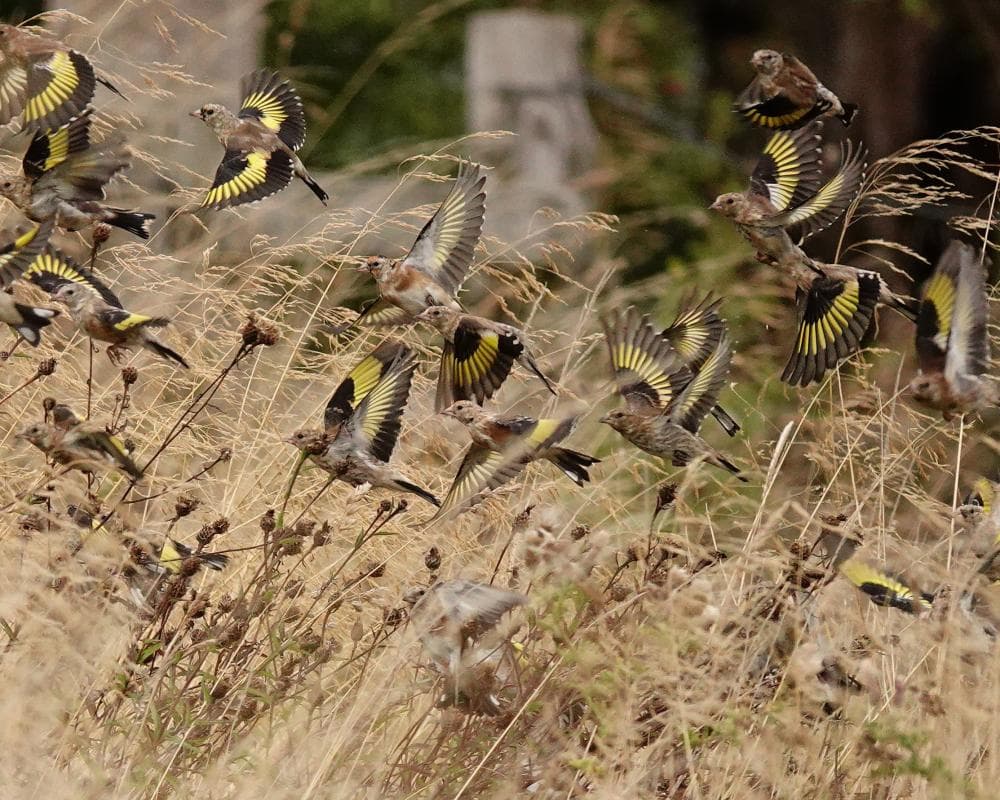
Stands of tufted hair-grass, some over a metre tall, burned beige by the summer heat, were churned by strong autumn westerlies. Over and through the vegetation’s swaying lather roved a flock of about 200 goldfinches, most of them this year’s young. They were intent on the hanks of thistle and knapweed seed which lay below the hair-grass “canopy”.
These immature finches lack any of the red and black bands of the adult’s head. Instead of the smooth mocha buff on their parents’ underparts, the youngsters were dull and streaky. What they had to perfection were the semi-circular disks of yellow across each black wing, while every feather through that full fan was tipped with white.
As they moved from place to place, working through the grasses, so the birds created double bands of brightness that shone in intermittent sunlight. The whole scene – the frothing plant stems and the shifting birds – produced exquisite countervailing patterns of movement.
An old name for goldfinch is “tailorbird”. It’s said to refer to the white eye-holes inserted into their tail- and wing-tips. As the birds worked away, winnowing thistle floss from seed, letting hanks float off on the breeze, it occurred to me that these prolonged ecological relationships with cottony material could also explain the “tailor” name. It may further account for the birds’ love of spiders’ silk and wool and other fibres as nest material: they are surely tailorbirds in name and nature.
As they showered up and descended again in patterns of yellow flecking, it also came to me that the visual impact and the sounds of the flock are more than mere analogues. They seem party to some greater creative whole. Goldfinch calls are soft, tinkling, fragmented, but also somehow molten and blended one to another like melting flakes of gold – no, not gold, but something rarer, something more meaningful than mere metal. Let’s say the dust from some exploded star in a far galaxy that wandered and settled hereabouts 5 billion years ago, only to be infused with something rarest of all: soiled, earthy and – here at Priestcliffe today – called “life”.
• Under the Changing Skies: The Best of the Guardian’s Country Diary, 2018-2024, is available now at guardianbookshop.com