'Insufficient' emissions cuts in the EU - report
The EU is almost on track to meet its 2030 climate targets, an official report has found, but efforts to cut pollution fall well short of its 2040 and 2050 targets.
The report, published today by the European Environment Agency (EEA), found EU emissions fell by 1.6% in 2025, though at a slower pace than the year before and not deeply enough to put it on track to meet its goals. If all planned climate policies are put in place, its net emissions should fall by 54% from 1990 levels by the end of the decade, just shy of its legally binding target of 55%.
Europe is among the biggest historical polluters of planet-heating gas, having begun the Industrial Revolution and exported its economic system around the world. In recent decades, though, it has championed some of the most dramatic reductions in pollution. The average European now pollutes a little less carbon than the average Chinese person. Both regions have per-capita emissions well below that of the US, Canada and Australia, though considerably greater than India, Brazil and Indonesia.
The EEA report found EU emission reductions in the next five years must be as high as those achieved over the last two decades to meet its targets. But observers fear many of the easy wins have been exhausted, observers fear, while recent rollbacks of climate policy have dealt a blow to the bloc’s credibility.
Updated
Last week, my colleague Adam Morton sat down with the Australian climate minister, Chris Bowen, who is leading the official negotiations. He put some of the apparent contradictions in Australia’s own climate record to the minister – a high-emitting nation chairing climate negotiations while exporting fossil fuels and approving more polluting projects.
Listen to the full interview here.
‘I want future generations to have the right to grow up with our rivers, our forests, our cultures’
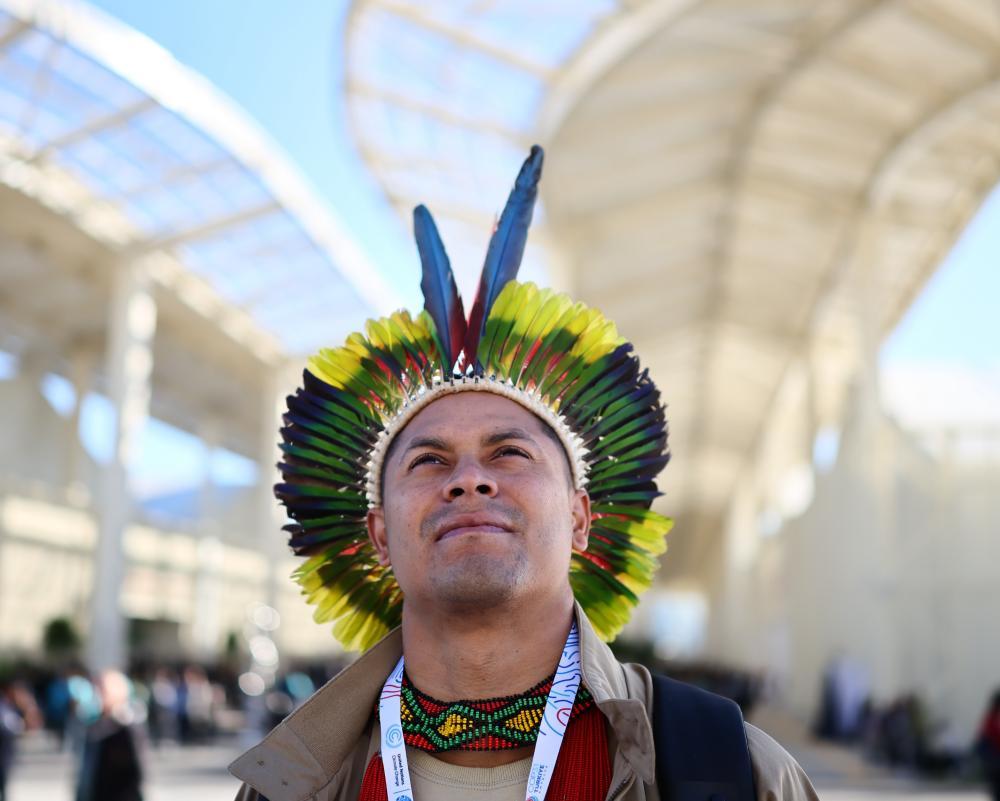
I’ve been interviewing some of the young climate activists who have gone to the summit. Janiely Truká, 18, is an activist, writer and poet who belongs to the Truká people of Pernambuco, Brazil. She’s a member of Engajamundo, a youth-led activist network, and serves as a youth adviser for Unicef Brazil.
“Growing up in an Indigenous territory means understanding, from an early age, that our existence is deeply connected to nature. I learned from my elders that caring for the land, the waters, and everything that lives within them is, in essence, caring for our own lives.
“For us, the climate crisis is not a distant threat or something that will only happen in the future. We feel the impact of rising temperatures, erratic rainfall, and the hardships these changes bring to those who depend on the land and water for their survival. For us, as Indigenous peoples, the climate crisis also poses a threat to our ways of life, our traditional knowledge, our culture, and future generations.
“This is my first time participating in a UN Climate Change Conference, and I am well aware of the challenges this entails – especially as a young person, I know that it is becoming increasingly difficult for youth to gain access to these spaces. I therefore hope that all of this is taken into account, and that our voices and demands are genuinely considered.
“We need concrete commitments that go beyond mere rhetoric – commitments that ensure climate financing, the protection of our territories, and the effective participation of Indigenous peoples. Furthermore, it should be easier for young people to be present in spaces like this. When I think about the future, I do not want to have to choose between existing and protecting my territory. I want future generations to have the right to grow up with our rivers, our forests, our cultures, and our territories protected.
“The recent election results in Brazil also present an opportunity to strengthen environmental policies, the rights of Indigenous peoples, and climate justice. I hope this outcome translates into tangible action, especially regarding the advancement of the demarcation of Indigenous lands.”
Avoiding a damaging “agenda fight” is a good start for this year’s Cop, as the beginnings of previous Cops have frequently been marred by such tussles, leading to the absurd situation where delegates could not begin their meetings because no one had agreed what the Cop was allowed to discuss.
At Cop29 in Baku in 2024, disagreements over the agenda – a crucial document as it determines the negotiation topics and strands – delayed the opening plenary for many hours. At Sharm el-Sheikh in 2022, negotiators worked through the night to try to sort out their differences.
In between, at Cop28 in Dubai, the Cop president Sultan Al Jaber surprised negotiators with an unexpected ploy – he began the conference with the adoption of a key decision, to operationalise the loss and damage fund. Usually, no decisions are reached until the very final hours of Cops, which often stretch well beyond the fortnight allocated before the gavel can come down.
But Al Jaber had prepared the ground, the loss and damage fund was a key demand for developing countries, and all parties agreed it was in their interest to pass it immediately. That set the tone for the rest of the Dubai Cop, which ended with the historic resolution to “transition away from fossil fuels”.
The jargon-filled texts that will be haggled over by suited delegates in a sterile conference hall feel far removed from the causes and consequences of the climate crisis. But it is real people’s lives – including your own – that they have the power to change.
Take a moment to read Zirrar Ali’s story for a taste of what fossil fuel pollution is bringing swathes of the planet.
Updated
The US will be absent from the key UN climate talks that started today, a further sign of Donald Trump’s scornful dismissal of the climate crisis. But Democrats’ crushing win in the US midterm elections has delivered a timely shot of optimism to countries now looking beyond the Trump era of climate obstruction.
For the second year in a row, there will be no official US government presence at the annual climate summit, this year known as Cop31 and held in Antalya, Turkey. While almost every other country in the world sends delegations to the talks, Trump has derided the climate crisis as a “hoax” and “bullshit” and triggered the withdrawal of the US from the entire international climate framework.
“This summit rejects reality by failing to acknowledge that extremist climate policies are destroying countries around the world,” a White House official said, confirming that the administration would not send anyone to Cop31.
The snub is so severe that about 20 members of the US Congress heading to the summit have been denied usual state department assistance, requiring them to turn to philanthropic funding for the trip. “I’m glad we found a way to get there, but it is insane,” said Sean Casten, a Democratic congressman who is attending Cop31. “We have a lot of rebuilding to do. It hinges on Congress to maintain diplomatic continuities at Cop and minimize the damage until adults are back in the White House.”
Trump’s active support of fossil fuels, evisceration of pollution limits and throttling of clean energy projects has caused the US to become an outlier among wealthy countries, a recent UN report found. While all the other 20 major economies reduced or slowed their carbon pollution last year, the US was a “major exception” by emitting an extra 133m tons of planet-heating gases from the burning of coal, oil and gas, the report states.
Despite the world rapidly surging past “safe” temperature thresholds because of such pollution, and escalating heatwaves, floods, droughts and other calamities, Trump has remained defiant. “If you don’t get away from this green scam, your country is going to fail,” the US president told other world leaders at the UN last year, adding that the climate crisis was “the greatest con job ever perpetrated on the world”.
Tensions are already beginning to rise in Antalya – and it’s all about money, of course.
Finance is one of the top priorities of developing countries going into Cop31, but it is a topic that wealthier countries would prefer not to tackle.
So the EU was not pleased when discussion of the Climate Finance Work Programme (CFWP), an initiative launched at last year’s Cop30 summit in Brazil, was added to the agenda. According to Carbon Brief, the bloc’s representative said it “remain[ed] deeply concerned” that the CFWP was being brought up again.
The two-year programme was agreed as part of Cop30’s “Mutirão” decision after developing countries fought hard at last year’s summit for a discussion of finance.
They repeatedly invoked the Paris Agreement’s Article 9.1, which stipulates that rich countries “shall provide financial resources to assist developing country parties” in adapting to and mitigating climate breakdown.
Carbon Brief quoted the EU rep as saying the block had “serious concerns that the agreed outcomes and delicate compromises of the Mutirao decision [from COP30] are increasingly called into question”.
Developing countries have not got all the finance topics included that they wanted. Proposals by the African group to include an agenda item specifically on a promise to triple adaptation finance and another on trade were refused.
Mohamed Adow, director of the climate thinktank Power Shift Africa, said their top priority, the Climate Finance Work Programme, will be adopted exactly as presented in the provisional agenda, but that they would have preferred the tripling of adaptation finance to become a dedicated agenda item.
“But the commitment countries made in Belém to at least triple adaptation finance by 2035 is not going away. The Chair will consult adaptation and finance negotiators after the opening plenary. We will hold developed countries to that commitment in every room where finance is discussed. For African countries, adaptation is not optional. It is survival.”
Updated
This drone shot shows the venue in which diplomats have begun negotiating global rules to stop the planet from heating and keep people safe from more violent weather. Antalya, the Turkish resort town hosting the summit, is one of the many Mediterranean tourism centres deeply threatened by extreme heat and rampant wildfires.
Updated
The agenda for the summit has been adopted, avoiding a lengthy fight over what makes it to the negotiation table – a problem that has frustrated diplomats at some recent climate summits. More to follow …
Updated
Who is running this year’s climate summit?
The annual Cop summits rotate between host countries from different regions of the world. In the previous four years, delegates have traveled to Sharm El Sheikh, Egypt; Dubai, UAE; Baku, Azerbaijan; and Belém, Brazil.
That this year’s conference takes place in Antalya, Turkey, makes it seem like a unusually large share are hosted in and around the Middle East, but that’s a quirk of geography and UN rules more than anything else. Egypt is in the African Group, UAE in the Asia and Pacific Group, Azerbaijan in the Eastern European Group, and Turkey in the Western European and Other Group. It’s this final group hosting this year’s summit.
But a standoff between Australia and Turkey means that Cop31 unexpectedly belongs to both countries – with Turkey the official host and Australia in charge of negotiations. My colleague Fiona Harvey breaks it down here.
Australia will take charge of the formal negotiations where countries thrash out the details of work programmes such as the “just transition”, climate finance and putting the world on track to stick as closely as possible to the Paris agreement goal of limiting temperature rises to 1.5C above preindustrial levels.
Turkey will take charge of the “action agenda”, the voluntary agreements that work towards the Paris goals but are not legally binding: programmes on cutting waste and achieving a circular economy, cutting methane, improving food security, and – perhaps most important – the electrification of the global economy.
Related: Cop31: what is at stake at the UN climate summit and what can it achieve?
Updated
'The human costs keep rising' - UN finds Earth heating faster and faster
Heat is accumulating in Earth’s systems at an accelerating rate, the UN’s weather agency has reported as the Cop31 climate change summit begins in Turkey, with 2026 on track to be one of the four warmest years on record.
The imbalance between incoming energy from the sun and energy leaving Earth reached its highest level since monitoring began, the World Meteorological Organization (WMO) said in its State of the Global Climate update this morning.
That imbalance and the accumulation of heat will supercharge extreme weather events such as heatwaves, droughts and tropical cyclones.
Around the world, the average surface temperature for January to September 2026 was about 1.47C above the preindustrial average, the agency said. Sea surface temperatures hit monthly records and sea level was the highest since records began. The ocean absorbs 90% of the excess heat trapped by greenhouse gases and 2026 is on track to be a 10th successive year of record ocean heat.
“We have entered a new age of climate extremes,” said António Guterres, the UN secretary general. “A supersized El Niño is colliding with a planet already superheated by manmade climate change. Climate records keep falling. The human costs keep rising. And those least responsible are suffering first and worst.”
Related: ‘A new age of climate extremes’: Earth accumulating heat at accelerating rate
And with that, the plenary closes and the hard work of negotiations starts for the next two weeks.
I’m off to find a coffee.
The UN’s chief climate negotiator, Simon Stiell, has rattled through the jobs before Cop31 – getting agreements on adaptation, mitigation and finance.
But like the other speakers, he returns to the science.
“The urgency of this moment must drive us forward. Global heating is already costing the Earth.
“A monster El Niño is piling fuel on the climate fire that’s already burning through communities and economies everywhere.”
He’s also just delivered some startling rhetoric on the oil price crisis.
“Meanwhile, this year’s fossil fuel cost chaos has delivered a global shock wave, hitting households hard and spreading inflation like a cancer.”
Updated
A bit of clenched fist-waving determination from Australian climate change minister Chris Bowen as he closes his speech.
“Friends, let’s show the world that multilateralism works. Let’s show the world we are equal to the challenge.
“Let’s join in a spirit of cooperation and respect. Let’s show future generations that this generation was equal to the moment, equal to the challenge.
“Let’s rise to this moment together.”
Now its the turn of the UN climate chief, Simon Stiell.
Next up is the Australian climate change minister, Chris Bowen, who is president of the negotiations here in Antalya.
This is his big moment to set the tone for the next two weeks, and he said even though the 1.5C Paris target will be overshot, “we can return … if we work together and act with urgency, solidarity and resolve.”
“We meet at a moment of consequence. Whether it be glacial collapse in Nepal, heat deaths in Europe, or an intensifying El Niño.
“Climate change is here. It is not a forecast. It is not a prediction. It is the lived reality for billions of people. Its impacts are growing more frequent and intense.
“Every fraction of a degree, and every delay, increases the risks to lives, communities, economic growth and the environment.”
Updated
We’ve just heard from Turkey’s environment minister, Murat Kurum, who is president of the COP. He asked negotiators to “replace delay with action,” and to “bring climate action into people’s lives.”
Updated
The lights go dark in the plenary room and we get a short movie, designed to awaken the emotions and inspire the negotiators with scenes of fire and storms.
“When did you start to look at nature as if it’s not your nature,” the gravel-voiced narrator asks.
“It’s time to reconnect with the planet we have grown apart from,” the text on the screen says.
Stirring stuff.
Updated
Veteran Brazilian diplomat André Aranha Corrêa do Lago, the president of last year’s Cop30 in Belem, is getting the opening ceremony under way.
“We know the wealthiest people are those increasing their emissions, but we have to bring people out of poverty,” he says.
We are waiting for the ceremony to start and I have a seat at the back. Cop31 has a theme tune and I’m going to call it – it’s a banger.
“Bring down the heat, make it drop.”
“One world, one call. Let’s Cop.”
It’s on Spotify and no doubt other music streaming services.
Leaders of many big polluters are expected to skip the summit
In the plenary session that has just begun, Turkey’s environment minister, Murat Kurum, and Australia’s climate and environment minister, Chris Bowen, will kick off the conference, along with the UN’s climate chief, Simon Stiell.
Their task will be to show that the 2015 Paris climate agreement is still working, despite record-breaking temperatures in the past two years that have surpassed the pact’s key threshold of 1.5C (2.7F) above preindustrial levels – though the goal will only be missed if the decadal average ends up hotter than that – and despite uncertainty over future climate finance to the developing world.
Most world leaders will not arrive until Wednesday and Thursday, when the “leaders’ summit” segment takes place, and they will hold multilateral and bilateral talks aimed at breaking the impasse over how to cut greenhouse gas emissions and adapt to the impacts of the climate crisis.
Some big names will be missing: Xi Jinping, China’s president, rarely attends summits; Narendra Modi, prime minister of India, also tends to skip Cops; and Donald Trump has withdrawn the US from the Paris agreement and is in the process of withdrawal from its parent treaty, the 1992 UNFCCC. This year, some European leaders will also join the absentee list: Emmanuel Macron of France, who has been a major presence at previous Cops, will not attend, nor Friedrich Merz of Germany or Mark Carney of Canada, despite claims to be climate leaders.
Brazil’s recently re-elected Luiz Inácio Lula da Silva will attend, following Brazil’s hosting of the Cop30 summit in Belem last year, and is expected to highlight issues of climate inequalities between the rich and the poor – including the rich elites within developed and developing countries, whose high-carbon lifestyles are at odds with those of their less well-off citizens.
The EU commission president, Ursula von der Leyen, will join, and the UK’s Andy Burnham will also take part, with foreign minister, Ed Miliband, who has been briefing other countries on the national security risks posed by the climate crisis and biodiversity collapse around the world.
Updated
Good morning from the COP31 media centre here in Antalya after a sardine-style tram journey in to the venue.
We are now expecting the official ceremonial opening of the COP to start at 11am Turkey time (8am in the UK) – 30 minutes later than previously advertised.
That’s not a bad start, given some previous plenaries have been delayed by several hours.
We’re expecting some stirring speeches from Simon Stiell, the executive secretary of the UN Framework Convention on Climate Change, and the Australian climate change minister Chris Bowen, who is president of the negotiations.
We will also hear from Turkey’s environment minister, Murat Kurum, who is president of the COP. If you want to know who the key players are, my colleague Fiona Harvey explains here.
Related: Who’s who at Cop31: key players at the climate talks
Updated
One of the most promising areas of potential progress is on electrification, which is needed to reduce global greenhouse gas emissions. Despite the strong growth in renewable energy around the world, nearly 80% of primary energy still comes from fossil fuels, used for transport, heating and industrial purposes.
Adopting electric vehicles, heat pumps, batteries and other low-carbon electric technologies could halve global primary energy needs, because they are so much more efficient than using fossil fuels.
Thornier issues of equity and climate justice will also come to the fore, including work on a “just transition” mechanism to help workers in high-carbon industries adjust to low-carbon jobs, and the vexed issue of climate finance for developing countries from the rich.
Poor countries are angry that many developed nations are slashing their aid budgets, including money for climate finance, and a promise to triple the funds available for helping them adapt to extreme weather has yet to be fleshed out.
Among the 70,000 registered attenders at today’s Cop will be civil society groups, Indigenous people from around the world, lawmakers from many countries, representatives of subnational governments, businesspeople and investors working on clean energy - and a number of fossil fuel lobbyists, whose repeated presence and influence at the annual “conference of the party” meetings of the UN Framework Convention on Climate Change (UNFCCC) has sparked protest.
Though Turkey is hosting, Australia will preside over the formal agenda of negotiations, under a compromise agreed last year when both countries bid for the right to hold the meeting.
Updated
Cop31, this year's UN climate summit, kicks off in Turkey
Hello, and welcome to the live blog for Cop, the annual UN summit to stop climate breakdown. I’m Ajit Niranjan, the European environment correspondent – I’ll be running the liveblog from Berlin over the next two weeks while my colleagues in Antalya, Turkey, bring us updates from where the action is. We’re looking forward to guiding you through a hectic fortnight of planetary significance.
More than 90 heads of state and government, along with ministers and senior officials from close to 190 countries, are expected to descend on Turkey’s coastal city of Antalya this week, for the latest round of UN climate talks. Against a backdrop of rapidly rising temperatures and extreme weather, supercharged by fossil fuels, and fractious geopolitics, made worse by soaring inflation owing to the Iran war, the fortnight-long meeting will focus on “implementation” of the world’s targets to cut greenhouse gas emissions and help those stricken by the climate crisis.
Updated