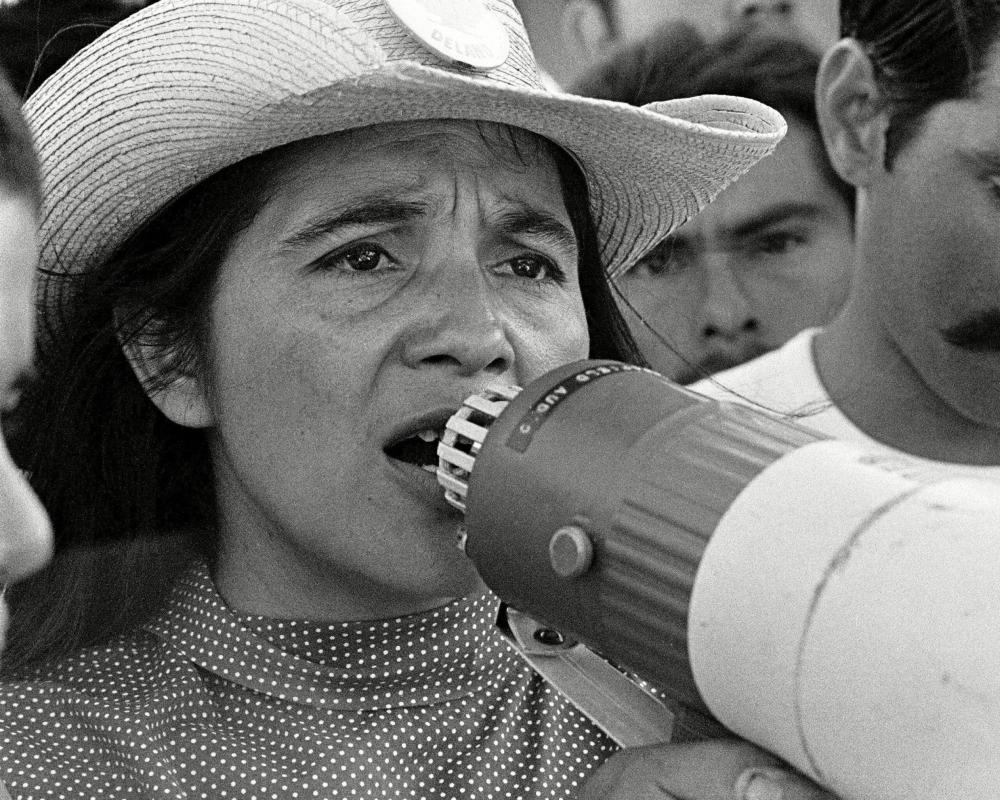
Although she was never the president of the United Farm Workers union, Dolores Huerta, who has died aged 96, was one of the most significant American trade union leaders of the 20th century. Her battle cry, “Sí, se puede!”, coined in the midst of tensions with police in Arizona in the 1970s, was adapted to the English “Yes, we can” and became Barack Obama’s slogan during his successful campaign for the US presidency in 2008.
While the UFW leader Cesar Chavez was the public face of the union as its president, Huerta was the organiser who helped break the resistance of California’s grape growers by building bridges to secondary boycotts by unions packing and transporting grapes, and by organising boycotts of national supermarket chains such as A&P and Finast, who sold them. “To take on agriculture, which to this day is still a powerhouse, that took a lot of guts,” her son Emilio said.
It sometimes also took a lot of restraint. When a New York Times investigation of Chavez’s life revealed that the union leader had sexually abused women and girls, Huerta revealed that she had been raped by Chavez. She had previously “felt pressured” to have sex with him while on a working trip in 1960; the rape occurred in his car parked in a grape field in 1966. Both times she became pregnant (she gave these children up, to be raised by others). She also detailed a brutal working culture within the UFW, which she attributed to “machismo”. She explained keeping her secret for so long because “building the movement and securing farm workers’ rights was my life’s work”.
It was also in her blood. She was born in Dawson, New Mexico, where her father, Juan Fernández, was a coal miner and United Mine Workers activist. He was driven out of town for these activities, and became a beet picker, but returned and in 1938 was elected, as a “fiery union leader”, to the state legislature. By this time her mother, Alicia (nee Chavez), had divorced him, and moved the family to Stockton, California, where her father, Herculano, helped her raise the children while she worked in a cannery and as a waitress. She opened her own restaurant in 1941, and in 1942 bought a hotel from a Japanese-American family forced to move to a “relocation centre” during the second world war.
Dolores graduated from Stockton high school, where she faced de facto segregation by race and class. She married her high-school sweetheart, Ralph Head, in 1948. After their divorce in 1951, she studied part-time while raising a family, and received a teaching qualification from Stockton College (now San Joaquin Delta College) in 1953. Discouraged by the poverty of her students, she left teaching in 1955, and joined the activist Fred Ross’s grassroots civil rights group, Community Service Organisation (CSO), where she met Chavez. That year she married Ventura Huerta.
In 1958 she helped organise what became the Agricultural Workers Organising Committee (AWOC), which was affiliated to America’s national trade union congress, the AFL-CIO. In 1962, she, Chavez and Gilbert Padilla started the National Farm Workers Association (NFWA). In 1965, they joined Filipino workers during the grape strike in Delano, north-west of Bakersfield, and the AWOC and NFWA became the United Farm Workers, with Chavez as president and Huerta as vice-president, by which point she had separated from Ventura and was living with Chavez’s family.
The Delano strike propelled Chavez and the UFW into national prominence, especially when, while campaigning for president in 1968, Robert F Kennedy symbolically broke bread with Chavez to end the union leader’s hunger strike. Huerta would later be on the platform and receive thanks from Kennedy at the Ambassador hotel in Los Angeles just moments before the candidate was assassinated.
Eventually, the successes of the UFW led to the California Agricultural Labor Relations Act, signed into law by Governor Jerry Brown in 1975. By that time, Dolores had divorced Huerta, and was living with Chavez’s brother Richard, her partner until his death in 2011. She continued to serve as the UFW’s chief negotiator, though her positions sometimes changed ahead of the union’s, and Chavez’s. The UFW originally opposed relaxing controls on immigration from south of the border, as illegal workers were used as a strike-breaking tool by big farmers. Huerta moved towards assisting immigrants to settle and work legally before it became union policy.
Similarly, although she was attracted early to feminism, meeting Gloria Steinem and founding the Coalition of Labor Union Women, she and the union originally dismissed feminism as being “middle class”, their position focusing on liberation in work, not on sexual liberation outside traditional female roles. However, in a 1976 interview with Steinem’s MS magazine Huerta spoke of feminism helping her to deal with the cultural guilt she felt over her two divorces.
Huerta used her growing profile to campaign on a wider range of social issues. Her awareness, going back to her CSO days, that the roots of workers’ strength lay in overcoming poverty and lack of education led to her protesting over other issues. She was arrested a reported 22 times, and in 1988, demonstrating at an appearance of George W Bush in San Francisco’s Union Square, she was nearly killed by police who broke several of her ribs and ruptured her spleen. After recovering, she took a leave of absence from the UFW, donated her $825,000 settlement from the city to women’s causes and campaigned for the Feminist Majority Foundation. Just before Chavez died in 1993, he apologised to Huerta for treating her and other women in the union “differently”, and she returned to the UFW, primarily as a campaigner.
In 1999 she stepped down from the UFW board, and in 2002 she founded the Dolores Huerta Foundation, whose aim was to encourage community democracy through “United Neighbours” groups, again an echo of her early days with the CSO. “I want to give our children an inheritance of justice,” she said. “That is the greatest gift I think any of us could have.”
She accepted the presidential medal of freedom from Obama in 2012, and in 2018 Jerry Brown signed a bill making 10 April Dolores Huerta Day in California. She received numerous honours, including the Eleanor Roosevelt Foundation’s human rights award, and has been the subject of two documentaries, Dolores (2017) and Seeds of Change (2025), and an opera, Dolores, which debuted in 2025. Rosario Dawson portrayed her in Diego Luna’s 2014 film Cesar Chavez.
She is survived by her daughters, Celeste and Lori, from her first marriage, her sons, Fidel, Emilio and Vincent, and daughters, Alicia and Angela, from her second, and a son, Ricardo, and daughters, Juana, Maria Elena, and Camila, with Richard Chavez. Her two children by Cesar Chavez were not publicly identified.
• Dolores Clara Huerta, labour organiser and campaigner, born 10 April 1930; died 28 October 2026