For a brief period in the early 1970s, Donny Osmond ruled the world. He was the global teenage heart-throb. Even Michael Jackson trailed behind him. He was 14 when his most famous song, Puppy Love, spent five weeks at No 1 in the UK. My sister had a huge poster of him on her bedroom wall. Then again, everybody’s sister had a poster of him on their bedroom wall. Between 1972 and 1973 he had six Top 5 hits in the UK, three of them No 1s (including The Twelfth of Never and Young Love). He was equally successful back home in the US.
Osmond was clean-cut, religious and respectful, with a mighty ability to punch out cover versions of saccharine standards. From his purple velvet cap to his doleful eyes and dazzling all-American smile, he was a marketing dream. We’d only just finished with Beatlemania. And now there was Donnymania.
Did Osmond realise how big he was back then? “You better believe it,” he says today. What was it like? “Incredible. Incredible.” In October 1973, a viewing balcony at Heathrow collapsed after fans went wild when Osmond and his brothers arrived in the country. Just after that, David Dimbleby hosted a debate on the BBC on teenage “hysteria”, asking whether the Osmonds were bad for the nation’s girls and if they should be deported. “My brother Alan said: ‘Donny, don’t forget this moment because nobody ever gets this!’” How did it make him feel? “I was enjoying every second of it. I was thinking this is so cool.”
Osmond was not deported. But in 1974, his solo career lurched to a sudden end. He continued having hits with his brothers for another year, then that all came crashing down, too. At 18, he was a pop has-been on two fronts. Osmond and his sister Marie reinvented themselves with a TV show, but ratings dropped after Osmond got married. The show was cancelled in 1979. By the age of 21, his career had gone kaput for a third time – and there appeared to be no coming back. It wasn’t simply that Osmond was no longer popular, but that somehow he had become an embarrassment. Even to himself.
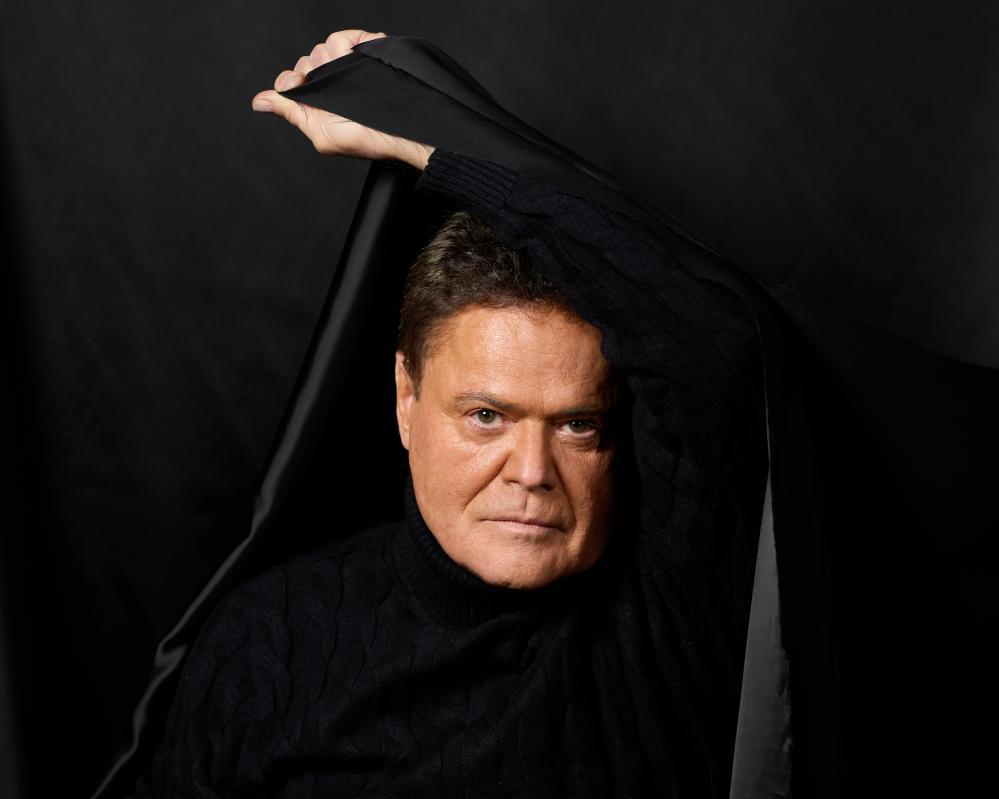
And yet almost half a century on, Osmond has a Vegas residency six months a year, he released his 65th album a few years ago, and is about to embark on a tour of the UK. At 68, he is the father of five boys and a grandfather 16 times over. We meet in a London studio where he is having his photo taken. Today, he looks both distinctively Donny and, unsurprisingly, different. He’s got the slight body of a teenager and the monumental face of a Mount Rushmore president, giving him the air of a marionette. The hair is still bluey-black, the teeth pearly white. How does he manage it? “Well, as far as my hair is concerned, I have a lady who takes care of it. Her name is Clairol.” He pauses. “It’s a joke!” he says, patting my knee playfully. Osmond is one of life’s knee-patters. “I’d have grey sides if I didn’t take care of it. I’m not going to do that. But I’m really careful with what I eat. And I guess I was lucky in the DNA department. My mom had perfect skin.”
Has he had any plastic surgery? “No!” But, he says, there was a period when he tried Botox. “I hate it.” Why? He freezes his face into a rictus grin. “Nothing works. I tried it 15, 20 years ago. It took away my crow’s feet and I worked really hard for these crow’s feet.” He laughs.
Osmond, who is from Ogden, Utah, was five years old when he entered showbiz. There’s footage of him on the Andy Williams Show singing You Are My Sunshine. He was the youngest Osmond brother in the band at the time and clearly the standout, just as Michael was in the Jackson 5. It was an extraordinary period in music. The Beatles and the Rolling Stones, arguably the two greatest bands of all time, had spent the 60s fighting for supremacy. Now there were the Osmonds and the Jackson 5, the greatest boybands, battling it out. There was a perfect symmetry between them – five brothers, similar ages, with Donny and Michael both solo stars in their own right. The Jackson 5 were black, soulful and funky. The Osmonds were white, soulful and dabbled in hard rock. While Donny was initially the bigger solo star, the Jackson 5 had the edge on the Osmonds. They were a phenomenon, with their first four Motown singles going to No 1 on the US’s Billboard 100 in 1969 and 1970, a year before the Osmonds had their first hit.
Even now, more than 50 years on, Osmond seems to be restaging old battles with his great rivals and friends. He tells me he wants to set the record straight, and looks at me with the intensity of a man about to deliver an essential truth. “The Osmond brothers were the first boyband. People say: ‘No, it was the Beatles,’ but the Beatles were not a boyband. Then people say the Jackson 5.” And this is where it gets controversial. “We were before the Jackson 5. I’ll tell you a story.”
Osmond moves in closer to make his point. “The first time I met the Jackson 5, we were in Toronto performing and they were performing the next night. They flew in a day early to watch our show. I looked stage right and Michael was peeking around the corner watching me. But what happened afterwards was pretty darn amazing. We were in our hotel room and, Joe and Katherine [the Jacksons’ parents] were sitting on the sofa with my mom and dad. I can see it like it was yesterday.” He says each boy instinctively sought out their contemporary, from oldest to youngest. “So Jackie and Alan were talking, Wayne and Tito were talking, Jermaine and Merrill, Marlon and Jay.” Pause. “And Donny and Michael were nowhere to be found. Guess where we were?’’ He grins. “We were in the other room playing with our toys, trying to be kids. We were 13 or 14.” And did you manage to be kids? “Mike and I talked about it a lot. We both missed out on a childhood, but we agreed that we made up for it with the excitement of our lives.”
That night, Osmond says, Joe Jackson told his father something that has stayed with him till today. “Joe disclosed something to my dad that the world doesn’t know about. He said: ‘I used to sit my kids down in front of the Andy Williams Show and say you’re going to do that, pointing to us on TV’.” When the Osmonds’ first hit, One Bad Apple, came out, “everybody said the Osmonds are copying the Jacksons. But actually it was just the opposite.”
The Jacksons and the Osmonds were both managed by their tough, disciplinarian fathers. Joe Jackson was notorious for his violence. Michael said he used to sit in a chair with a belt in his hand while watching them practise. I ask Osmond what the two fathers had in common. “Not a lot. My dad was strict. He was an army sergeant. But Dad was not Joe. Joe was mean. He was not a nice man. I can tell you that from first-hand experience. I would go over to Mike’s house and we’d have all kinds of fun talks. But Joe didn’t like me being there.” Why? “He just didn’t like me to be in the house.” How does he know? “Because of the glares he gave me.” Did he say anything? “No, he just glared.”
Having said that, Osmond admits it was not easy to stand up to his own father. When he was eight, the brothers were on tour in Sweden and Osmond was desperately homesick. “I just wanted to go home and play with my trucks. I wrote a letter to my mom saying: ‘Please, I want to come home.’ I told my brother Jay what I wrote and he snitched on me. He told my dad. He was so mad.” What did his father say to him? “He said: ‘You’re going to stay out here, and you’re going to do your job.’” Now, he says, he understands his father’s position – if he had gone home, it would have ruined the tour for everybody.
Life on the road and in the studio soon became his only reality. “I didn’t know any different. If I’d had a normal life, going to school and everything, then I’d have something to compare it to, but being on television, learning dance routines, spending 25 hours a day in the rehearsal room was my norm.” When did he realise his life was different from most other young boys’? “I remember making a decision at about the age of 12, when One Bad Apple became our first No 1 record, that I was going to do this for the rest of my life.” Was that a good thing or a reluctant acceptance of his future? “It was yeah! When you have a No 1 record on the Billboard charts, it is yeah!” Did he realise the impact he was having on girls? “You better believe it! I’d walk out on stage with my brothers, and Alan would introduce me and the place would go berserk. It was a blast.”
Success was wonderful while it lasted, he says. But when the young girls fell out of love with Osmond, he was left with nothing. His religion (the family are members of the Church of Jesus Christ of Latter-day Saints, often referred to as Mormons), his songs and his lack of cool were all held up to ridicule by a merciless music press. I start to ask about a particularly cruel quote from Rolling Stone magazine, but before I get my question out Osmond is quoting it at me: “‘The worst day in rock’n’roll history was the day Donny Osmond was born.’ Is that the one you’re talking about?” He laughs, bitterly. “Try that on as a teenager.” How old was he when that was written? “Sixteen, I think.” How did it feel? “Devastating. I mean, come onnnnn. I can laugh at it now. But I’d like to meet the guy who wrote that.” What would he say to him? “Probably nothing because I’m over it.” And at the time? “You have no idea what you’re saying.”
It was never accurate to write Osmond off as a bubblegum star. After all, he went from one studio where he sang his soppy ballads to another where he joined with his brothers who were developing their heavy prog rock sound, most famously heard on Crazy Horses. I ask if his brothers resented him. After all, he had hogged the limelight, and then their careers suffered when he fell out of fashion. Well, for starters, he says, that’s not how he saw it. “It was the whole thing, the whole persona of the Osmond brothers: the dancing, the singing, the harmonising. Then I was highlighted. I had a good conversation with my brother Merrill. He said there wasn’t any jealousy, but they were rock’n’rollers, and my career was keeping them away from the rock’n’roll scene.” So they felt stymied? “Yeah, I think so. Look at Crazy Horses. Ozzy Osbourne told me it was his favourite rock’n’roll song. And last week I took my car to get it fixed, and the mechanic told me Tommy Lee from Mötley Crüe had been in and said: ‘You’ve got to check out Donny Osmond’s music. I don’t like the Puppy Love era, but the new stuff is amazing!’”
By the age of 21, Osmond had been dumped by record labels and TV stations, and didn’t have a clue what to do with his life. Your name in effect became taboo, didn’t it? He looks at me. “You used the word taboo. I’m going to use a different word. It’s a little more severe. Laughing stock. The name Donny Osmond became a laughing stock.” That’s awful, I say “It is. It was. I lived with it. That was me.” How did he cope? “Don’t take this as an egotistical statement, OK? But I knew the talent was there.”
He still hung out with Michael Jackson, and asked him for advice. Both young men had been going through a tough few years, as their early success waned. Who was more famous at the time? “I was still doing the Donny and Marie show so probably me. And then Mike just left me in the dust.” Jackson was finishing 1979’s Off the Wall, the first of a series of classic albums that made him the biggest-selling solo artist of all time, while for Osmond things were going from bad to worse. And Jackson could see it. He came up with a radical solution.
Osmond was in LA looking for work when he got a call from Jackson. “He needed a ride to A&M records to talk to Quincy Jones. He asked if I could give him a ride. So I did, and during that conversation, I said: ‘Mike, how do I get back on the charts again?’ He said: ‘You’ve got to change your name because your name is poison.’” Wow, I say, he didn’t beat about the bush? “No! But he was right.” Had you thought it was poison? “Yes! I’m me. I knew. I’m living in this body so I know my name is poison.” How did you respond? “It hurt, but I realised he was right. So I drop him off, a little depressed because Michael Jackson has just told me my name is poison. But he was giving me very constructive criticism.”
Osmond’s 20s were a terrible decade for him. He had become persona non grata and by the early 80s, the Osmond brothers had lost their fortune to poor investments. How did he cope? “Debbie Glenn saved me.” He was 20 and Glenn was 19 when they married. They first met properly in Provo, Utah, when he was 16 and she was a 15-year-old high school cheerleader (when she was three and Donny was five the families crossed paths at an airport in Montana, and Glenn’s parents got the Osmond brothers’ autographs). By the age of 21 he was a father. “I was very fortunate. I found the perfect girl for me, who dated my brother first!” He giggles. Which one? “Jay.” How did he react when you started going out with her? “Oh, we haven’t spoken since. I’m kidding!” Another knee pat. “They only dated twice.” Osmond is still thinking about how he coped with the tough times. “Obviously you’re going to have a little depression because that’s the way you make a living. But I went home and had such a strong foundation. My kids and my wife literally saved me.”
He tells me that one man he worked with had an even more radical idea than Jackson about how to make him cool again. “This was 1984. I won’t tell you who it was, but Michael and I had the same publicist. He said: ‘We’ve got to get you some street cred.’ And I was desperate. He said: ‘I know how to do it.’ I said: ‘OK, tell me.’ He said: ‘You’re going to fly to Japan and on the way back you’re going to come through immigration. They’ll say open your suitcase and there’ll be all sorts of drug paraphernalia in there. You’ll be on every newspaper and magazine cover.’” Was he joking? “No.”
The publicist Jackson and Osmond shared was Norman Winter, who died in 2013 and was known for his “anything goes” approach to showbiz. “Here’s the thing, it would have worked. For 15 minutes.” And did he consider it? “I’m the kind of artist who will look at every idea and analyse it, and if I don’t like it maybe it can morph into something better. So I said: ‘Let me go home and think about this one.’”
What about going to jail? “Donny Osmond going to jail would have made me a real person, right?” Yeah, it would have made you the Don, I say. “Yeah, the Don! So I went home and thought: ‘What am I even talking about? What am I even analysing?’” Did he talk to Debbie about it? “Of course. And we both realised. She knew immediately. I said: ‘What are my kids gonna say some day? What are my grandkids gonna say?’ ‘Grandpa, why did you sell out for 15 minutes of fame?’ So I did it the hard way: with music. A lot of artists would do it controversial ways.”
Jackson was proved right in the end, he says. Osmond, by now mentored by Peter Gabriel, did eventually have another hit in 1989, 15 years after his last one. He was 31 and had been on the verge of walking away from the industry. “It was Christmas 1988, and I went home and said I want to quit, it’s not going to work. I’ve got three kids, I need to support a family. And this whole show business thing isn’t working – even with Peter Gabriel’s help.”
He had recorded a single called Soldier of Love. “A fan of mine took a copy of it to the radio station WPLJ in New York and played it for the music director, Jessica Ettinger, who said: ‘I love it, but I’m not going to play it because it’s Donny Osmond.’” Ettinger had a rethink and decided to play it and say it was by a “mystery artist”.
Not long after, he got a call from his manager. “He said: ‘I’ve got some good news and some bad news.’ I said: ‘I don’t need bad news right now, give me the good news.’ He said: ‘You have got the No 1 requested record on United States radio.’ I said: ‘What can be bad?’ He said: ‘Nobody knows it’s you!’” Osmond hoots with laughter. The radio station asked Osmond to fly to New York to reveal who he was live on air. “People thought it was George Michael,” he says. But then, on Friday afternoon drive time, there was a “drum roll … ‘Mystery Artist, who are you?’ I said: ‘I’m Donny Osmond,’ and I swear every one of the lights on the phone lines started blinking.”
A new, almost cool Osmond emerged. Instead of a purple velvet cap, this one wore a leather jacket. “Mike was right, my name was poison. But I figured out a way, accidentally, to detoxify it.” Soldier of Love went to No 2 in the US charts. Osmond followed it up with another hit, Sacred Emotion. And that was enough. He’d proved to himself he could make a comeback.
He signed up to a six-month stint in Andrew Lloyd Webber’s Joseph and the Amazing Technicolor Dreamcoat in Toronto, and did it for five years. After that he reunited with his sister Marie for a daytime TV show, wrote his memoir, starred in the 1999 film version of Joseph, hosted the gameshow Pyramid, and had his first Top 10 hit in the UK in more than 30 years in 2004 with Breeze on By, which he co-wrote with Gary Barlow and Bobby Womack. He then returned to Broadway with Beauty and the Beast, won the talent show Dancing With the Stars in 2009, enjoyed an 11-year residency in Vegas with Marie, and it’s been five years and counting with his solo residency. In the process, he has remade his fortune.
He remained friends with Jackson, who died of a drug overdose in 2009 at the age of 50. He says they had plans to record a cover of Stevie Wonder’s I Wish together. “Think about the lyrics: ‘Looking back on when I was a little nappy headed boy.’ Michael was going to sing that part, I was going to sing the next part, and we were going to go back and forth. I played Stevie the track I had laid down without the vocals and he said: ‘This is going to be massive!’ So the next day I went to Neverland and said to Mike: ‘We’ve got to do this.’ I remember he had a little blanket on his lap and his kids were surrounding him, and he said: ‘We’ve got to do this!’ He set a session for three weeks from that date. He called me about a week later and said: ‘Donny, can we postpone it – I’ve got so much on my plate and so much is happening?’ I said: ‘Let’s postpone it till it feels right.’” But the right time never materialised.
Osmond heard from Jackson one more time, a year or so before he died. “I was on tour and my phone rang and I said hello and I hear this little voice. ‘Donny?’ I went: ‘Hello.’ He went: ‘Donny?’ I went: ‘Mike, where are you?’ He said: ‘I can’t tell you.’ I said: ‘Mike, you’re talking to me, come on, we’re friends, where are you?’ He said: ‘Please don’t tell anybody but I’m in Phoenix. I rented a tour bus, and put my kids in it. I had to get out of LA because of all these allegations and things.’ I said: ‘Mike, I’m done with this tour this weekend. Come and stay with me in Provo. No one will know you’re there … I’m going to give you a weekend of normalcy.’ He said to me: ‘I really need that right now.’ But he didn’t take me up on it, and that was the last time I spoke with him.”
While Osmond’s personal life remained stable, Jackson’s went from weird to weirder. Jackson had numerous surgeries to transform his appearance; fathered three children conceived through artificial insemination and surrogacy with two different women; was inseparable from his chimpanzee Bubbles; and, shockingly, admitted to sharing his bed with many children throughout his adult life. In 2003, he was charged with child sexual abuse, though he maintained throughout that the practice was non-sexual.
In 2005, after a 14-week trial that dominated news headlines, Jackson was acquitted on all counts (which included child molestation, conspiracy, and providing alcohol to a minor). Before the trial began, it emerged that he had paid about $25m in a civil settlement to the family of Jordan Chandler, who had accused him of child sexual abuse. I ask Osmond if he thinks the allegations against Jackson destroyed him. “I think a lot of things destroyed him. The pressure destroyed him, too – the expectations of all the people around him. There’s only so much blood in our veins. Every time I’d go over, he’d be like: ‘How’s your family, tell me this, tell me that,’ because he realised I had something he didn’t have: normalcy. It’s sad. We lost a genius.”
Does he think there was truth in the allegations? “I’m not going to go there. I don’t want to go there. Because he was such a dear friend.” Osmond is careful with his words. He does not suggest Jackson is innocent, simply that he doesn’t want to think about it. Instead, he says, he’d rather tell me about his favourite memory of the two of them together as 15-year-olds. “We’d been giving an award and were backstage and I said: ‘Are you hungry?’ And he said: ‘I’m starved.’ I said: ‘Follow me.’ I had a limo and we went to this fast-food place called Jack in the Box. You pull up and there’s these clowns that serve you.” He seems lost in the memory. “I wish I had a picture of Michael Jackson and Donny Osmond ordering tacos in a black limo from a clown. And I told the driver: ‘Drive down Sunset Boulevard.’ We opened up the sunroof, the wind blew through our hair, we ate tacos and laughed down Sunset Boulevard.” He comes to a stop. “Mike is alleged to have done terrible things later on in his life, but I prefer to remember nicer times. I just want to hold on to the wonderful memory of those two kids trying to be kids.”
We’ve lost so many pop legends prematurely. How does Osmond think he survived? “Well, the first thing I would say is I had great parents. I never heard my dad yell at my mom. I never heard him say a swearword. So he was a great example in how to treat a woman and my mom was just the ultimate kind-hearted mother; a shoulder to cry on. They were the real deal. And my faith has helped me a lot. It was my foundation for spiritual stability.” However painful it may have been, he says, falling out of favour also probably helped – it gave him the ability to reinvent himself and survive. And it’s true, he has constantly evolved, little adaptations here and there, while remaining true to the wholesome Osmond image.
There was a time when I think you hated yourself, I say, when you sang the old hits, deliberately ruining them. “Uh-huh.” He nods in agreement. I remind him of a time I interviewed him 25 years ago, when he still seemed a little embarrassed about the old Donny. You’d not totally made peace with him, I say. “Uh-huh!” And now there’s the Donny who seems totally at ease with himself and his history. “I think you’re reading it right.” Can Debbie tell the difference? “Oh, we’ve talked about this many times. She says I’m more comfortable in my skin than I’ve ever been.”
Over the past couple of years, two of his older brothers, Wayne and Alan, have died. Eight years ago, Jimmy, the youngest brother, best known for his huge hit Long Haired Lover from Liverpool, had a big stroke while playing Captain Hook in the pantomime Peter Pan. I ask how he is doing. “It’s tough.” Can he talk? “Not much. But they say when one sense gets taken away the others are embellished. And now he’s an amazing painter. Sometimes when people have a stroke they end up in a very angry place, but Jimmy constantly says: ‘I love you.’ He just wants to give you a hug. So he’s in a good place-ish.”
Osmond says he now feels it’s less important to champion his personal legacy than the siblings’, and to big up their role in pop history. That’s why he’s so keen to tell me what Joe Jackson said to his father, and why he has made Crazy Horses a key part of his forthcoming tour. But, of course, there will still be space for the old solo hits. One of the features in the new show is a lottery draw with the winner getting to go up on stage and sit in a chair, while Osmond serenades them with Puppy Love. You can be sure, this time round there will be no attempt to self-sabotage. It will be sung with love for the song and for his old self.
If the young Donny could meet today’s Donny, what would the boy say to him? He thinks. And he thinks some more. “I think he would say: ‘Can you please hold my hand through this whole thing because it’s going to be tough? You figured it out – please tell me the secret.’”
• Donny Osmond tours UK arenas from January. Tickets are available via myticket.co.uk/artists/donny-osmond