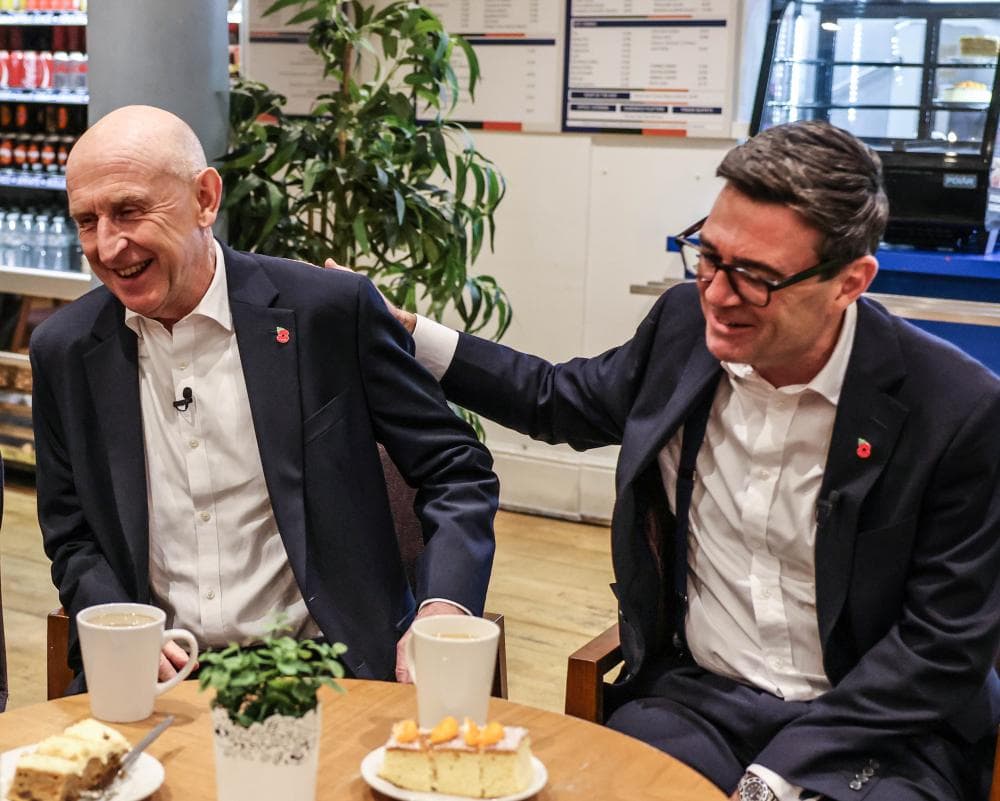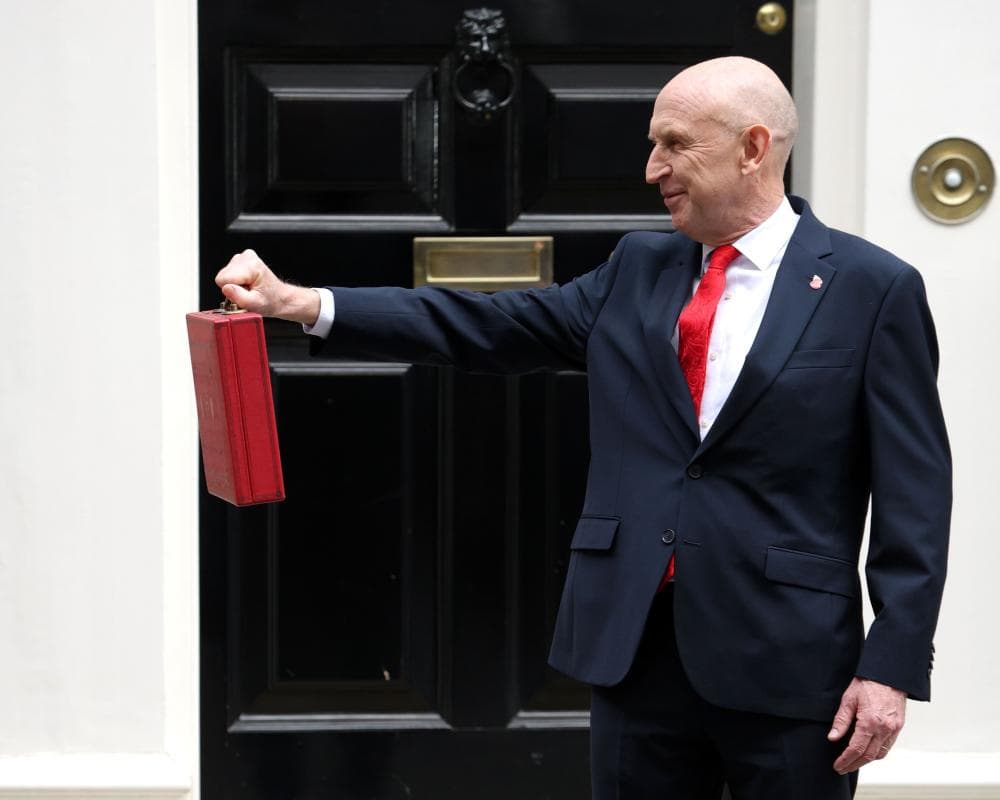
Healey (66) says he does not expect UK to rejoin EU in his lifetime
Last year Andy Burnham told a Guardian podcast that he hopes to see the UK rejoin the EU in his lifetime. He is currently 56, and he has recently said that he stands by this comment – although he has also stressed that this does not necessarily mean that he expects his proposed debate on a closer relationship with the EU to result in a proposal to rejoin after the election.
In his interview on Channel 4 News, John Healey, the chancellor, was also asked if he wanted Britain to rejoin in his lifetime. He replied:
I’m older than Andy Burnham. I don’t expect to see that …
I expect, and my job is to try and make the most of Britain’s position now.
Healey is 66.
Healey confirms government not committed to bring down welfare bill before next election
John Healey, the chancellor, has now personally clarified that the government is not committed to bringing down the welfare bill before the next election. He did so in an interview with Channel 4 News, revising a message he gave out with an ambiguous answer in an interview with the Today programme. (See 9.23am.)
Asked if he was committed to reducing the welfare bill this parliament, he replied:
We’re certainly committed to bringing the cost of the welfare bill down. I’ve said that, the prime minister’s said that. It is not correct to say that we set any schedule or time limit for that.
Asked if that meant it would not come down this parliament, he replied:
It’s not correct to say that we’re going to bring this welfare bill down in this parliament because we’ve not set a timetable for that.
Channel 4 News sent out a press release with the transcript headlined: “John Healey tells Krishnan Guru-Murthy Labour will not bring welfare bill down in this Parliament”. Healey’s not having much luck with media today because this does not seem 100% accurate either. He is saying the government has not committed to bringing the welfare bill down this parliament. But that is not the same as saying the government has committed to not bringing it down. In practice, given the circumstances and what Healey and Andy Burnham are saying, it seems very unlikely that welfare spending will fall this parliament. The press release headline is a bit misleading because it implies Healey has actually ruled that out as an option.
Councils complain they've been left 'frustrated' as latest local government reorganisation update leaves many still in limbo
Patrick Butler is the Guardian’s social policy editor.
One of the government’s arguably most unloved policies – the biggest reform of local government for 50 years – continues to stumble on, with few signs that the rancour and confusion surrounding the project is dissipating.
The process started nearly two years ago, with proposals to abolish the current two-tier system of districts and counties in favour of a smaller number of unitary authorities – or “mega-councils” – covering large areas.
Plans juddered to a temporary halt in September amid legal challenges from several councils, including Reform-led Kent, Essex, and Lancashire. Ministers said a short internal review was needed to reassess merger decisions.
The outcome of that review was announced today. (See 3.20pm.) Local government minister Jim McMahon said merger decisions already made in 13 areas would be withdrawn and “reconsidered” – plunging the project into another period of uncertainty. There are another two areas were decisions are still being awaited.
The frustration across local government, which has never shown huge appetite for what it sees as a costly and time-intensive reorganisation agenda, was palpable.
Jonathan Carr West of the Local Government Information Unit said:
Councils in all of those 15 areas have put serious time, money and goodwill into this process, at government’s urging. All that effort feels in jeopardy … That is a fragile basis for a national reform programme.
Ministers insist that withdrawing those decisions does not mean the process has been abandoned. It says fresh decisions will have been made by early next year in all areas, and the new councils will be up and running by 2029.
But many councils remain unconvinced. Richard Wright, chair of the Local Councils Network, said:
Unfortunately, with some councils threatening legal challenges, even final decisions from government may not be the end of the process, so uncertainty is likely to continue for a while.
And Eamonn O’Brien, chair of the Local Government Association, said:
While today’s announcement provides some certainty for some areas, many councils remain frustrated by the situation they have been placed in. All councils affected need urgent clarity on next steps and how costs already incurred will be met.
Shadow communities secretary Katie Lam branded the government’s approach to local reorganisation “nothing short of a farce” and “a complete joke”.
Areas where plans will be reconsidered are: Derbyshire and Derby; Devon, Plymouth and Torbay; Hertfordshire; Kent and Medway; Lancashire, Blackburn with Darwen and Blackpool; Leicestershire, Leicester, and Rutland; Lincolnshire, North Lincolnshire and North East Lincolnshire; Nottinghamshire and Nottingham; Staffordshire and Stoke-on-Trent; Essex, Southend on Sea and Thurrock; Hampshire, Isle of Wight, Portsmouth and Southampton; Norfolk; Suffolk.
Areas where reorganisation is going ahead: Surrey; East Sussex and Brighton and Hove; GLoucestershire; Oxfordshire; Warwickshire; Worcestershire.
Decisions are awaited in: Cambridgeshire and Peterborough; West Sussex.
NI's first minister says she's been blocked from summit with PM after Drumcree row provokes DUP into using veto
Andy Burnham is chairing a national economic council in Glasgow tomorrow. Ministers from the Scottish and Welsh governments will be there, but the Northern Ireland executive will not be represented because of an increasingly acrimonious dispute between Sinn Féin and the DUP.
Emma Little-Pengelly, the DUP deputy first minister, has in effect blocked Michelle O’Neill, the Sinn Féin first minster, from attending. Under the power-sharing arrangements that apply at Stormont, designed to ensure unionists and nationalists have to govern together, the FM and deputy FM have equal status and Little-Pengelly has exercised her veto over their attendance at the meeting in Glasgow.
In response, O’Neill posted this on social media, accusing Little-Pengelly of a “reactive stunt”.
But Little-Pengelly defended her action, which relates to unionists being furious with O’Neill for supporting the Garvaghy Road residents who blocked an Orange Order parade at Drumcree that had been allowed by the Parades Commission. O’Neill was siding with nationalists objecting to a parade they find intimidating, but unionists argue that she should not have backed an unlawful protest.
Little-Pengelly said:
The situation surrounding the first minister’s recent conduct remains extremely serious. There is significant anger, hurt and legitimate public discontent arising from her actions. These concerns cannot simply be dismissed or minimised. This is an exceptionally serious matter, particularly given the responsibilities of the office she holds and the importance of public confidence in the rule of law.
Of further concern is the first minister’s continuing refusal to recognise or meaningfully acknowledge the depth and legitimacy of the discontent caused by her behaviour. Her approach has contributed to a significant deterioration in confidence and in the working relationship necessary to discharge the responsibilities of our joint office.
At a news conference today, Gavin Robinson, the DUP leader, backed Little-Pengelly. He said her move showed O’Neill that “law breaking must have consequences”.
Relations between Sinn Féin and the DUP were already extremely strained before Drumcree – seven months into the financial year, the executive still has not passed a budget – and this latest development shows how they are getting ever closer to collapsing entirely.
Updated
Nigel Farage accused of shoving female Lib Dem MP in parliament
Nigel Farage has been accused of having shoved a female Liberal Democrat MP earlier this year, after he spoke about missing this week’s budget because of a previous altercation about seating. Rowena Mason has the story.
Related: Nigel Farage accused of shoving female Lib Dem MP in parliament
Tories dismiss Labour's local government reorganisation as 'nothing short of farce' as 15 areas remain subject to review
The Conservatives have branded the Labour’s local government reorganisation programme “nothing short of a farce”. Speaking in the Commons in response to Jim McMahon’s statement saying some reorganisation projects are going ahead, while 15 are still being reviewed (see 3.20pm), Katie Lam, the shadow communities secretary, said:
It gives me no pleasure whatsoever to say that from start to finish, this government’s approach to local government reorganisation has been nothing short of a farce …
The vast majority of councils are none the wiser after what we have heard today … People across the country are left without any sense of which council will be providing services in the year and years to come, while councillors and council officials have spent millions of pounds of taxpayers’ money planning and preparing for new authorities, which may never materialise.
The money spent on this farcical reorganisation process should have been spent instead on resurfacing roads, collecting bins, and maintaining parks, local government functions that people actually care about.
For all the prime minister’s talk about local government, this whole approach to devolution has shown nothing but contempt for local democracy.
Five counties have had local government reorganisation plans confirmed, MPs told, as others still subject to review
Five counties have had their local government reorganisation plans confirmed, as officials said all regions in England would have final decisions by next year, the Press Assocation reports. PA says:
In a Commons statement, local government minister Jim McMahon said ministers had found the original criteria for the reorganisations was “robust”, after they were reviewed when Andy Burnham became PM.
The changes are part of the government’s flagship local government policy announced by Keir Starmer’s government.
It aims to replace existing two-tier systems of councils with one unitary body that will look after all local services, to streamline decision-making.
The previous proposals were announced by former communities secretary Steve Reed earlier this year, but reviewed by Labour in September.
Eamonn O’Brien, chair of the Local Government Association, said councils were “frustrated” by the process and needed “urgently clarity”.
In its news release about the plans, the Ministry of Housing, Communities and Local Government says:
The five areas where the government is minded to proceed are:
-In East Sussex and Brighton and Hove, the two unitary proposal including boundary changes requested by Brighton and Hove City Council, except for the parish of Falmer.
-The one unitary proposal in Gloucestershire;
-The three unitary proposal in Oxfordshire, including boundary changes.
-The two unitary proposal in Warwickshire;
-The two unitary proposal in Worcestershire.
In another 15 areas, plans are still being reviewed.
Healey says he does not accept joining EU single market would automatically be good for growth
John Healey did not just sound sceptical about rejoining the single market, or the EU proper, in his GB News interview. (See 12.14pm.) In an interview with LBC, he said that he did not accept the growth would automatically be better if the UK were in the single market.
Asked by the presenter, Nick Ferrari, if growth would be stronger if the UK were in the EU, or the single market, Healey replied:
Well, I don’t actually accept that.
Brexit has certainly hit our level of growth. It’s certainly hit our level of trade. But we had a referendum. We’re out of the European Union.
The challenge for me now is how do we make the best of an economy which this year has proved remarkably resilient. It’s confounded the forecasters.
When it was put to him that being in the single market could boost GDP by 4-5%, Healey said:
Well, that’s part of a bigger conversation that the prime minister wants the country to have because he recognises - and everybody, many other people do – that our Brexit deal was not a good one. It’s not been good for Britain over the last decade.
But my job now is to make sure, when you’re talking about growth, is to try and reinforce that resilience in the British economy.
Most economists believe being in the single market would boost UK growth significantly. But it would also involve aligning with EU regulations and allowing free movement, which Brexiters view as politically unacceptable.
Updated
Burnham insists letter telling ministers not to argue for specific UK-EU renegotiation outcomes doesn't mean they're gagged
Andy Burnham has rejected claims that he has stopped ministers speaking out about his plans for a closer relationship with Europe.
As mentioned earlier (see 12.14pm), Burnham wrote to ministers yesterday saying he does not want them to “advocate for specific options or opine on the likely outcome of the process” as he opens a debate on forming a closer relationship with the EU. At GB News, this has been written up under the headline: “Andy Burnham gags Cabinet on rejoin EU plot”.
Asked if he was preventing ministers from speaking out in his pooled interview with broadcasters today, Burnham replied:
Not in the slightest. I have been working with the cabinet on the approach that we’re taking to Europe, and we have a clear approach now as we go into the next UK-EU summit, which is three weeks away.
For the record, this is what Burnham said in the letter sent to cabinet ministers yesterday.
I am clear in my conviction that the Brexit deal negotiated by the Conservative government was not good enough for Britain. It has led to a decade of low growth, burdened businesses with more red tape and weakened our ability to control immigration.
It is a harder Brexit than was promised at the EU referendum.
Burnham said that at the UK-EU summit on 20 November he wanted to lock in deals on food and drink, emissions trading and a youth mobility scheme. But he said he would also set out the next steps for considering the UK’s long-term relationship with the EU. He went on:
Both the UK and the EU have changed considerably in the 10 years since the Brexit vote. Any future relationship depends on practical arrangements that are realistic for both sides, and responsive to this new reality.
I am also clear that any fundamental change to the direction of the relationship would be for the public to decide and a matter for the next parliament.
Burnham said there was an “agreed mandate” in government for the summit. He went on:
In the period beyond the summit, government policy will be to explore options for the long-term relationship with the EU for consideration in the next parliament.
At the end of this process, we will set out to the country the respective merits and drawbacks of the various options.
It is important that we remain aligned and disciplined as a government in our messaging throughout this period.
It will not be appropriate for ministers individually to advocate for specific options or opine on the likely outcome of the process.
Burnham says he's confident economy will go 'from strength to strength'
Andy Burnham has claimed that the British economy is going “from strength to strength”.
Economists have argued that the documents published alongside the budget suggest this parliament will be dire for living standards. (See 10.21am.) But, asked about the country’s economic prospects when speaking to reporters on a visit in Derby, Burnham said:
The British economy is defying the expectations of forecasters, so this year we will grow more strongly. The growth forecast has been upgraded.
The IMF [International Monetary Fund] said last week we’re the standout nation for deficit reduction, so it remains difficult because the world is difficult and the situation in the Middle East has an impact.
But I think people should look at what the chancellor said yesterday, see a country that has got a platform of stability in the economy. We’re beginning to defy those expectations, and I’m confident that we will go from strength to strength from here.
Burnham claims government working 'flat out' to cut welfare spending
Andy Burnham has said the government is working ‘‘flat out” to cut welfare spending.
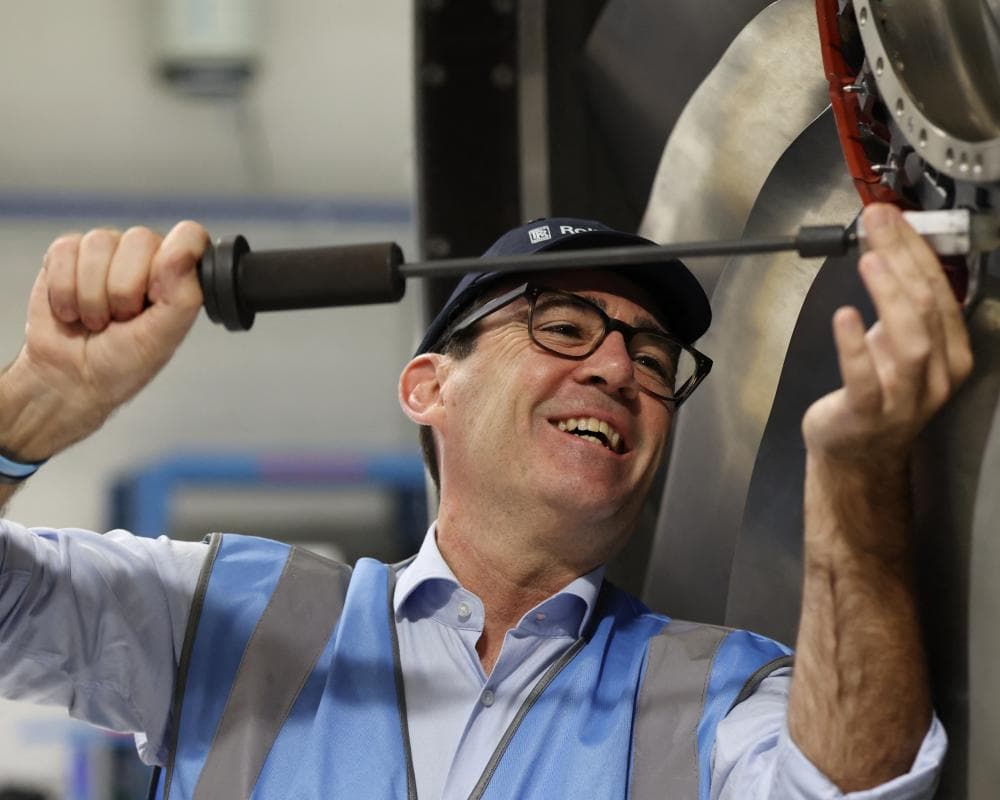
Speaking to reporters at a Rolls-Royce factory in Derby, when asked if he could confirm what John Healey was reported to have said about planning to cut welfare spending by the next election, Burnham replied:
We want to get the welfare bill down as quickly as possible, and we’re working flat out to that end. Now that we are through the budget, the big next priority in front of us is the publication of the [Alan Milburn report on youth unemployment], long awaited, but it’s coming soon.
We just want to get stuck into supporting people to help people off benefits and into work. There’s no delay there. We want that to happen as quickly as possible.
Burnham also argued that “crude cuts” on their own would just leave people “in crisis”, requiring more public spending down the line.
At the Downing Street lobby briefing, the PM’s spokesperson was also asked if John Healey’s comments about the EU in a GB interview this morning (see 12.14pm) were out of line with Andy Burnham’s. No, was the answer. The spokesperson said:
The position of the government, and the prime minister and the chancellor, is that a stronger relationship with our closest neighbours is in our national interest.
Healey did not say anything that contradicted Burnham’s views on Brexit. But if Burnham had been asked the GB News questions, he would have stressed the problems with the current EU relationship. Healey, instead, said “we’ve got a Brexit decision” and stressed the importance of making the best of the current arrangements.
No 10 confirms government not setting timetable for when it will cut welfare spending
Downing Street has said John Healey was not committing to cutting welfare spending before the general election in his Today programme interview this morning. (See 9.23am.)
Although one answer he gave to a question could be interpreted as saying that, the PM’s spokesperson said that was not Healey’s message. The spokesperson said:
We’ve never set an arbitrary target or timetable [for when the welfare bill starts to fall]. But both the prime minister and the chancellor have been crystal clear that the welfare bill needs to come down, and that we need to do that in a progressive and sustainable way and not through crude cuts which push people into hardship and puts pressure on the system elsewhere.
Asked if Healey mis-spoke in his interview, the spokesperson said:
The chancellor is completely in line with what the PM has said over the last few months that the welfare bill needs to come down and, as I say, we are not setting an arbitrary target or timetable on that.
The spokesperson said the government would be publishing Alan Milburn’s report on youth unemployment and Stephen Timms’ report on the personal independence payment (Pip), and that these would be followed by a white paper on welfare reform published next year. That will be followed by legislation.
Badenoch claims it's 'astounding' Healey won't commit to cutting welfare bill before general election
Kemi Badenoch has described the Treasury clarification that John Healey is not promising to cut the welfare bill before the general election (see 9.23am) as “astounding”. In a response on social media, she said:
This is astounding. The government’s own figures show working-age welfare will go up by £60 BILLION by 2030, yet the Treasury has to rush out and correct the Chancellor to say there is no timetable for cutting the benefits bill. Looks like foot in mouth syndrome is spreading.
John Healey couldn’t even find £10 billion to get defence spending to 3% of GDP - the thing he quit over.
Don’t let anyone tell you this was a ‘do no harm budget’. In doing so little, Labour have harmed our economic security and they’ve harmed our national security.
Selling nicotine-free vapes to under-18s banned from today, government says
Selling nicotine-free vapes to children under the age of 18 has become illegal from today, the government has said.
Children were already banned from buying vapes containing nicotine. But, under the Tobacco and Vapes Act, shops across the UK will now be banned from selling nicotine-free vapes, and nicotine pouches, to children.
In an article for the Daily Mirror welcoming the new law, Prof Sir Chris Whitty, the chief medical officer for England, said:
Vaping can be a way to help established adult smokers who are already addicted to nicotine from tobacco to swap to a less dangerous product. Vaping is considered safer than smoking, but that is a low bar. Vapes should therefore never be used by children or non-smokers.
Some children have already come to harm from bad reactions to vapes. The long-term health harms of vaping in today’s children will only become clear over time. They are however unlikely to be good; inhaling multiple, often heated, chemicals into the lungs may well do irreversible harm.
According to the Department of Health and Social Care, which has put out a new release about how the ban will operate in England, “more than a million children are estimated to have tried vaping, with more than 370,000 vaping regularly, putting them at a higher risk of developing respiratory illnesses.” Scotland, Wales and Northern Ireland are also implementing bans.
Healey plays down talk of UK rejoining EU after election, saying he's 'in favour of accepting we've got Brexit decision'
As Peter Walker reports, Andy Burnham has written to cabinet ministers telling them that, as he opens a national debate on improving the UK’s relationship with the EU, he does not want them to “advocate for specific options or opine on the likely outcome of the process”.
Related: Tory Brexit was ‘harder’ than promised in EU referendum, says Andy Burnham
John Healey stuck to this in his interviews this morning. But, speaking to GB News, he did hint that he might not be 100% enthusiastic about taking the UK back into the EU single market after the next election.
When Christopher Hope, GB News’ political editor, put it to him that more than two thirds of voters in Rawmarsh and Conisbrough, Healey’s south Yorkshire constituency, voted for Brexit and would not be happy with rejoining the single market, Healey replied:
No, freedom of movement is not on the agenda, and certainly for this parliament it’s ruled out.
Healey said the government would be having “a bigger discussion about how we get a better Brexit deal”. Asked if he would favour joining the EU, with freedom of movement, if that helped the economy, he replied:
No, I’m in favour of accepting that we’ve got a Brexit decision. And I’m in favour of the job we need to do now, which is to make the best of the terms we’ve got.
Healey accepts government faces 'hard decisions' ahead over spending
In his interviews this morning John Healey pushed back a bit against the claims that his plans are based on unrealistic assumptions about spending cuts. (See 11.29am.) Speaking to Bloomberg, he said “hard decisions” would be needed. He said:
My cabinet colleagues are demonstrating that they can also exert fiscal discipline and spending control, and we will take that into the spending review.
But the spending review will be framed by the priorities that we set in the 10-year plan for Britain, that’s as it should be.
Hard decisions about the top priorities for Britain in the years to come, judgments that then follow about how we fund them.
Healey's longterm government spending plans would require cuts government probably wouldn't accept, IFS says
Here are some more lines from Helen Miller’s presentation about the Institute for Fiscal Studies’ assessment of the budget. (See 10.45am.)
Miller said higher inflation means John Healey would need at least £17bn to avoid real-terms cuts in some government departments under the long-term spending plans. Echoing a point made by the Resolution Foundation (see 8.36am and 10.21am), she said:
The chancellor left plans for overall departmental spending across the rest of the parliament broadly unchanged in cash terms. In the face of higher inflation, this means that the real-terms value of budgets has been cut. Taken at face value, and alongside the inherited plans to slow down spending growth sharply in coming years, that is a big choice. It effectively implies that some public services will see real-terms cuts in next year’s spending review. Avoiding the cuts implied by both higher inflation and tight envelopes could plausibly require a top-up of £17bn in 2030-31. That’s true even before thinking about the £11bn needed to fund defence plans.
She said she did not believe Healey would implement the future spending cuts implied by his departmental spending plans. She said:
I want to be clear that my concern is not that it would be impossible to deliver the implied cuts to other services – that could be done. But I’m sceptical that this government would be willing to do it. I’m also sceptical because I didn’t hear John Healey starting the kind of pitch-rolling that you would expect if he intended to deliver these spending plans. And I’m sceptical because history advises scepticism. When chancellors pencil in tight spending plans in the future, they tend not to deliver.
She criticised Healey for raiding the reserves to fund the defence investment plan. She explained:
I’m grumpy about how the chancellor decided to fund the relatively small hole in the defence investment plan – that’s the plan that gets defence spending to 2.7% of GDP next year and keeps it there until 2029–30. Much of it came from further cuts to the capital budgets of other government departments. Fine. Priorities change. But the rest came from raiding reserves in future years. This is worth drawing out: John Healey has now spent 25% of the capital reserve set aside for the next three years. He’s also spent 40% of the day-to-day reserve. This is categorically not what the reserves are for. Drawing down reserves is another way that the government has reduced its buffer against future shocks.
She said it was “sad” that the government was having to decide who should get energy support based on council tax bands that are based on property values 35 years ago. She said:
It is also sad that, in the time since the last energy price surge, the government hasn’t bothered to invest in the data that would have allowed a package more targeted at those most badly hit by rising energy prices. But here we are.
She said Healey was at risk of needing to put up taxes next year. She said:
I am left with the impression that the chancellor is hoping the economic forecasts improve enough that he can make good on his plan to cut borrowing without having to also make large cuts to public spending or raise taxes. I hope that happens. And it might – a re-opening of the strait of Hormuz or AI-driven productivity growth really could create sunnier skies. But, equally, things could get worse. If they do, the chancellor now has less insurance.
A clear short-term risk with the chancellor’s choices is that next year – with low headroom and a spending review that looks pretty brutal for some departments – we see another season of damaging speculation about tax rises.
Healey's new 'founder's relief' tax cut for entrepreneurs 'looks bonkers', says IFS
Helen Miller, director of the Institute for Fiscal Studies thinktank, is giving a presentation summing up the IFS’s view of the budget. Arguing that it contained plenty of “bad things” as well as welcome measures, she singled out founders’ relief for particular criticism.
She said:
After years of arguing that business asset disposal relief was a bad idea – and just when I thought the relief was on its last legs – a new, similar relief has popped up. The new founders’ relief looks bonkers. It gives a lower rate of capital gains tax to a small subset of people with large gains. That will include some entrepreneurs that make investments with broader societal benefits – although most of that activity would have happened without the relief. But it will also include people that just got lucky. There are very complex rules around who gets it – rules that will incentivise people to change their behaviour in weird ways simply to be able to get the relief. I could go on. But the punchline is that this looks to me like yet another tax break for a chosen group with little economic reasoning behind it.
Tories overtake Reform UK in 'poll of polls' tracker
Since the start of 2025 Reform UK has been ahead of the Conservative party in the Politico poll of polls, a tracker which averages how the political parties are in surveys carried out by all the main polling organisations. Different polling companies use different methods, and so the poll of polls provides a reliable overview. Other poll of poll trackers are available, but Politico’s may be the most widely read in Westminster.
And today it has good news for the Conservatives. For the first time since early 2025, they have regained their lead over Reform UK.
How 2020s are set to be worst decade, by far, since 1960s for rising living standards, according to Resolution Foundation
The Resolution Foundation has now published its full 48-page report on the budget. Some of its main arguments were covered earlier. (See 8.36am.)
Here are five charts from the report illustrating five of its main arguments.
1) The amount the government is spending paying interest on its debt is “high and rising”, the report says. It says:
Debt interest spending is now forecast to reach £147bn in 2029-30, £13bn more than in March. This leaves debt interest spending at 4.1 per cent of GDP in 2029-30 (and peaking marginally higher at 4.14 per cent in 2031-32, the highest on record since 1956-57) and above the total expected spend on universal credit, Housing Benefit and Child Benefit combined in that year.
2) The 2020s are set to be the worst decade, by far, for more than half a century for rising living standards, the report says.
The 2020s are on course to have the lowest growth in incomes of any decade on record when measured using Real Household Disposable Income (RHDI). RHDI is projected to rise by just 1.4 per cent in total over the decade (equivalent to £400 in 2026-27 prices), one-tenth of the growth rate achieved in the 2010s (which itself was the second-worst decade on record). Income growth this decade is set to be much weaker than GDP growth because of rising taxes and import prices.
3) Labour’s cost of living support package benefits the rich almost as much as the poor, the report says.
Taken altogether, the Government’s £4.4bn cost of living package for 2025-26 and 2026-27 is poorly targeted. As Figure 8 makes clear, support is very widely spread. The Household Energy Payment goes to up to 20 million households in England, which are dispersed across the income distribution (87 per cent of the bottom half of the income distribution and 73 per cent of the top live in Council Tax bands A-D). The VAT cut and the Fuel Duty delay are not targeted at all. Taken together, we estimate that 52 per cent of the whole cost of living package will benefit the poorest half of the income distribution this year and next, with the other 48 per cent going to the top half (equivalent to an average £158 for poorer households, compared to £144 for richer households).
4) But, overall, the tax and benefit changes since the government took power have been progressive, the report says.
We estimate that annual incomes will, on average, be £320 higher for households in the bottom quintile in 2029- 30, compared to £2,000 lower for those in the top quintile as a result of the Starmer and Burnham governments’ measures. This is largely the result of policies announced before this budget: the repeal of the two-child limit and the commitment to uprate the universal credit standard allowance at a higher rate than inflation for four years, both introduced from April 2026.
5) All government spending departments apart from defence, health and education are likely to face cuts in spending per head from the end of this decade under current plans, the report says.
Healey denies postponing difficult decisions on welfare
John Healey has denied postponing difficult decisions on the welfare system, insisting the government is making changes “now”.
Thinktanks and opposition parties have made this claim. But, when this was put to Healey in an interview on GB News, he replied:
This was a broken system. And two years ago we started putting back in place face-to-face assessments. We’ve changed terms of universal credit, so people don’t have to brand themselves as too sick to work.
So, those are changes we’re making now. But in the long run, as I’ve argued, and the prime minister has said, too, we have to bring the cost of benefits down.
Treasury says Healey hasn't committed to cutting welfare bill before election, claiming interview answer misinterpreted
John Healey is rowing back from his answer in an interview in the Today programme implying he wanted welfare spending to go down before the next general election. According to Chris Mason, the BBC’s political editor, Treasury sources are saying his words have been over-interpreted.
This relates to what Healey said in an interview with Nick Robinson for the Today programme. It was broadcast this morning, but recorded yesterday, and the BBC has written it up in a story on its website headlined: “Healey promises reduction in welfare bill before next election”.
For the record, here is the key exchange.
Robinson: Let’s take welfare if we could. £19bn up in the year ahead. That’s the entire police budget for England and Wales. That’s the entire annual defence equipment budget. And yet in your speech you said, well, we’ve got a couple of reports coming next month, then we’ll have a white paper, which in non-Westminster jargon means a consultation, then you’ll have some legislation, then you’ll have a row in the Labour party. You’re not going to make any of these cuts before the next election, are you?
Healey: Well first, I’ve said clearly, the prime minister said as well, we have to bring the benefits bill down. You don’t do that by crude cuts, especially when people are feeling the cost of living pressures. We do have a big report, two big reports being produced next month, that will help us map out the way that we need to change the system for the long run. We are in fact reducing and have been over the last two years the rate of increase in the welfare bill compared to the previous period – I’m afraid to say – of a broken system the Conservatives put in place. We’re bringing back and have brought back face to face assessments which they axed for instance. We’ve been changing universal credits so people aren’t branding themselves as too sick to work in order to make that system work better.
Robinson: But you’re reducing the rate of increase in welfare spending chancellor aren’t you? But the OBR’s forecast is that £1 in every £8 will be spent on welfare by 2030 or thereabouts. You’ve got to make cuts, haven’t you?
Healey: This system is unsustainable. I’ve been clear about that. The prime minister’s been clear about it ….
Robinson: Briefly, because I want to give you the chance to talk about other things – there will be cuts in welfare before the election?
Healey: There will be there will be a reduction in the benefits bill. We’ll do that in a Labour way and we will do that because it is simply not good for Britain or progressive to have a bigger and bigger benefits bill and I feel a moral duty to deal with these youngsters who at the moment have been written off by previous governments.
The answer highlighted in bold is what gave the BBC its story. Healey paused slightly between the first “there will be” and the second “there will be” and it would be perfectly reasonable to interpret it as:
There will be. [Direct answer to Robinson’s question.] There will be a reduction in the benefits bill [etc etc – Healey expanding on the answer.]
But the Treasury is implying what he meant was:
There will be, there will be a reduction in the benefits bill [Healey simply repeating three words as he launches into more general answer, not answering Robinson directly, but just explaining the government’s approach.]
Reasonable people could interpret is either way. But Mason said the Treasury had told him the first interpretation was not accurate, and that if Healey really wanted to commit to getting cutting the benefits bill before the general election, he would have announced that in the budget.
Given that Alan Milburn himself has said that his plans to tackle youth unemployment may require more spending upfront in return for savings later, and given that welfare reforms often take most of a decade to roll out, it does seem unlikely that Healey intended to say the benefits bill would be cut before the election.
But, as Mason pointed out on the Today programme, “correcting” this story means the Treasury is implicitly saying benefit spending won’t go down before the election – which is very helpful to the Tories and Reform UK.
Updated
Healey accused by Resolution Foundation of ‘complete failure’ to target energy bill support at those most in need
Good morning. The day after the budget is often the moment when big initiatives announced by the chancellor the day before with a flourish start to unravel as experts pore over the small print. There is not much of that happening this morning – mainly because John Healey did not have any really big initiatives up his sleeve. Compared with a normal budget, his tax and spending initiatives were mostly relatively minor. That means that the opposition parties have been struggling to find things to attack, and so instead they have resorted to criticising Healey for what he did not do: slash welfare (the Tory/Reform UK solution), or join the EU’s single market (the Lib Dems’).
Healey has given interviews to all the main broadcasters, which are playing out this morning, but they were recorded last night and they don’t have any sensational new revelations. As Rowena Mason reports, one of the top lines was Healey saying he would cut welfare spending before the election.
Related: Healey vows to cut welfare bill before next election with ‘tough’ approach to young people
But there were other lines in the interviews too. I will be posting all the highlights this morning.
The two main public spending thinktanks, the Institute for Fiscal Studies and the Resolution Foundation, are both publishing reports assessing the budget this morning. The RF has issued a news release with its main findings and its assessment of the overall economic impact of the budget measures highlights three problems.
It accuses Healey of a “complete failure” to target help with energy bills at those most in need. It says:
The poorest half of households will gain £158 on average from cost of living support this year and next, just £14 more than the £144 received by the richest half – highlighting a complete failure to target help at those who need it most.
It says long-term public spending plans imply a return to austerity. It says:
Tight spending plans beyond 2028-29 imply departmental budgets will take more of the strain in the future. But if the 3% defence target is met and real health spending continues to grow at 2.6%, pencilled-in spending totals imply that funding for 13 ‘unprotected’ departments will fall to just 4.7% of GDP by 2031-32, close to the post-austerity historic low.
It says people will get poorer between now and the end of the parliament. It says:
Median real annual disposable incomes for working age households are set to grow by a paltry £600 over the course of the parliament. Worse still, those gains are already behind us. Between now (2026-27) and the end of the parliament (2028-29), typical incomes are forecast to fall in total by £1,050 (3 per cent).
This is one reason why so many people continue to think Andy Burnham will call an election next spring (before the electorate feels the full misery of getting poorer) – despite Burnham yesterday saying he would not hold one within the next 12 months.
Here is the agenda for the day.
9am: Jonathan Haskel, chair of the Office for Budget Responsibility, and Ruth Curtice, head of the Resolution Foundation, speak at an event where the RF is presenting its budget analysis.
9.30am: Heidi Alexander, the transport secretary, takes questions in the Commons.
10.30am: Helen Miller, director of the Institute for Fiscal Studies, presents the IFS’s budget analysis.
11.30am: Downing Street holds a lobby briefing.
After 11.30am: MPs resume the budget debate in the Commons.
Lunchtime: Andy Burnham is on a visit to a Rolls-Royce factory in the Midlands where he is speaking to the media.
I’m afraid we are no longer able to have comments open below the line every day on this blog. If you want to contact me, please email politics.live@theguardian.com. You can use this email to flag up corrections, comments for publication, questions or complaints.
Updated