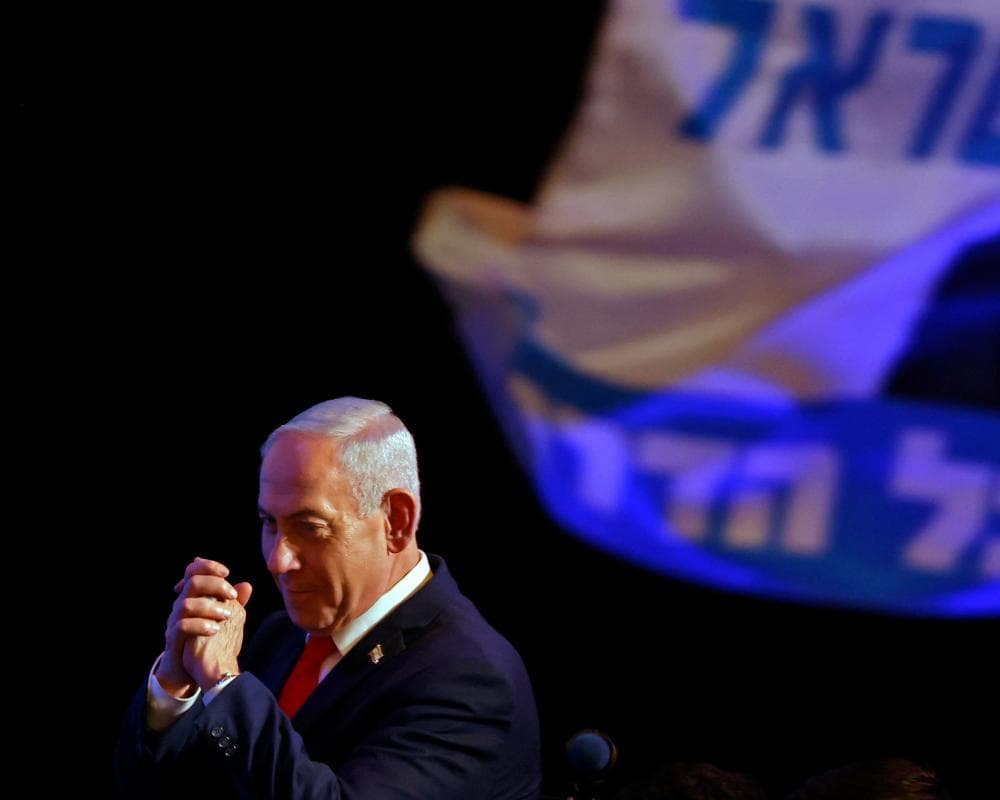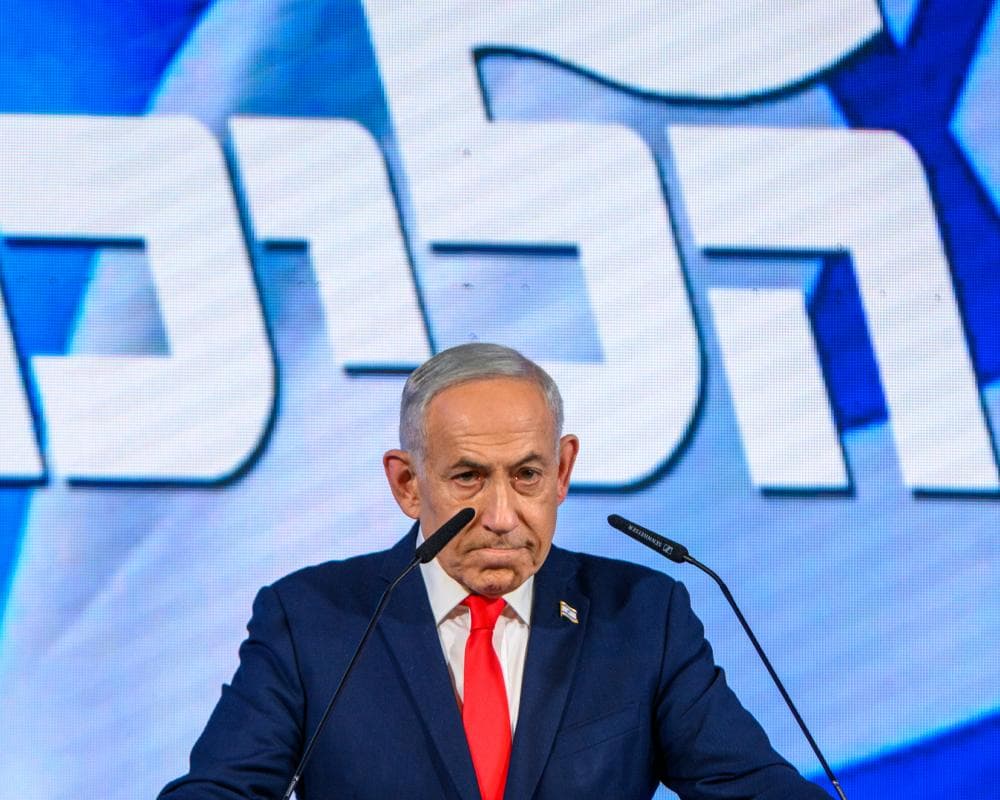
Israel’s chief opposition candidate Gadi Eisenkot has warned that prime minister Benjamin Netanyahu was working to delegitimise election results with his allegations of malfeasance by Arab parties that performed well.
“It’s already clear that Likud and Netanyahu have embarked on a coordinated, organised campaign seeking to delegitimise the results of the election,” Eisenkot said in a video message, referring to the prime minister’s right-wing party.
Supreme Court justice Noam Sohlberg, a conservative who heads the Central Elections Committee, requested an investigation by the Shin Bet security service into allegations that Ra’am received money from Qatar.
“The Raamgate scandal is a political earthquake. Israel’s elections have been stolen!” Netanyahu’s Likud party said.
Ra’am chief Mansour Abbas said his party had “no connection whatsoever to the affair” and welcomed an investigation.
Iran tried to interfere with Israeli election - report
Iran attempted to interfere in the Israeli election this week and will try to disrupt the US midterm elections next week, the Telegraph reports.
“We have been looking into ways to recruit agents in both the American and Israeli regimes’ election processes,” one official said, adding that “powerful cyber groups have also been established to hack their election systems”.
Meanwhile, another official described it as an extension of its war with the US and Israel.
“War does not just mean missiles and guns when we are under their blockade,” he said. “It also means we are prepared to disrupt their elections, their banking, their travel and all their ordinary systems. We are not in favour of any candidate anywhere, but we would like to see a divided America and a divided Israel.”
Ahmad Tibi, one of the leaders of the Joint List party, said Benjamin Netanyahu was on an orchestrated, toxic campaign meant to undermine the election results.
“This entire campaign is directed against Eisenkot, to prevent him, intimidate and scare him off forming a government that relies on external support from the Joint List or Ra’am,” Tibi told Reuters.
During and after Tuesday’s election, Netanyahu and his allies warned against rising Arab turnout and his right-wing Likud party issued statements accusing the parties representing Palestinian citizens of Israel of “stealing the vote.“
It demanded police and the Shin Bet domestic intelligence service investigate incidents of suspected election bribery and intimidation at ballot stations. It said it possessed evidence of such activity but has not presented it to the public.
Updated
The Israeli newspaper Haaretz has reported that, with 97% of votes counted, the balance between the political blocs remains unchanged.
Netanyahu’s coalition remains at 53 seats and Eisenkot’s bloc at 48. Parties representing Palestinian citizens of Israel hold 19 seats.
Updated
Abbas expresses hope for dialogue with new Israeli government
Mahmoud Abbas, the president of the Palestinian Authority, expressed hope that the Israeli election would pave the way for renewed peace talks.
“For many years now, we have been extending a hand to the Israeli side in order to achieve peace with them, so that Israel and Palestine may live in security, stability and peace,” Abbas said during a meeting with Cypriot president Nikos Christodoulides in Nicosia.
“We hope that, immediately after a new Israeli government is formed, we will be able to engage in dialogue together.”
Summary of developments so far
As vote counting continues in Israel, here is a roundup of today’s key developments:
Benjamin Netanyahu and his allies have amplified allegations of election fraud against parties representing Palestinian citizens in Israel. He and members of his coalition have referred the parties to Shin Bet, the country’s domestic security service, for investigation. Netanyahu’s Likud party accused the Palestinian parties of “stealing” the election and claimed, without evidence, that they received money from Qatar.
Qatar’s foreign ministry spokesman, Majed al-Ansari, rejected the allegations, saying they were “ridiculous and dangerous”. Responding to the claims, he said: “We categorically deny allegations that Qatar has interfered in Israeli elections or funded any activities intended to influence their outcome.”
The Israeli president, Isaac Herzog, has come to the defence of Palestinian voters, as he urged political leaders against “tarnishing an entire community that sought to exercise its right to vote”. He said Shin Bet and the country’s central elections committee would investigate allegations of foreign interference “throughly”.
The central elections committee’s acting director general, Dean Livne, said there was “no basis for claims of systematic violations of election integrity”. The Israeli police also dismissed the claims, according to comments reported in Hebrew-language media, with one source quoted as saying: “Election day passed with very few irregular incidents.”
Netanyahu’s chief rival, former military chief and Yashar party leader Gadi Eisenkot, warned political opponents against exploiting allegations of foreign interference to delay the swearing-in of the next Knesset, which is set for 10 November.
The sentiment was shared by Yair Golan, the leader of the centre-left Democrats, who accused Netanyahu of trying to “undermine the election results through an ugly delegitimisation campaign” targeting Palestinian citizens in Israel.
So far, Netanyahu’s bloc is projected to win 53 seats, compared with 48 for the grouping led by rival Eisenkot. Palestinian parties are projected to win 19 seats, a record high.
The final tally of absentee ballots is not expected to significantly shift the results, with no grouping managing to reach the 61 seats needed for a majority in the Knesset.
Updated
Qatar says accusations of election interference in Israel 'ridiculous and dangerous'
Qatar’s foreign ministry spokesman rejected accusations “made by certain Israeli politicians and their contacts in the media” that his country had interfered in the Israeli elections.
“We categorically deny allegations that Qatar has interfered in Israeli elections or funded any activities intended to influence their outcome,” Majed al-Ansari said on X.
“They accuse Qatar of buying off Benjamin Netanyahu, the Israeli political left and now, in this latest campaign, the Arab vote... These accusations are ridiculous and dangerous in equal measure.”
Updated
Both Benjamin Netanyahu and his immediate challenger, Gadi Eisenkot, lack the seats in the Knesset to form a majority government. Eisenkot and his allies face a clear choice.
They could forge a pact with the Arab Israeli parties, currently heading for an historic 19 seats, which would allow them to vote Netanyahu out and form a governing coalition. Or they could enter a unity government with Netanyahu, in return for a ministry or two.
Likud officials are cited in today’s Israeli press as saying Eisenkot will ultimately have no option but to throw in his lot with Netanyahu. Other observers say that would be political suicide, especially as the opposition leader vowed in the campaign he would never collaborate with the prime minister.
However, Eisenkot and key members of his bloc have also ruled out cooperation with the Arab party lists. Breaking either pledge would be costly for them.
The prime minister’s attack on the legitimacy of the Palestinian vote is designed to tip the scales, to force Eisenkot into the Netanyahu camp by increasing the political toxicity of any arrangement with Arab parties, the Joint List and Ra’am.
For its part, the Joint List has ruled out participating in an Eisenkot government because of his bloc’s support for the war in Gaza and the occupation of southern Lebanon, but it has offered to support an Eisenkot minority government with tactical voting in the new Knesset, in the shared interest of ousting Netanyahu.
Even such a transactional arrangement is hard to achieve given the state of Israeli Jewish politics. The only Zionist party that advocates cooperation with Palestinians, the Democrats, won just 6.5% of the total vote by the latest count.
The right and centre-right accounted for 66.5%, while ultra-orthodox Jewish parties won 11%.
Against that background, Eisenkot has doubled down on his determination to form a Zionist government. Such rhetoric makes the prospect of cooperation with Arab parties even more remote, but he is hoping instead to lure away conservative Jews from Likud, just as Netanyahu’s is trawling for defectors from Eisenkot’s “Change” bloc.
This is the current phase of the post-election struggle, and it is one that, for now, excludes Arab Israelis, despite their dramatically increased political strength.
Updated
The head of one of Israel’s parties representing Palestinian citizens of Israel rejected allegations of electoral fraud and welcomed an investigation, saying his moderate Islamist Ra’am party had “no connection” to the matter.
“Ra’am has no connection whatsoever to the affair in question or to any other affairs, and we declare that we will fully cooperate with all law enforcement authorities to uncover the truth,” Mansour Abbas said, according to a spokesperson for his party.
Updated
Analysis: Netanyahu cries foul as Palestinian parties in Israel surge
The race to form a government in Israel has begun with characteristically brass-knuckle tactics from Benjamin Netanyahu. He and other members of his coalition have referred the parties representing Palestinian citizens of Israel, the only part of the opposition which over-performed in Tuesday’s elections, to the country’s domestic security service, the Shin Bet, for investigation.
The government’s claims centre around the allegation that Qatari funds were used illegally to buy votes and mobilise Palestinian Israeli citizens. There is so far no evidence to support the accusation. Haaretz quotes a senior police official saying there were no signs of election fraud and that Tuesday’s vote was cleaner than usual.
In Nazareth on election day, it was clear that turnout was unusually high because of anxiety and fear of what actions the extremists in Netanyahu’s government might turn their attention to Palestinian communities in Israel if they continue in power.
The only reported irregularities involved the the ruling coalition. Many of the ballots delivered to the polling station were printed only in Hebrew, while monitors from the far right used a variety of ploys to slow down the vote.
There is also a certain irony underpinning the allegations as Netanyahu is mired in a scandal over Qatari payments to his advisers in return for improving the Gulf monarchy’s image.
'We must avoid tarnishing an entire community,' says Herzog in defence of Palestinian vote
Israel’s president, Isaac Herzog, has come to the defence of Palestinian voters in the Israeli election, amid accusations by Benjamin Netanyahu and his allies of alleged ballot fraud by parties representing Palestinian voters of Israel.
Herzog said he has spoken to the heads of the country’s central elections committee and Shin Bet regarding allegations of foreign interference in Tuesday’s vote, saying the issue must be “thoroughly investigated”.
“I am closely following developments in the investigation into the suspicions reported this morning,” he said in remarks published by Israeli media.
He added: “But even at a moment like this, we must avoid tarnishing an entire community that sought to exercise its right to vote and take an active part in democracy.”
Herzog called on party representatives ahead of impending coalition talks to reconsider their positions out of a sense of responsibility towards the country.
Once the official results are in, I will meet with representatives of all the political groups. I say this to everyone here – to the public and its leaders – ahead of next week’s consultations: keep an open mind, keep an open heart and broaden your perspective.
There is only one question that should be at the forefront of your minds: what is in the best interests of the country?”
Updated
Palestinian party leader accuses Netanyahu of laying groundwork to reject election results
A Palestinian party leader in Israel has accused Benjamin Netanyahu and his allies of undermining the legitimacy of “the clearest election results Israel has seen in decades”.
Sami Abu Shehadeh, chair of the Balad party which forms part of the Arab-led Joint List, said unsubstantiated allegations of foreign interference in the election sought to delegitimise the Palestinian vote.
Abu Shehadeh, a former Knesset member who was effectively forced to drop out of the race himself by the Israeli supreme court, said on X:
What began with the illegal disqualification of Arab parties escalated into incitement against Arab parties and the Arab public. On election day, hundreds of far-right activists armed with weapons were deployed at polling stations in Arab towns in an attempt to suppress voter turnout. Now, this racist blood libel is entering its next phase, fuelled by dangerous accusations.
Netanyahu and his allies are dangerous. They are laying the groundwork to reject the clearest election results Israel has seen in decades.”
He added that Netanyahu, as “a man charged with bribery, fraud and breach of trust”, was inciting against the Palestinian citizens of Israel, which make up 20% of the population.
He continued:
In any functioning democracy, those who lose an election accept responsibility and step down. In Israel, the losing side manufactures a racist blood libel and calls on the security forces to use force to overturn the people’s verdict.
We must not let the far right steal the election or drag the country into another election on the basis of fabricated, delusional accusations.
You lost. Get out.”
Echoing Ben-Gvir, the far-right Israeli finance minister, Bezalel Smotrich, has also called on Shin Bet to interrogate the leaders of parties representing Palestinian citizens of Israel, amid claims of alleged foreign election interference that critics say risk casting suspicion on the Arab vote.
“The suspicion of election manipulation using foreign Islamist money is a litmus test for the State of Israel,” Smotrich said on X.
“The heads of the Arab parties must be interrogated by the Shin Bet today.”
Golan accuses Netanyahu of 'ugly delegitimisation campaign' against Palestinian voters
Hot on Eisenkot’s heels, Yair Golan, the leader of the centre-left Democrats, has accused Benjamin Netanyahu of trying to “undermine the election results through an ugly delegitimisation campaign” targeting Palestinian citizens in Israel.
Netanyahu’s Likud party has claimed – without evidence – that parties representing these citizens have “stolen” the election and demanded the police and the Shin Bet investigate the allegations.
In a post on X, Golan said:
Netanyahu suffered a crushing democratic defeat. The public fired him, and he refuses to accept the verdict of the voters.
Now he is trying to undermine the election results through an ugly delegitimisation campaign against the will of the public, and against the Arab public in particular.
Any genuine suspicion of damage to the integrity of the elections must be investigated to the end.”
Israel’s central elections committee has requested the Shin Bet to investigate alleged foreign interference, the Associated Press reported, citing claims in a letter dated Wednesday of funding by “foreign entities against the Israeli interest” but providing no details or assessment of their validity. The source of the allegations remains unclear, and the committee has requested findings within a week, ahead of the 4 November deadline for certifying election results under Israeli law.
Updated
Eisenkot warns against exploiting foreign interference allegations to delay Knesset
Gadi Eisenkot, leader of the Yashar party and Benjamin Netanyahu’s main rival, has warned political opponents against exploiting allegations of foreign interference in Israel’s election to delay the swearing-in of the next Knesset.
In remarks posted on X, Eisenkot said:
Israel must safeguard the integrity of the elections against any attempt at interference, spin and manipulation, and examine every complaint thoroughly. On the other hand, political actors must not be allowed to exploit the situation and affect the swearing-in date of the 26th Knesset.”
Updated
Ben-Gvir calls for arrest of Arab political leaders
Israel’s far-right national security minister, Itamar Ben-Gvir, has called for the arrest of leaders of Arab political parties, citing unsubstantiated claims of foreign funding.
In a post on X, he said the Shin Bet, Israel’s domestic security service, “must order, as early as this morning, the arrest of the leaders of the Arab parties suspected of involvement with Qatari funds”, without clarifying further.
The Shin Bet has not responded to the allegations.
As reported earlier, Israeli police and the central elections committee have said there is no evidence of election fraud.
Israel police dismiss claims election 'stolen' by parties representing Palestinian citizens - report
Israeli police have dismissed claims by Benjamin Netanyahu’s Likud party that the election was “stolen” by parties representing Palestinian citizens of Israel, according to comments reported by Hebrew-language media outlets.
A police source, as quoted by the Times of Israel, said:
Election day passed with very few irregular incidents concerning the integrity of the election, even when compared to previous elections.
It should be emphasised that there is no investigative- or intelligence-based supporting evidence for the claims.
Dean Livne, the acting director general of Israel’s central elections committee, said there was “no basis for allegations of election theft”, the Israeli Kan radio reported. The committee said yesterday that it had received a complaint by the Likud party alleging Arab parties had compromised election integrity, which it would review as part of its routine post-election process.
As vote counting continues, parties representing Palestinian citizens of Israel are projected to win 19 seats after Tuesday’s election, driven by record-high turnout among the Arab population.
Updated
Israeli news website Ynet is reporting that just over 29,000 of the absentee ballots have been counted so far, out of an estimated 500,000.
According to Ynet, Benjamin Netanyahu’s Likud party is leading among these ballots, with 18.5% of the votes of far. The Together alliance of Naftali Bennet and Yair Lapid comes in second with 15.6%, while Gadi Eisenkot’s Yashar is third, with 14.8%.
The absentee ballots are afforded to people unable to return to their registered polling stations on election day. They include many in the IDF, as well as diplomats, prisoners and people in hospital.
Experts say that the final tally of the absentee ballots is unlikely to significantly shift the current seat projection.
Yousef Jabareen, the leader of the Joint List – which represents a number of Israeli Arab parties – has told the Reuters news agency his party will seek to use its projected 11 seats “to facilitate getting rid of Netanyahu’s government and hopefully help to change the political situation in Israel.”
Gadi Eisenkot’s opposition bloc is currently projected to receive 48 seats, well short of the 61 needed to form a majority government, but many in his bloc have ruled out governing with Palestinian-led parties which are projected to win 19 seats in total.
Yair Golan, the leader of the centre-left Democrats, and a junior partner in Eisenkot’s bloc, has backed the idea of working with the parties led by Palestinian citizens of Israel. But he is so far the only opposition leader making that call.
Jabareen said the Joint List could not join an Eisenkot-led government because of its support for Israel’s military campaign in Gaza and occupation of southern Lebanon. But he has left open the possibility of bolstering Eisenkot’s bloc from the outside, propping up a minority government through confidence votes.
We have our demands to protect our community, to advance the rights of our community and to promote equality for our community.”
The other main Palestinian party, Ra’am, is led by Mansour Abbas, who joined Naftali Bennett’s government in 2021, the first time an independent Arab party had entered an Israeli coalition. That government collapsed after 18 months, partly because of disagreements over the occupied West Bank.
Abbas has said he would join an Eisenkot-led government. Speaking to Israeli media after voting wrapped on Tuesday night, Abbas said
I believe we can overcome the difficulties … and I think that most voters for the [Eisenkot] bloc do want to see a government with the Ra’am party.”
Throughout the elections campaign, Israel’s far-right demonized Palestinian citizens of Israel and branded Palestinian political participation as a threat to the state.
Eisenkot himself ruled out forming a government with Palestinian parties during the campaign, citing what he called a lack of shared values, including recognition of Israel as a Jewish and democratic state. However Abbas has claimed that senior members of Eisenkot’s bloc discussed a possible deal with him even before the election.
Ameer Fakhoury, a political sociologist at Jerusalem’s Van Leer Institute, said that Palestinian votes may block Netanyahu and make an alternative government possible.
The Jewish opposition may need Palestinian votes while refusing Palestinian partners. That is the central paradox.”
Israel’s currency, stocks and bonds came under pressure on Wednesday after initial election results showed prime minister Benjamin Netanyahu’s right-wing bloc performing better-than-expected but falling short of a parliamentary majority.
With 91% of votes tallied, Israeli media project Netanyahu’s right-wing bloc could win 53 seats, ahead of the 48 forecast for rival Gadi Eisenkot’s opposition bloc but short of the 61 needed for a majority.
Final results are expected on Thursday.
On Wednesday the shekel weakened more than 2%, on course for its worst day since the aftermath of the 7 October 2023 Hamas attacks and erasing Tuesday’s gains, when high voter turnout had raised expectations of a change in government.
Tel Aviv’s key benchmark stock index was down 2.5%, its worst performance in more than four months.
Opinion polls ahead of the election showing Eisenkot in the lead had helped gains, with some investors expecting a change in government to improve relations with western allies.
“Israel’s financial markets have reacted negatively to the result,” said William Jackson, chief emerging markets economist at Capital Economics. He said the initial results offered Netanyahu more paths to remain in power, though any government that emerged was unlikely to be robust.
The next government will probably be fragile.”
If neither Netanyahu nor Eisenkot can form a government, Israel could be facing another election, with Netanyahu remaining at the helm of a caretaker government in the meantime.
Updated
Israel’s left-leaning newspaper Haaretz has published an editorial calling on the country’s opposition bloc to form a government with the Palestinian parties.
With the combined number of Knesset seats for Gadi Eisenkot’s opposition bloc and the grouping of Palestinian parties projected to be 67, the paper writes that Netanyahu’s government has “lost substantial support since the last round of elections.”
The figures clearly point to an unprecedented achievement by the Arab community, which voted en masse for political partnership with Jews. Despite the challenges and reservations about voting, and amidst a particularly racist incitement campaign, a record 19 Knesset seats loudly and clearly declare: We are an inseparable part of this country.”
The editorial goes on to say that there is reason to believe that the leaders of Eisenkot’s change bloc will discard these “19 Knesset seats simply because they belong to Arab voters.”
This would be a slap in the face to the citizens who went to the polls in droves to vote for integration.”
Israel’s choice: Netanyahu remaining in power or a Palestinian-backed coalition
Hours before the final results from Israel’s elections were in, several things were clear. Benjamin Netanyahu’s far-right coalition had lost its mandate, and the opposition had a firm majority.
But most of Israel’s Jewish opposition ruled out governing with Palestinian-led parties, in the course of a racist election campaign in which Netanyahu painted Palestinian citizens as an enemy inside the state.
The self-imposed ban on a broader opposition alliance, if it holds, offers Netanyahu the prospect of turning his defeat into another term in office – or at least a prolonged mandate as caretaker prime minister and perhaps another round of elections.
This confected barrier to unseating Netanyahu became the focus of Israeli media and analysts. “No Clear Government” announced the newspaper Israel Hayom. “Road to Unity Government Has Been Paved”, read an article on Channel 12.
Yair Golan, leader of the centre-left Democrats, attacked that framing. “Netanyahu lost. I know how to count,” he said in a statement calling for a government with Palestinians, who make up about 20% of Israel’s population.
“We must no longer accept Netanyahu’s racist division between Jewish votes and Arab votes,” he said. “We have a majority. We have a responsibility. And we have an opportunity to form a change government in partnership with Arab citizens of Israel.”
While Palestinian-led parties do not describe themselves as Zionist, neither do some of the ultra-Orthodox groups who are a key part of Netanyahu’s current coalition.
A survey taken as polls closed on election day showed that a clear majority of opposition voters supported forming a government with the Palestinian-led Ra’am in order to unseat Netanyahu, political psychology researcher Eran Halperin said.
But opposition leaders were silent on Wednesday, as they apparently tried to balance their desire to unseat Netanyahu with promises against working with Palestinians.
Former general Gadi Eisenkot, who leads the biggest opposition party, has not directly ruled out governing with Palestinians but laid out conditions that made it politically impossible for them to join a coalition.
Palestinians have been clearer about their priorities. “We are ready and prepared to pave the way for the ousting of the Netanyahu government,” Yousef Jabareen, leader of the larger Joint List, said on Wednesday. “The change comes through Jewish-Arab partnership.”
Related: Israel’s choice: Netanyahu remaining in power or a Palestinian-backed coalition
Israel’s elections committee has said it began counting absentee ballots at 1am local time. That count is expected to last until Thursday evening, with an estimated 500,000 ballots from military personnel and diplomats to be tallied up.
They are not expected to significantly change the results.
Under Israeli electoral law, each voter is assigned a specific polling station and can only vote at that station. However in exceptional circumstances, some voters are allowed to cast their ballot at special polling stations they are not registered at. Among those afforded this exception are soldiers stationed at IDF bases, diplomats working abroad, prisoners and prison guards and people in hospital.
These absentee ballots are transported directly to the Knesset where they undergo a series of checks before they are counted, which is why they arrive in the final count much later.
Final ballots being tallied with results expected to show no clear winner
Hello and welcome to our continuing coverage of the Israeli election.
With 91% of votes now counted, the current results show prime minister Benjamin Netanyahu’s bloc projected to receive 53 seats, with the grouping of his opponent Gadi Eisenkot on 48 and the Palestinian parties on track to receive a record 19 seats.
The final tally of absentee ballots is not expected to significantly shift the results, and with no grouping managing to reach the 61 seats needed for a majority in the Knesset, Israel could be in for weeks of uncertainty, as both sides try to gather enough support to form a government.
Yair Golan, the leader of the centre-left Democrats, a junior partner in Eisenkot’s bloc, has told Israeli media that he will meet leaders on Thursday for coalition talks. According to the Times of Israel, he will hold talks with Eisenkot, the leading opposition candidate and chair of the Yashar party, and Yair Lapid, the number-two in the opposition B’Yachad party.
This would mark the official start of coalition talks, and Golan has been the only opposition leader so far backing working with the parties led by Palestinian citizens of Israel.
Israel’s president, Isaac Herzog, voiced hope that the country could avoid a second election. “We must do everything we can, certainly after yesterday, to avoid another round of elections,” said Herzog, who is tasked with determining which candidate to tap to form a government, urging parties to keep “an open mind”.
Israel’s future hangs in the balance after it became clear that Benjamin Netanyahu has lost his governing majority. His political fate now depends on whether opposition Jewish parties are prepared to forge a common front with Palestinian parties, whose support surged in Tuesday’s historic elections. Indeed, Gadi Eisenkot and his allies face a clear choice: either make a pact with Arab Israeli parties heading for a record result of 19 seats, or hand Netanyahu a political lifeline in the form of new elections or a unity government.
Yousef Jabareen, head of the Arab-majority Joint List, said the Israeli public had voted for new leadership and “anyone who wants to offer a substantive and genuine alternative to Netanyahu’s blood-soaked government will have to talk to us”. He told AFP that while he was willing to cooperate with an opposition-led government to unseat Netanyahu, he was not open to joining such a coalition outright. The ad hoc support of Palestinian lawmakers could enable Eisenkot to maintain a minority government, although few observers believe such an arrangement would survive for long.
Israel’s Central Elections Committee said it had received a Likud party complaint alleging that Arab parties had compromised election integrity and would examine the claims as part of its routine post-election review. Netanyahu’s party responded to partial election results showing Arab-led parties could play a king-making role in forming a new government by accusing them – without evidence – of “stealing” the election and demanding that the police and Shin Bet security service investigate the allegations.
UN rights chief Volker Turk has said that he hopes the next Israeli government will “change course massively” and respect international law. “The message is: don’t continue the current course of warfare where you think you are above international law, because I think that’s what we have frankly seen in the current environment,” Turk told reporters in New York. He added: “Israel has its obligations under international law, international humanitarian law, international human rights law, and they need to respect them, and I hope that the next government will do precisely that and change course massively.”
Updated