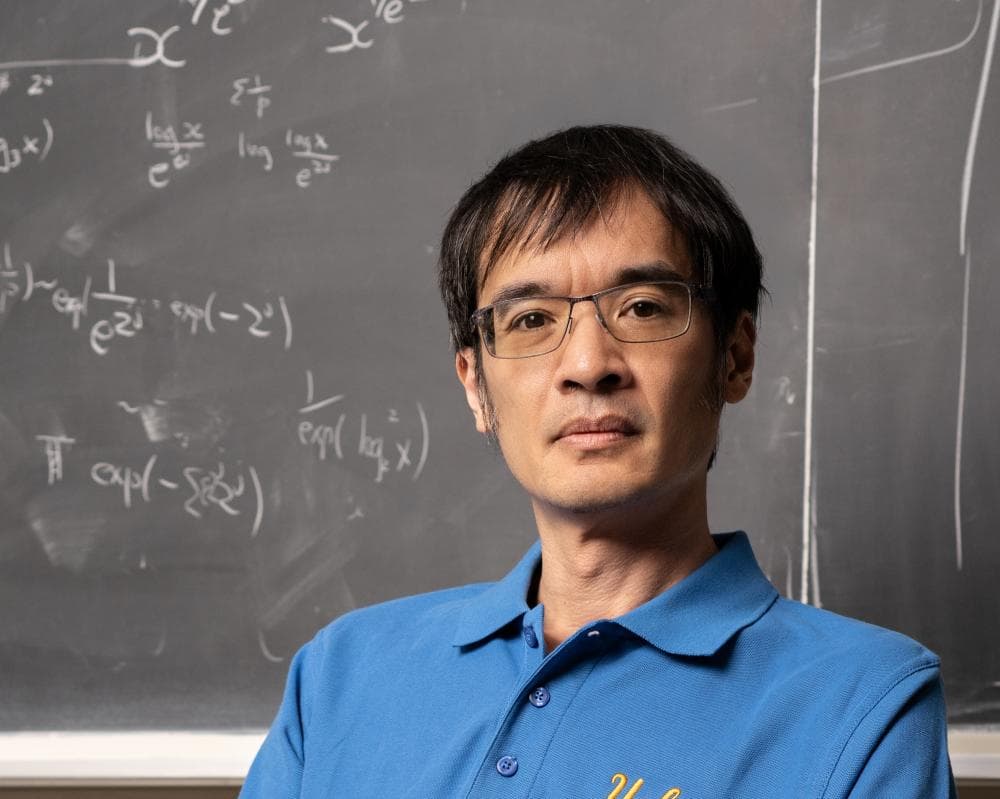
Earlier today, I set a puzzle by UCLA professor Terry Tao, who is widely regarded as one of the world’s top mathematicians.
Here it is again with solutions.
The magic money plant
In an online game, you earn coins by harvesting from plants. There are two types of plant:
a regular plant produces a single coin per day
a mother plant produces a single coin and two seeds per day. (A seed will grow into a regular plant the following day.)
At the start of the game, a player has a certain number of mother plants, regular plants and coins, but not more than nine of each.
Suppose that I begin on Day 1 with a mother plants, b regular plants and c coins.
1. How many coins do I have in total at the end of days 2 and 3?
2. Find an expression for how many coins I have at the end of Day X.
3. At the end of Day 10 I have 427 coins. What are a, b and c?
Solution
1. Day 2: 4a + 2b + c. Day 3: 8a + 3b + c
Workings: At the end of day 1 the number of coins is is a + b + c. Each mother plant has also produced 2 seeds, but these have not yet grown into regular plants. On day 2, these plants produce a coin each, so there are 2a of these, added to another a from the mother plant and the a from day 1, makng 4a. The regular plants produce another coin each, making b in total to add to the b from day 1. This gets us 4a + 2b + c for day 2, and the same reasoning gets us the above expression for day 3.
2. aX2 + bX + c
We calculated for X = 1, 2 and 3. You hopefully saw the pattern emerge. The number of coins produced by the mother plant and her descendants is the square of the day.
3. a = 4, b = 2, c= 7.
When X = 10, there are 427 coins. Thus
100a + 10b + c = 427. So a, b and c must be 4, 2 and 7. The answer was in the question!
Tao said he suggested this puzzle because he likes the way it naturally introduces algebraic ways of thinking as the most efficient way to solve a problem.
“It turns out that the number of coins at day X is given by a polynomial, aX2 + bX + c. In modern algebra, we have realized that polynomials are very similar to numbers in many ways: for instance, one can add and multiply two polynomials together much as one can add and multiply numbers. For this problem, it is more than an analogy: on day 10 (X=10), the value of the polynomial aX2 + bX + c is just the three-digit number abc (assuming that a,b, and c are at most nine). So one can now read off the desired unknowns a, b, c just by inspecting the digits 4, 2, and 7 of the given coin value 427.”
The idea that polynomials behave like numbers is one of the themes of Tao’s first book for a general audience, Six Maths Essentials.
I hope you enjoyed today’s puzzle. I’ll be back in two weeks.
Six Maths Essentials by Terence Tao is out tomorrow. You can buy it at the Guardian Bookshop.
I’ve been setting a puzzle here on alternate Mondays since 2015. I’m always on the look-out for great puzzles. If you would like to suggest one, email me.