This week we will track down Pegasus, one of the most distinctive constellations in the autumn sky. Pegasus was one of the 48 constellations listed by Ptolemy in the second century. In Greek mythology, it represents the magnificent winged horse ridden by the hero Bellerophon.
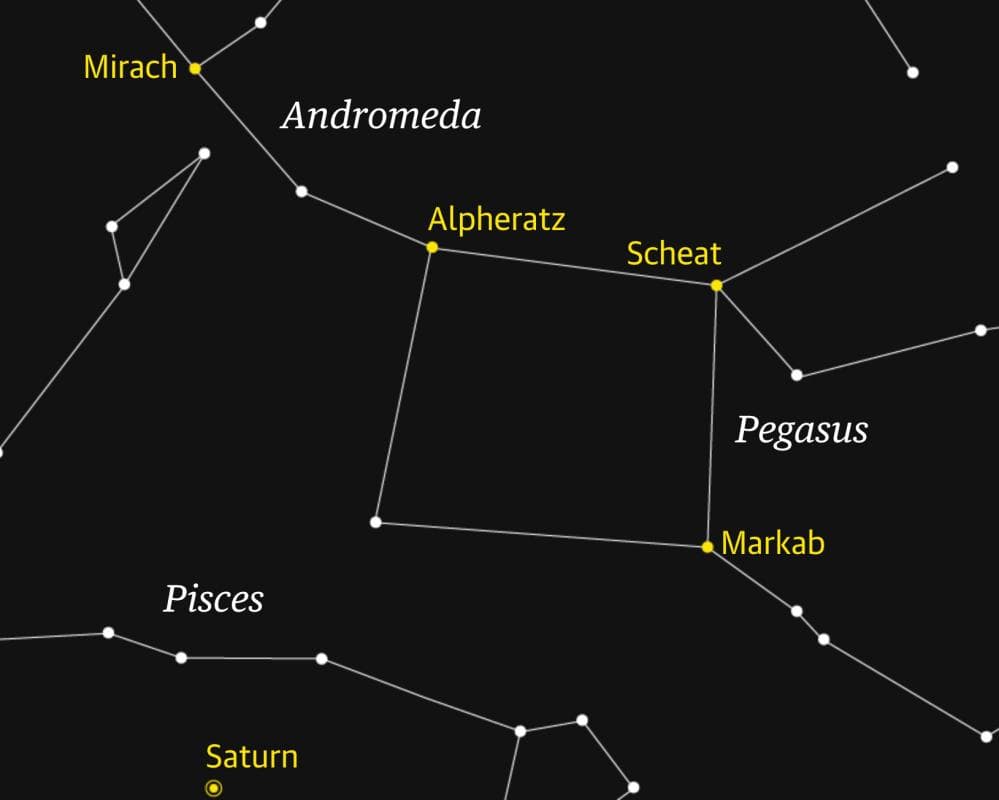
The easiest part of the constellation to recognise is the Great Square of Pegasus, a large pattern of four moderately bright stars. The chart shows the view looking high in the southern sky from London at 10pm on 26 October.
Three of these stars, Markab, Scheat and Algenib, belong to Pegasus. The fourth, Alpheratz, is actually part of the neighbouring constellation Andromeda. Historically, Alpheratz was considered to belong to both constellations, but when the official boundaries of the 88 modern constellations were established, it ended up in Andromeda.
The Great Square is the body of Pegasus. From Markab, follow a curving line of stars towards Enif (whose name means nose in Arabic) to trace the horse’s neck and head. Other lines of stars extending from the Square represent the horse’s front legs. Notice that the horse appears upside down.
Pegasus can also be seen at this time of year from the southern hemisphere. It appears lower in the northern part of the sky, but with the winged horse the right way up.