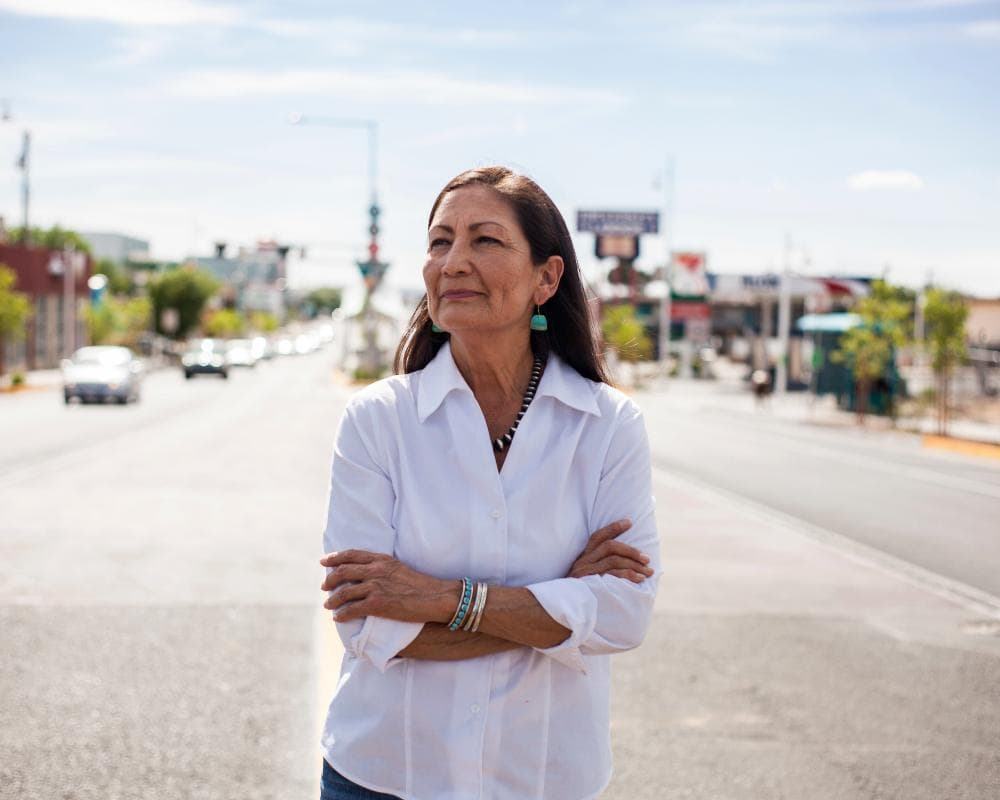
The road to Isleta Pueblo, a Native American tribal community just 20 minutes south of downtown Albuquerque, New Mexico, is peppered with campaign signs. Among the many names of candidates running in next week’s midterm elections and tribal elections later in November, there’s one that is poised to make history.
Deb Haaland is set to become the first Native American female governor in the US when voters cast their ballots on 3 November. Recent polling shows her with a comfortable lead over her opponent, Republican Gregg Hull, a businessman and the longtime mayor of the city of Rio Rancho. Her bid for office also signals the growing power of the Democratic party in the state, where Democrats control the legislature, hold all top offices and have enacted progressive policies, such as universal childcare, that have been heralded across the country.
Haaland, who is a member of Laguna Pueblo, has been a rising star in national politics since 2018, when she was elected to Congress alongside a wave of progressive freshmen lawmakers, including Alexandria Ocasio-Cortez, Ilhan Omar and Rashida Tlaib. In the House of Representatives, Haaland sponsored legislation such as the Not Invisible Act, which focused on the epidemic of missing and murdered Native Americans. After Joe Biden was elected president in 2020, he named Haaland to lead the interior department, making her the first Native American to lead a cabinet agency. In that role, Haaland oversaw the formation of a missing and murdered unit within the Bureau of Indian Affairs and advocated for protecting culturally significant lands, including Chaco Canyon and Bears Ears.
After years in Washington, she’s returned to her home state, running for governor with promises to expand the social safety net, improve healthcare access in rural communities, and protect natural resources and sacred lands. In recent weeks, she’s secured endorsements from prominent Democrats including Barack Obama, while Michigan’s governor, Gretchen Whitmer, and the former transportation secretary Pete Buttigieg traveled to the state to stump for her.
Her campaign has sparked excitement among New Mexico’s sizable Indigenous community, who make up more than 12% of the state. Many see themselves reflected in her, and voice enthusiasm for a candidate who’s promised to protect the state’s water, investigate the legacy of New Mexico’s Native American boarding schools, and prioritize missing and murdered Indigenous persons cases.
Related: ‘A revolution in slow motion’: is Arizona’s wealthiest district finally done with Trump?
For Haaland, the historic nature of the election isn’t lost on her – but the final weeks of campaigning have been so hectic she sometimes forgets she’s on the brink of a milestone.
“Sometimes I forget about the fact that I would be the first Native woman. We’re in the throes of this statewide campaign and it’s so busy and we’re trying to be everywhere all at once,” she said in a recent interview. “But I recognize that for some people who feel like they haven’t ever been represented – I really, I’m grateful that I have this opportunity … I just hope that I can help folks to see that hard work still means something. That anyone can be a leader regardless of where you come from or how much money you do or don’t have.”
Haaland has throughout her campaign invoked her experience as a single mother navigating the Medicaid, WIC and Snap programs before attending law school in her 30s. Early in her career she ran a small business selling salsa, and when she was appointed secretary of the interior, Haaland was still paying off student loans. At a recent panel conversation on housing with the Massachusetts senator Elizabeth Warren, Haaland described trying to apply for a special home loan available to Native Americans while raising her young child.
“I think that there is a lot of excitement,” Janice Lucero, who is a member of the Isleta Pueblo and a co-founder of the Isleta Pueblo Voters Alliance, said, speaking from her farm on the Isleta reservation. “I think Deb actually has a lot of influence on the younger generation. She’s able to really reach those folks and really hear the concerns as well in a lot of the communities.”
Jade Begay, who is Tesuque Pueblo/Diné, lives in New Mexico and served as the Native American engagement director for Kamala Harris’s 2024 presidential campaign, agrees.
“I think that Native women are especially excited – and young Native people,” she said. “They know that she’s qualified for this job. They know that we can trust her as a leader of New Mexico. And we know we can trust her as someone who will be on the frontlines for New Mexico and defend us from the Trump administration.”
Record-setting number of Native candidates
Haaland is running in an election cycle that is uniquely significant for Native candidates. According to Advance Native Political Leadership, a record-setting 358 Indigenous candidates have or are running for office in local, state and federal elections across the country this year.
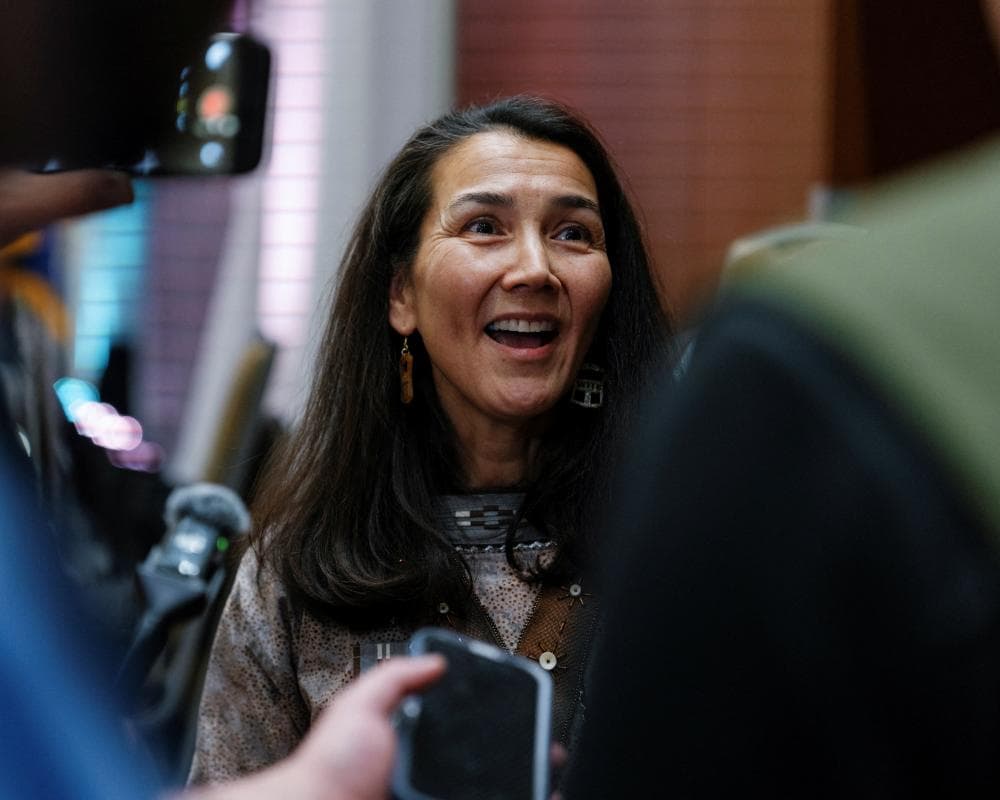
Alongside seeing the first Native woman elected governor of a US state, the country could see its first Indigenous woman elected to Senate, if either former Alaska congresswoman Mary Peltola or Minnesota’s lieutenant governor, Peggy Flanagan, win their race.
“The first thing that made it feel really possible was seeing Deb Haaland, was seeing Sharice Davids [the Native American congresswoman from Kansas] on a national level,” said state senator Angel Charley, who is Laguna/Zuni/Diné and entered politics in 2024 when she ran to represent a district that includes Laguna and Acoma Pueblos but had never previously been filled by a Native woman.
“I am a strong believer in the strength of the matriarchs,” said Ahtza Dawn Chavez, who is Diné/Kewa Pueblo and the executive director of NM Native Vote, a Native-led group focused on getting out the vote, which endorsed Haaland soon after she announced her candidacy. “We felt very strongly about having an Indigenous governor, and in particular an Indigenous female governor.”
Although Native Americans have made significant gains in political power in recent years, it’s been a long road to get here. Native Americans have only been allowed to vote across the entire United States since the 1960s.
In New Mexico, Native Americans won the right to vote in 1948, when Miguel Trujillo, a second world war veteran and an Isleta Pueblo tribal member, sued the state.
“My mother was a registered Republican for the longest time, believe it or not,” Haaland said. “There was a Republican candidate who came around to the Indian camp in Winslow, where they all lived, my grandparents working on the railroad because they were part of the assimilation policies,” she explained, referencing federal policies that forcibly relocated Native Americans and aimed to assimilate many into white society through jobs. That candidate, she said, “registered all the Laguna people in the Indian camp as Republicans”.
When Haaland ran for lieutenant governor in 2014, in a race Republicans ultimately won, her mother switched her registration. “I’ve worked really hard to help people like my mom understand that our values as Native people align with the Democrats,” Haaland said. “When I think about who’s in the White House right now and the horrible policies that are coming out that are making New Mexicans sicker, poorer and hungrier, those values don’t align with us.”
Related: ‘Prairie Populists’ fight to win back rural voters long ceded to Republicans
Getting out the Native vote
Across the country, many Indigenous voters continue to face challenges casting their ballots due to vast distances between polling sites on rural reservations, a lack of addresses served by the postal service from which to mail in ballots and provisions in some states preventing Native people from using tribal IDs to register to vote.
In 2023, New Mexico became the first and only state in the country to implement an updated Native American Voting Rights Act, which gave tribes greater input on polling locations and redistricting.
Charley adds that, particularly since the Covid-19 pandemic, many tribes and Native organizers have adopted new measures to help voters get to the polls – including sending out text alerts sharing when poll sites are open, coordinating rides to the polls and hosting community events, rather than door-knocking in rural areas.
While local groups such as the Isleta Pueblo Voters Alliance and NM Native Vote have focused on getting out the Native vote in New Mexico, national coalitions such as the Native Organizers Alliance and Advance Native Political Leadership have aimed to organize Indigenous voters nationwide.
Haaland herself got involved in national politics in 2012 when she served as the Native American vote director in New Mexico for Barack Obama’s campaign. “I’ve been a voter activist for the longest time. And I was always trying to help my grandma and my aunties and my mom get out to vote,” Haaland said.
That organizing work saw remarkable success in 2020, when an outpouring of voters from the Navajo and Hopi reservations in Arizona saw the long-red state vote for Biden.
Despite that win, Begay says working on the Harris/Walz campaign in 2024 underscored for her “just how deeply under-resourced and overlooked Native voter engagement is”.
She also adds that, although she’s seen deep support for Haaland among Native women, “my criticism and my observation is that Native men are not as excited”.
At the Isleta Pueblo Voters Alliance, Lucero and her colleagues have published a voting workbook that includes worksheets for thinking through a candidates’ platform – including by ranking issues such as housing and healthcare, but also a candidates’ approach to land and water, language and culture, and the crisis of missing and murdered Indigenous people.
“We have to think about the future and what’s at stake,” said Lucero. “How are we going to keep sustaining our ways of life?”