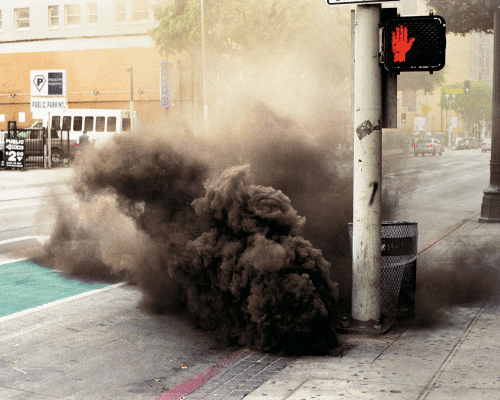
This image was taken in 2011 or 2012, just after I had moved to Los Angeles. I was downtown, an area I don’t go to that much, walking around with my camera. Some black smoke started to emerge from a grate in the street – I guess something underground was on fire. It was hilariously cinematic, as if some sort of devil was going to appear. It was really just one of those eerie, spontaneous things that happen in a city. There is a very powerful feeling of surrender when I am photographing. I have to submit to the authority of ignorance when I’m out there.
I grew up in San Jose, which is a sprawling American suburb – there’s no city about it. I came to LA because I was depressed where I lived, and I had just met my future wife, who didn’t want to live in San Jose either. LA is not really a city, it’s hundreds of places. You can drive 15 minutes and be in a completely different environment – the beach, the mountains. There’s a weird sentience to the city, if you let it take you. I get an inexplicable desire to just get in the car and go.
Despite the fact it’s sunny every day, there is a noir that is pervasive here. I really like the dark part of the city. There’s a transgressive pulse, and if you search hard enough, there’s a lot of intimacy too. In my book How About Never, there are photographs of big things – fires, hard-hitting events – but at the same time, the smaller things. Cities are cruel and I wanted to capture that, but I also found compassion.
As a skateboarder, I’m hardwired to react quickly
After I had done the edit for the book, I looked at it and realised that it was also about my relationship with my wife. The photographs span from the time we met to when our marriage ended earlier this year. My wife is a prominent character in it, although you don’t see her face until the end. It’s a very vulnerable photograph of her in a hospital bed. I have a lot of beautiful photographs of her, but I didn’t choose those. I think that in all relationships, vulnerability is the key to how we truly connect, and that was difficult for us. The book is a fantasy of what I was searching for, a dream about what I wanted it to look like and what it couldn’t be – all of the opposing forces, all the fire, water, destruction – and at the same time, hope and beauty. These are the contradictions you find in a relationship.
I started skateboarding at 12, and at 16 I turned pro. I was a professional for 25 years. I guess the most obvious connection between that and photography is that skateboarders are constantly seeing the environment in a way other people don’t. We see a park bench, a handrail or an embankment and we think about how we can manipulate it for our purposes. There’s a constant searching and endless curiosity, thinking about how to make an environment our own. As a skateboarder, you’re also hardwired to react quickly – you have to reach a flow state and not hesitate to do something that might be life-threatening. It takes a lot of focus to process information quickly – it’s a type of premonition about what’s about to happen. Skateboarding taught me from an early age that I have permission to view reality how I want; to take from it what I want. It gave me the permission I needed to make my own choices, which helped a lot with photography, and in my life generally.
I am interested in dreams, and in my book I treated the city as if it were my subconscious. I wander through it as if I am in a dream. A dream shows you images and is trying to tell you something about yourself. LA was doing that to me, it was showing me all these things I was attracted to, and I was capturing and collecting them without knowing what I was going to do with them.
I have always been painfully shy and interacting with the world is not easy, but this connects me with it and it’s how I can speak about it. Photography is a solitary practice and making work can be so isolating - I was scared to show my work, scared of being rejected or misunderstood, but I wanted to tell this story. People look at this book and think it’s bleak – and sure, it is, but there’s also a lot of hope in it. The last image of a cat, moving out of the frame to the right, is about moving forward and going on living, despite all of this.
• How About Never is published by MACK.
Jerry Hsu’s CV
Born: San Jose, California 1981
High point: My new book, How About Never.
Top tip: Always research. Copy artists you are drawn to and your voice will eventually emerge.