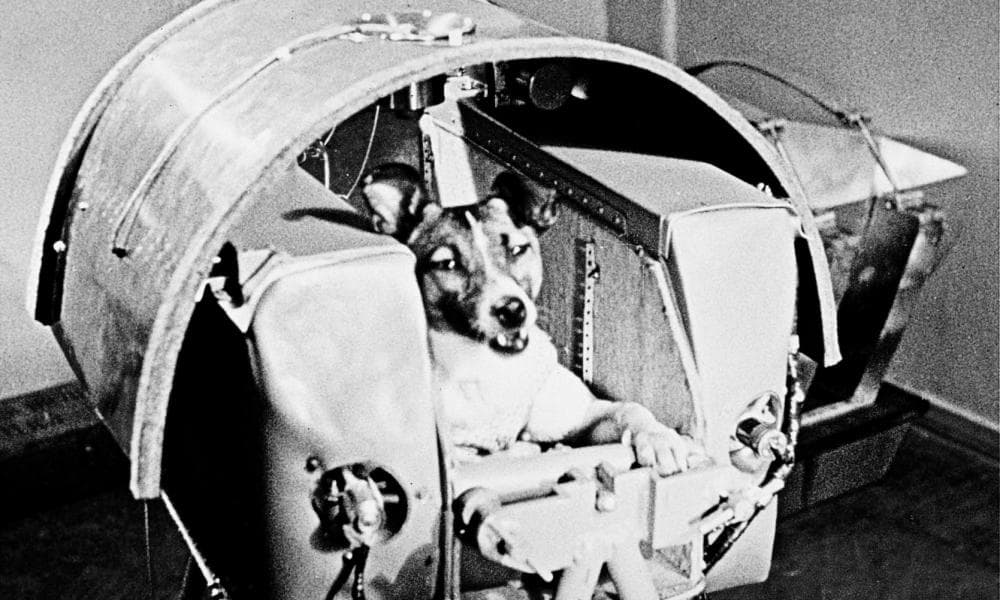
The second Russian satellite has demonstrated not only that space travel is practicable but that it has come true. Tass said early yesterday that the latest satellite contains a dog, later described to be a female of the Russian breed which is smaller than but similar to the husky.
At the same time the weight of the instruments, batteries, food, and dog kennel which the satellite carries was said to be half a ton. The Tass statement makes it clear that this weight is in addition to the weight of the last stage of the carrier rocket, to which, however, the satellite appears still to be attached.
The orbit of the new satellite is a much more ambitious one than that of the first. According to a report form Moscow last night, the greatest height of the satellite so far to be measured is 1,700km. The same report says that the period of the satellite's rotation is 103.7 minutes. This implies that the average height of the satellite round its orbit is nearly 1,100km. This is more than twice the average height of the first satellite, which still circles the earth. It follows that the new Russian venture will stay in the sky for several years unless it is brought down by some mechanism which it may carry.
Confirmed
Last night Moscow radio followed the announcement of the satellite's successful launching with a familiar time-table of its expected progress over the major cities of the world. The information about the inclination of the orbit of the satellite given in the original Tass statement appears to have been confirmed during the day . In this respect the orbit is much like that of the first satellite - inclined at something like 65 degrees to the Equator of the earth.
One notable difference, however, which will prove a mixed blessing for the observers in this country, is that Great Britain will pass under the new orbit during daylight hours. As a result radio reception will be more difficult, but night work will not be necessary.
The dog is reported by Moscow to have been trained for her journey by previous laboratory experiments and by flights in actual rockets. So that she would not eat all her food at once, she has been conditioned in a Pavlovian experiment to eat only at the sound of a bell, which is rung inside her pressurised and air-conditioned compartment at regular intervals.
Records of her respiratory activity and pulse rate are being telemetred back to earth by the radio-transmitters. They will be valuable signs of the way in which the dog is standing up to prolonged exposure to the sensation of weightlessness which future space travellers must expect. It will not be possible to tell how the dog is affected by the cosmic radiation to which she will be exposed unless she is recovered on earth.
This implies that the Russians will attempt to bring her back to earth. That this is so is confirmed by reports from the East German news agency last night, based on an article in the current Soviet "Aviation Review." Technically the problem should not be insuperable.
Means of descent
First it will be necessary for the dog and her pressurised compartment to be thrown out of the orbit in which she is now carried. This could be done by a separate rocket, as yet unburnt, by an explosive charge or even by a simple mechanical spring catapult.
However, the launch back to earth would have to be carried out with some precision: the later stages of the descent would have to be slowed down by some parachute arrangement and some means would have to be provided for protecting the dog's compartment from the heat that would be generated on first entry into the dense atmosphere. This, it will be noticed, is the problem of arranging that ballistic missiles fall safely back to earth.
It may well be that the weight of the arrangements needed to do this accounts for the great mass of the Russian satellite, which yesterday provided scientists with material for speculation.
The instruments needed to measure cosmic rays and the sun's radiation need not weigh more than a hundred weight, even with the power supplies. Radio transmitters and batteries would not take up more than that weight, while the dog and her kennel should not weigh much more. This leave at least half the weight of the instrumentation unaccounted for.
250-ton rocket
Weight is the starting point for another speculation: what kind of rocket was used to launch this satellite? If the rocket fuels available to Western engineers are taken as a starting point, it can be calculated that the initial weight of the rocket would have been between five hundred and a thousand tons for every ton put into orbit.
This implies that the initial rocket structure would have weighed about 250 tons or more. The size of this vehicle is hard to imagine. Its cost would not have been less than several million pounds.
In the circumstances it would appear all too probable that the Russians have developed some kind of rocket fuel which is not available in the West. Otherwise the sheer physical size of their latest project could not have allowed them to carry it off with such speed and success.
It is unlikely that they have developed some means of exploiting atomic energy for rocket propulsion because the inherent problems of this task have only recently been recognised. But it may easily be that they have found some means of burning fuels like metallic boron and compounds of this which exploit the greater inherent energy of these materials.
In the circumstances it would appear that the Russian ballistic missiles could be built on less gigantic lines than those which have until now been thought necessary in the West. This would also mean that Russian rockets could more easily be put into production than the vehicles being developed in the United States.
More bleeps
The arrangements for telemetering information back to the ground from the second satellite appear to be much the same as those from the used previously. Broadcasts are being made on frequencies of 20 and 40 mcs. The first frequency is a continuous transmission. The second is "keyed" into a bleeping form, and is modulated with a coded form of information being sent.
Radio observations of the new satellite were carried out yesterday at several stations in the United Kingdom. At the Mullard Observatory, Cambridge, scientists from the Cavendish Laboratory heard seven transits - including the first in this country at 5.58.