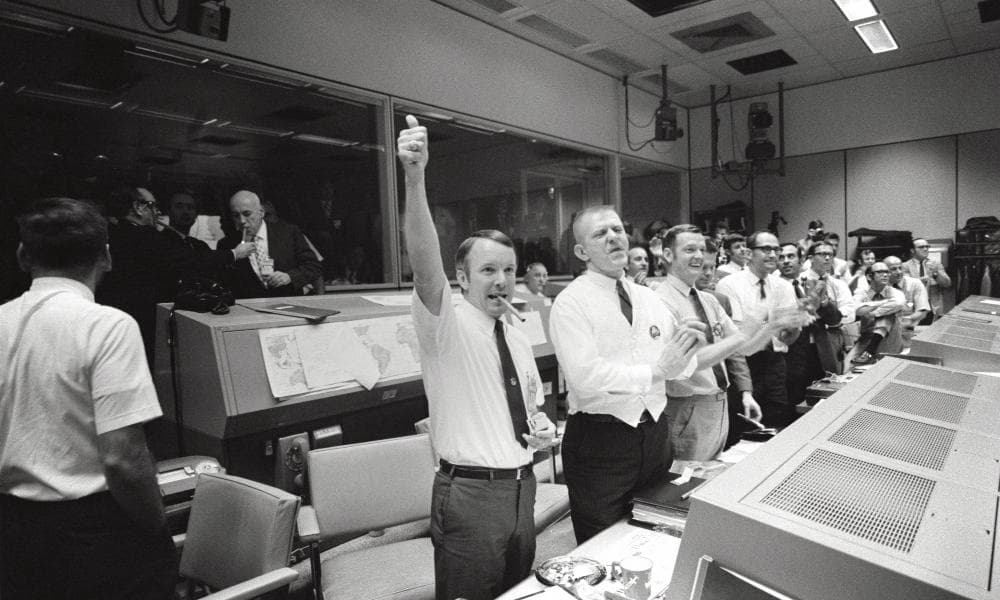
The three astronauts in the stricken Apollo 13 looped round the moon early today and successfully fired their only usable rocket engine to set a planned course back to earth. The critical burn, which began at 3 41a.m. BST, had to last 4 minutes 24 seconds to ensure that the spaceship developed the necessary speed to put it on its splashdown course.
Two minutes into the critical burn the controller at the Houston Space Centre said the engine was "looking good" and after the engine was shut off it was announced: "Apollo 13 is on course for home."
The space ship, which was crippled by a mysterious explosion which damaged its fuel cells, was due to splash down at 7 30 p.m. BST on Friday, 750 miles north-east of New Zealand.
Earlier, the three astronauts, James Lovell, Fred Haise, and John Swigert, had been out of radio contact while the space craft passed round the dark side of the moon. There were some agonising moments when only static could be heard before the calm voice of Lovell, the mission captain, broke through.
Ground control replied that it could hear them and an official then announced: "Apollo 13 has turned the corner and is heading for home."
Nearly 20 minutes after the Apollo re-established contact, the Saturn third stage rocket - the only lunar experiment of the mission to be carried out - hit the surface of the moon.
Still a mystery
Adam Raphael writes from Houston
The cause of the mysterious explosion or impact which damaged the command ship's fuel cells in deep space was still unexplained as harassed mission controllers continuously monitored oxygen, water, and fuel supplies in the lunar module to make sure they would last until splashdown.
The main descent engine of the lunar lander was fired for a crucial 30 seconds early today and Apollo swung round the back of the moon tonight on a free trajectory back to earth. If this emergency firing had failed, the spacecraft would have missed the earth by 20,000 miles and the astronauts would have been lost forever in space as the failure of the fuel cells had rendered the command ship's main engine useless. A further critical burn lay ahead.
To conserve electrical power, the astronauts are maintaining almost total radio silence, communicating with the ground only when essential. The command module is in darkness, and the man riding there has to use a flashlight to move around.
Mission controllers were tense but hopeful tonight that the astronauts, in spite of rapidly depleting supplies of oxygen and water, could be brought back safely.
If the LM's systems continue to operate, the astronauts should have adequate reserves of oxygen to last them until splashdown, but the water supply used for drinking, cooking, and cooling, is more critical. The flight controller, Glyn Lunney, when asked today if there was enough, replied: "Yes, barely."
Slight margin
Mission controllers, concerned about this slight margin of safety, had considered for much of today whether to risk a "superfast" return to earth, shortening the journey by 24 hours. This would have meant an all-out burn of the LM's engine instead of the short burn.
The long burn, however, would have involved a serious danger of overheating and demanded an almost perfect alignment of the command ship's internal guidance system. For this reason it was finally, and reluctantly, ruled out by flight controllers.
Precisely how much oxygen and water the astronauts do still have left is not clear. The lunar lander carries 48lb of oxygen in its tanks: since the three men each use about 7lb a day, there is almost enough to last them until splashdown. 'Fireflies'
The first hint of trouble came at 4 30am, when the astronauts saw a swarm of "fireflies" outside the command ship. It turned out to be venting fuel cells. Jack Swigert then noticed a sudden power drop in the command craft, brought about by the failure of two of the three fuel cells. Flight controllers at Houston told the crew to reduce the electrical load so that the remaining call would not be drained of its power.
Without the fuel cells to power oxygen, water, and the engine system, the command module was almost uninhabitable. Commander Lovell told ground control: "It looks like we're going to have to go to an LM lifeboat." Shortly after 5 a.m. Lovell and Haise crawled through into Aquarius, the lunar lander, which alone has the heated oxygen necessary for survival, while Swigert remained behind in the command module to make sure that the remaining fuel cell continued to operate.